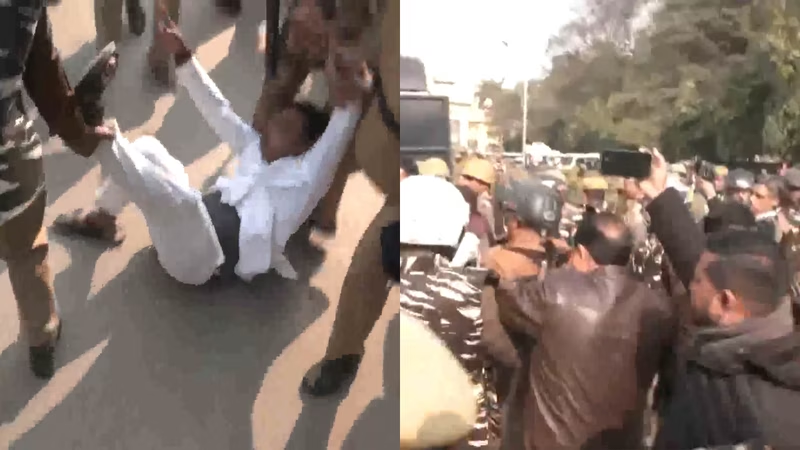
In a dramatic show of force that has rattled the political establishment, the National Students’ Union of India (NSUI) has taken to the streets of Uttar Pradesh, launching a full-throated assault on the controversial VB-GRAMG scheme. From the bustling heart of Lucknow to the spiritually charged lanes of Varanasi, young activists are demanding one thing: ‘Save MGNREGA!’
Their message is clear and urgent. They see the new VB-GRAMG scheme not as an evolution of rural employment policy, but as its potential death knell. With security forces on high alert and dozens of protesters detained, the stage is set for a significant political showdown.
Table of Contents
- What’s the VB-GRAMG Scheme?
- Why is NSUI Protesting Against VB-GRAMG?
- VB-GRAMG vs MGNREGA: A Critical Breakdown
- The Political Fallout in Uttar Pradesh
- What Happens Next?
- Conclusion
- Sources
What’s the VB-GRAMG Scheme?
Officially known as the Vikasit Bharat Guarantee for Rozgar and Ajeevika Mission (Gramin) Act, 2025, the VB-GRAMG scheme was introduced by the central government as a major revamp of the existing Mahatma Gandhi National Rural Employment Guarantee Act (MGNREGA). On paper, it promises more: an increase in guaranteed work days from 100 to 125 per household . It also pledges faster weekly wage payments and a sharper focus on creating durable assets in four key areas: water security, core rural infrastructure, land development, and natural resource management .
The government frames it as a move towards greater efficiency and transparency, aiming to fix what it sees as structural gaps in the old system . However, critics argue that beneath these shiny promises lies a fundamental shift in philosophy—one that could undermine a crucial social safety net for millions.
Why is NSUI Protesting Against VB-GRAMG?
The NSUI, the student wing of the Indian National Congress, contends that the VB-GRAMG scheme is a wolf in sheep’s clothing. Their core argument, echoed by various farmer and labour unions, is that the new law dismantles the very essence of MGNREGA: the legal right to work.
Under MGNREGA, if a person demanded work and it wasn’t provided within 15 days, they were entitled to an unemployment allowance—a powerful legal guarantee. The NSUI and other opposition groups fear that the VB-GRAMG scheme replaces this demand-driven model with a top-down, centrally allocated budget system, turning a right into a discretionary favour .
“MGNREGA guaranteed work as a legal right, not a favour,” stated AICC General Secretary K.C. Venugopal, a sentiment that has galvanized the current wave of protests . In Uttar Pradesh, this anger translated into direct action. In Lucknow, NSUI workers staged a demonstration that led to their detention by security personnel . In Varanasi, a city of immense political significance as the Prime Minister’s constituency, a planned “Save MGNREGA” march was met with a massive security presence, including police and paramilitary forces, effectively shutting down the protest before it could gain momentum .
VB-GRAMG vs MGNREGA: A Critical Breakdown
To understand the depth of the controversy, it’s essential to compare the two schemes side-by-side. Here’s a look at the key differences that have sparked such intense debate:
| Feature | MGNREGA | VB-GRAMG Scheme |
|---|---|---|
| Core Principle | Demand-driven; a legal right to work | Allocation-driven; based on pre-fixed central funds |
| Guaranteed Days | 100 days per household | 125 days per household |
| Funding | Primarily by the Central Government | Proposes a joint funding model between Centre and States |
| Scope of Work | Broad list of permissible works | Narrowed focus to 4 priority areas |
| Governance | Ministry of Rural Development | Central Gramin Rozgar Guarantee Council |
While the increase in work days and faster wage payments are welcome improvements, the shift from a legal entitlement to a centrally managed allocation is the crux of the opposition’s fear. For many rural families, MGNREGA isn’t just a job; it’s a lifeline during agricultural off-seasons or economic distress. Removing the legal guarantee could leave them vulnerable.
The Political Fallout in Uttar Pradesh
Uttar Pradesh, with its massive rural population and complex caste dynamics, is a critical state for any national party. The NSUI’s decision to launch its most visible protests here is a calculated political move. By framing the VB-GRAMG scheme as an anti-poor and anti-farmer policy, they aim to mobilize public opinion ahead of future elections.
The government’s response—tightening security and detaining protesters—has only added fuel to the fire. It creates a narrative of a government that is unwilling to listen to the concerns of its citizens, preferring to use force over dialogue. This dynamic is playing out not just in UP but across the country, with the Samyukta Kisan Morcha (SKM) planning a major nationwide protest against the law on January 16, 2026 .
What Happens Next?
The battle over the VB-GRAMG scheme is far from over. The NSUI has announced a 45-day protest campaign, vowing to keep the pressure on until the government reconsiders its stance . The upcoming SKM protest will be a major test of the opposition’s ability to unite farmers, students, and labourers under a common banner.
The government, meanwhile, will likely continue to defend the scheme as a necessary modernization. The real test will be in its implementation. Will the promised 125 days of work materialize? Will the new council be effective? Or will the fears of activists—that this is a step backward for India’s rural poor—prove to be true? Only time, and the lived experience of millions of workers, will tell.
Conclusion
The NSUI protests against the VB-GRAMG scheme in Uttar Pradesh are about more than just a policy disagreement. They represent a fundamental clash over the role of the state in providing a social safety net. At its heart is a simple question: should access to basic employment be a legal right for every citizen, or a privilege granted at the discretion of the government? As the protests continue and the political stakes rise, this question will remain central to India’s democratic discourse. For now, the streets of UP have become the frontline in this critical national debate.