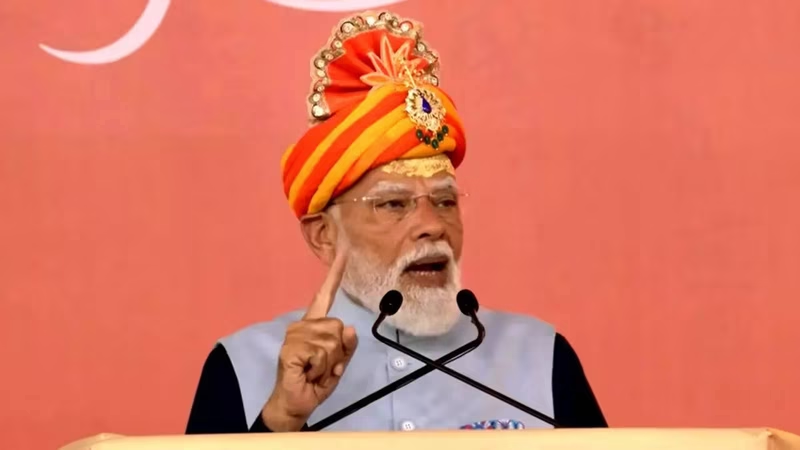
On a crisp January morning in 2026, Prime Minister Narendra Modi stood before the sacred Somnath temple, not just as a political leader, but as a narrator of a thousand-year-old saga of faith, fury, and unyielding resilience. His address during the Somnath Swabhiman Parv wasn’t merely a speech; it was a deliberate stitching together of historical threads—from the brutal raids of Mahmud Ghazni to the iconoclastic orders of Aurangzeb—into a potent symbol of contemporary Indian identity.
Table of Contents
- Modi’s Somnath Address: A Call to Historical Memory
- The Blood and Stone: History of the Somnath Temple
- From Ghazni to Aurangzeb: The Invasion Timeline
- The Politics of History: Whitewashing Allegations
- Why the Somnath Temple’s Resilience Matters Today
- Conclusion: Rebuilding More Than Just a Temple
- Sources
Modi’s Somnath Address: A Call to Historical Memory
Speaking at the event commemorating 1,000 years since the first major attack on the temple, PM Modi’s words were both a tribute and a challenge. “Those present here, your ancestors, our ancestors, bet their lives for their faith, for their belief, for Mahadev – they sacrificed everything they had,” he declared . This powerful statement framed the temple not just as a place of worship, but as a monument built on the collective sacrifice of generations.
His reference to a journey “from Ghazni to Aurangzeb” was a masterful, albeit implicit, historical shorthand. He accused previous governments, widely understood to be the Congress-led administrations, of deliberately “whitewashing the history” that details the repeated invasions and destructions of this iconic Somnath temple . This isn’t just about recounting past events; it’s about reclaiming a narrative that the current administration believes was long suppressed.
The Blood and Stone: History of the Somnath Temple
The Somnath temple in Gujarat is arguably one of the most storied religious sites in India. Its legend is intrinsically tied to its repeated destruction and reconstruction—a cycle that has played out as many as seventeen times over the centuries . This isn’t a myth; it’s a documented testament to a community’s unwavering resolve.
Each time the temple was razed, it was rebuilt with greater fervor, becoming a physical manifestation of the idea that faith cannot be permanently extinguished by force. This incredible story of perseverance makes it a perfect focal point for discussions on cultural continuity and national spirit.
From Ghazni to Aurangzeb: The Invasion Timeline
PM Modi’s phrase “from Ghazni to Aurangzeb” encapsulates nearly seven centuries of turbulent history. Here’s a brief look at the key moments:
- 1026 CE: The most infamous attack was carried out by Sultan Mahmud of Ghazni. He plundered the temple, broke the main idol, and looted its vast treasures, an event that sent shockwaves across the subcontinent .
- 1297 CE: Forces under Alauddin Khilji, led by his general Ulugh Khan, attacked and destroyed the temple again, continuing the pattern of iconoclasm .
- 1706 CE: In one of the final major acts of destruction before the colonial era, Mughal Emperor Aurangzeb ordered the demolition of the temple. He specifically instructed his governor in Gujarat to ensure it could not be easily renovated or used for worship again .
This timeline, stretching from the 11th to the 18th century, forms the backbone of the historical narrative PM Modi invoked. It’s a story of repeated attempts to erase a symbol, met with an even stronger will to restore it.
The Politics of History: Whitewashing Allegations
The Prime Minister’s sharp criticism of “whitewashing the history” points to a long-standing and deeply contentious debate in India. Critics of previous governments, particularly those led by the Congress party, have often alleged that school textbooks and official histories downplayed or omitted uncomfortable truths about foreign invasions and their impact on indigenous culture and religion .
The argument is that a sanitized version of history was promoted to fit a specific secular-political framework, which inadvertently erased the struggles and sacrifices of countless communities. By bringing this up at Somnath, PM Modi is directly challenging that established narrative and positioning his government as the restorer of a more complete, albeit painful, historical truth.
Why the Somnath Temple’s Resilience Matters Today
The story of the Somnath temple transcends its religious significance. It serves as a powerful metaphor for national resilience. In a world where cultural identities are constantly being negotiated and sometimes threatened, the temple stands as a reminder that core values and beliefs can endure through the most severe trials.
Its reconstruction in the 20th century, famously inaugurated by Dr. Rajendra Prasad in 1951 after Sardar Vallabhbhai Patel’s initiative, was itself a potent political statement for the newly independent India—a declaration that the nation would rebuild its own heritage on its own terms . PM Modi’s speech ties this 20th-century act of rebuilding to the ancient legacy of resistance, creating a continuous thread of self-determination from the medieval era to the present day.
Conclusion: Rebuilding More Than Just a Temple
PM Modi’s address at the Somnath Swabhiman Parv was far more than a ceremonial appearance. It was a strategic and emotional invocation of history, using the powerful symbol of the Somnath temple to speak to contemporary issues of identity, historical justice, and national pride. By connecting the dots from Ghazni to Aurangzeb, he has reignited a crucial conversation about who gets to tell India’s story and how that story shapes its future. The temple’s true victory isn’t just that it stands today, but that its story continues to inspire and provoke, serving as an eternal flame of resilience for the nation.
Sources
- Times of India: From Ghazni to Aurangzeb’: PM Modi invokes Somnath’s history; hails temple’s resilience
- Press Information Bureau (PIB): Press Note Details
- Archaeological Survey of India: [INTERNAL_LINK:historical-monuments-india]
- Britannica: Somnath Temple | History, Architecture, & Facts