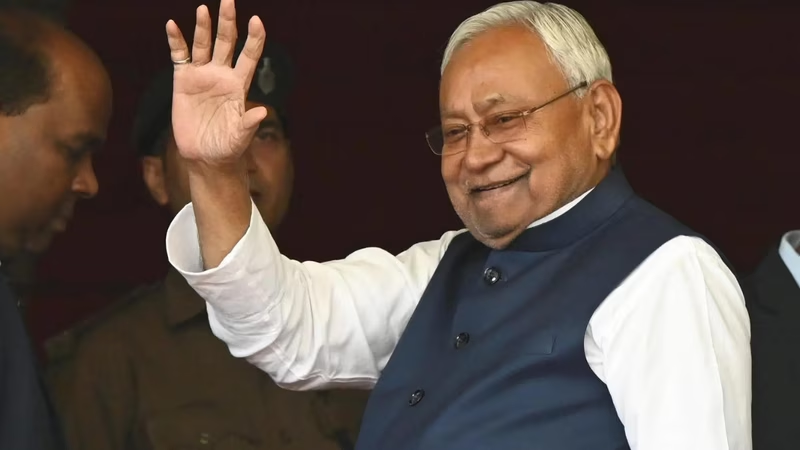
The corridors of power in Patna are buzzing with a new kind of tension. The recent, unofficial push to confer the Bharat Ratna for Nitish Kumar has not been met with universal acclaim. Instead, it has become the latest flashpoint in the long-standing rivalry between the JD(U) and its former ally, the RJD, which has delivered a stinging, pun-laden rebuke that cuts straight to the heart of the debate.
Table of Contents
- The Political Battle Over a Civilian Honour
- What is the Bharat Ratna and Who Qualifies?
- Nitish Kumar’s Legacy: A Record of Governance or Political Survival?
- Why the RJD’s ‘Ratna’ Jab Stings So Much
- Conclusion: A Debate That Goes Beyond an Award
- Sources
The Political Battle Over a Civilian Honour
The call for the Bharat Ratna for Nitish Kumar appears to have been championed by figures like Union Minister Jitan Ram Manjhi and JD(U) leader KC Tyagi, who point to his “exemplary governance” and socialist roots . However, this move has been met with swift and sharp criticism from the opposition camp. The RJD, in particular, has seized on the opportunity to question the very foundation of this demand.
RJD MP Sudhakar Singh’s statement, calling Nitish Kumar “undoubtedly a ratna,” is a masterclass in political sarcasm. On the surface, it acknowledges his long tenure as Chief Minister of Bihar, even through periods of ill health. But the choice of the word “ratna” (which translates to “gem”) is a deliberate and biting pun, playing on the name of the award itself to imply that the demand lacks serious merit. This isn’t just disagreement; it’s a full-throated challenge to the narrative of Nitish Kumar as a statesman of national stature worthy of India’s highest civilian honour .
What is the Bharat Ratna and Who Qualifies?
To understand the weight of this controversy, one must first grasp the significance of the award in question. The Bharat Ratna, instituted in 1954, is India’s most prestigious civilian award. It is conferred in recognition of “exceptional service/performance of the highest order” in any field of human endeavour, though traditionally it has been awarded for achievements in art, science, literature, and public service .
The list of recipients reads like a who’s who of Indian history: from C. Rajagopalachari and Sarvepalli Radhakrishnan to Mother Teresa, Sachin Tendulkar, and former President Pranab Mukherjee . In 2024, the award was posthumously given to social justice icons like Karpoori Thakur and Chaudhary Charan Singh, setting a high bar for the calibre of contribution expected .
The central question in the current debate is whether Nitish Kumar’s contributions as a regional leader, however significant for Bihar, rise to this national, historic level. The RJD’s jibe suggests they believe the answer is a resounding no.
Nitish Kumar’s Legacy: A Record of Governance or Political Survival?
Nitish Kumar’s political career is nothing short of extraordinary. He is the longest-serving Chief Minister of Bihar, having held the office for nine separate terms since his first, albeit brief, stint in 2000 [[20], [24]]. His tenure is often credited with transforming Bihar from a state synonymous with lawlessness into one focused on development, particularly in the areas of road construction, women’s safety (with the creation of all-women police stations), and education reforms .
However, his legacy is equally defined by his political agility—some would say opportunism. His journey has seen him switch alliances multiple times, moving from the BJP to the Mahagathbandhan with RJD and back to the BJP-led NDA, often citing “irreconcilable differences” with his allies . This reputation for political survival is what his critics, especially the RJD, latch onto. They argue that while he may be a skilled administrator at the state level, his constant political manoeuvring undermines the image of a stable, principled national leader that the Bharat Ratna typically honours.
Why the RJD’s ‘Ratna’ Jab Stings So Much
The RJD’s reaction is more than just political point-scoring. It strikes at a core vulnerability in the argument for the Bharat Ratna for Nitish Kumar. By using the word “ratna” itself, they are framing the entire demand as unserious, almost mocking. Their underlying message is clear: while Nitish Kumar has been a significant figure in Bihar’s politics, his contributions are primarily regional and his legacy is too intertwined with the messy realities of coalition politics to warrant the nation’s highest honour.
This narrative is powerful because it forces a direct comparison. Is Nitish Kumar in the same league as a scientist like M.S. Swaminathan, a freedom fighter like Bhupen Hazarika, or a statesman like Atal Bihari Vajpayee—all Bharat Ratna recipients? The RJD’s position is that he is not, and that the push for the award is a politically motivated attempt to bolster his image ahead of future elections, rather than a genuine recognition of unparalleled national service.
Conclusion: A Debate That Goes Beyond an Award
The controversy over the potential Bharat Ratna for Nitish Kumar is a microcosm of larger debates in Indian politics. It’s about how we measure a leader’s worth: is it through their administrative record, their longevity in office, their national impact, or their unwavering principles? For now, the JD(U) and its allies see a deserving “gem” of a leader. The RJD sees a politician whose “ratna” status is, at best, a matter of local opinion and, at worst, a subject of ridicule on the national stage. This political firestorm is far from over, and its outcome will say as much about the state of Indian politics as it does about Nitish Kumar himself.
Sources
- Times of India: ‘Undoubtedly a ratna’: RJD takes jibe at Nitish Kumar amid Bharat Ratna push
- Government of India – Ministry of Home Affairs: [INTERNAL_LINK:Bharat_Ratna_award_criteria]
- Britannica: Bharat Ratna | History, Award List, & Facts