Table of Contents
- The Grand Procession: A Visual Spectacle
- What is the Shaurya Yatra? Decoding its Meaning
- Why Somnath? The Temple of Resilience
- Political and Cultural Significance in 2026
- Conclusion: A Symbol for the Times
- Sources
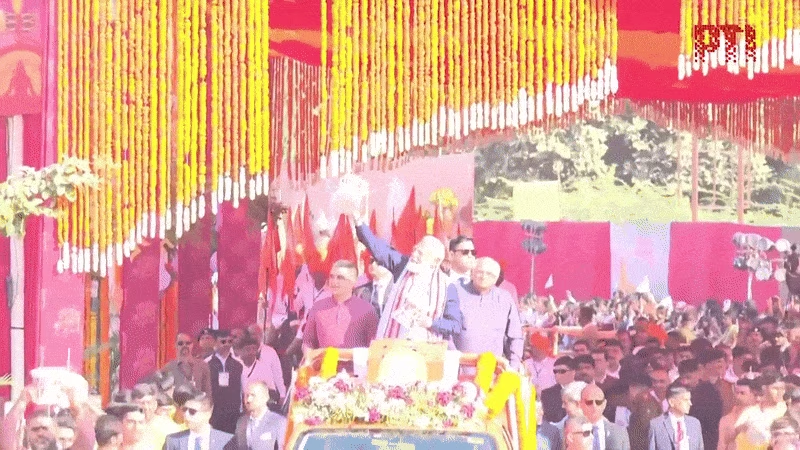
On the crisp morning of January 11, 2026, the historic coastal town of Somnath in Gujarat was the stage for a meticulously choreographed event that fused deep religious sentiment, historical narrative, and contemporary political messaging. Prime Minister Narendra Modi, standing tall in an open, flower-bedecked vehicle, led the Shaurya Yatra, a ceremonial procession featuring a striking contingent of 108 horses. The visuals were unmistakable: the PM, holding a damroo (a small two-headed drum associated with Lord Shiva) and blowing a conch shell, greeting throngs of supporters who lined the streets [[1], [7]].
The Grand Procession: A Visual Spectacle
The procession was far more than just a parade; it was a carefully curated piece of political theatre. Accompanied by Gujarat Chief Minister Bhupendra Patel and Deputy CM Harsh Sanghavi, PM Modi’s journey through Somnath was designed to evoke a sense of grandeur and solemnity . The choice of 108 horses is deeply symbolic in Hindu tradition, representing cosmic order and completeness. This visual, combined with the Prime Minister’s active participation in the rituals—offering prayers at the famed Somnath Temple immediately after the yatra—created a powerful image of a leader rooted in faith and national heritage .
This event was the centerpiece of the ongoing Somnath Swabhiman Parv (Somnath Self-Respect Festival), a celebration marking a significant moment in the temple’s long and turbulent history .
What is the Shaurya Yatra? Decoding its Meaning
The term “Shaurya Yatra” translates directly to “Valour Journey” or “Journey of Courage.” In the context of the Somnath event, its meaning is specific and profound. According to official communications, the yatra is a “symbolic procession” that “represents courage, sacrifice and the indomitable spirit that preserved Somnath through centuries of adversity” [[19], [23]].
It serves as a tribute to the countless unnamed warriors and citizens throughout Indian history who defended the sanctity of the Somnath temple against repeated invasions and destruction . The procession is not just about looking back, however; it’s also a call to remember and embody that same spirit of resilience in the present day.
Why Somnath? The Temple of Resilience
To understand the full weight of the Shaurya Yatra, one must grasp the immense significance of the Somnath Temple itself. It is not just another place of worship; it is considered the first and most sacred of the twelve Jyotirlingas of Lord Shiva, making it a paramount pilgrimage site for millions of Hindus [[11], [14]].
The temple’s history is a testament to India’s enduring faith. Legend and historical accounts tell of its repeated destruction and reconstruction over a millennium, most famously by Mahmud of Ghazni in 1026 CE. Each time it was razed, it was rebuilt, turning the site into a powerful symbol of “courage, faith, and spiritual renewal” . Its very existence is a narrative of defiance and unwavering belief. By choosing Somnath as the venue for the Shaurya Yatra, the event’s organizers anchored its message of valour in a location whose entire identity is built upon that very concept.
Political and Cultural Significance in 2026
Held on a Sunday during a major festival at the temple, the timing and scale of PM Modi’s participation are impossible to separate from the political landscape. The imagery of a strong, devout leader leading a procession of power (the 108 horses) through a site of such deep civilizational importance is a potent narrative.
Critics might argue that such events, often termed Shaurya Yatras across various contexts, can sometimes be used to “weaponise religion and history” for political ends . However, the official stance frames it as a unifying celebration of national heritage and a reminder of a shared past of sacrifice [[20], [25]].
For the Prime Minister, a native of Gujarat, this event also reinforces his personal connection to the state’s cultural and religious heartland. His actions—blowing the conch, holding the damroo, and performing the puja—are not just ceremonial; they are a public performance of his identity as a protector of Hindu faith and tradition, a key pillar of his political persona . This move can be seen as part of a broader strategy to solidify his base ahead of future electoral battles, reminding voters of his commitment to cultural nationalism.
Conclusion: A Symbol for the Times
PM Modi’s participation in the Somnath Shaurya Yatra was a masterclass in symbolic politics. It successfully wove together threads of ancient religious practice, a poignant historical narrative of resilience, and a clear, modern political message. Whether viewed as a genuine act of devotion, a strategic political maneuver, or a combination of both, the event undeniably captured the nation’s attention. It presented a vision of India where faith, history, and national strength are inextricably linked, with the Prime Minister positioned firmly at its center. For a deeper dive into the temple’s fascinating past, explore our guide on [INTERNAL_LINK:sacred-jyotirlingas-of-india]. To understand the broader context of cultural festivals in Indian politics, you can also refer to resources from the [EXTERNAL_LINK:https://www.britannica.com/place/India] on India’s civilizational history.
Sources
- Press Information Bureau, Government of India. “Press Note Details.” January 2026.
- The Times of India. “Damroo in hand, 108 horses in procession: PM Modi takes part in ‘Shaurya Yatra’ at Somnath; offers puja.” Accessed January 2026.
- Various news reports from Mint, ANI, and other Indian media outlets covering the January 11, 2026 event.
- Britannica. “India: History, Culture, and Heritage.” https://www.britannica.com/place/India