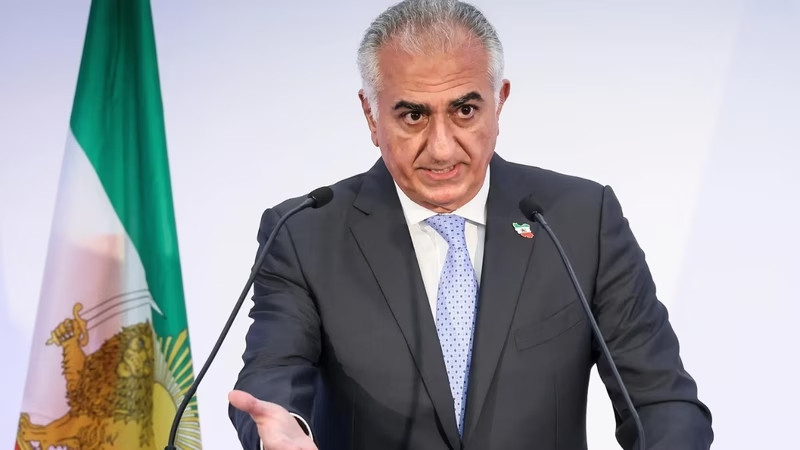
In the heart of a historic uprising, a name from Iran’s past has surged back into the present: Reza Pahlavi. As nationwide protests against the Islamic Republic enter their second week, the exiled crown prince is no longer just a relic of a bygone monarchy—he’s become a potent symbol of hope for a new, secular Iran .
From his home in the Washington, D.C. area, where he’s lived in exile for nearly five decades, Pahlavi has issued impassioned calls for Iranians to “not abandon the streets” . His message is clear, direct, and resonates deeply with a population weary of economic collapse and political repression . But who is this man, and why is his voice gaining such traction during Iran’s most significant wave of dissent since the 1979 revolution?
Table of Contents
- Who is Reza Pahlavi? A Prince in Exile
- The 2026 Iran Protests: From Economic Grievances to Revolutionary Demands
- Reza Pahlavi’s Vision for Iran: A Secular and Democratic Future
- The Pahlavi Legacy: A Complex History
- Can Reza Pahlavi Unite the Opposition?
- Conclusion: The Future of Iran Hangs in the Balance
- Sources
Who is Reza Pahlavi? A Prince in Exile
Born on October 31, 1960, Reza Pahlavi is the eldest son of Mohammad Reza Pahlavi, the last Shah of Iran, and Empress Farah Diba . He was just 19 years old when the 1979 Islamic Revolution forced his family into exile, ending the 54-year rule of the Pahlavi dynasty .
For most of his adult life, Pahlavi has resided in the United States, transforming from a royal heir into a prominent political dissident . He has consistently advocated for the overthrow of the current theocratic regime, not to restore a monarchy, but to pave the way for a national referendum on Iran’s future form of government .
The 2026 Iran Protests: From Economic Grievances to Revolutionary Demands
The current wave of unrest began in late December 2025, sparked by a deepening economic crisis that has seen the national currency collapse and inflation soar . What started as protests in Tehran’s Grand Bazaar quickly spread across the nation, evolving from purely economic complaints into full-throated calls for political change .
Protesters are now demanding an end to the Islamic Republic itself. The regime’s response has been brutal, involving mass arrests, internet blackouts, and deadly force [[6], [12]]. Despite this, the demonstrations have only grown in size and intensity, marking them as the most significant challenge to the government in years .
Reza Pahlavi’s Vision for Iran: A Secular and Democratic Future
Pahlavi’s recent interventions are carefully calibrated to address the core demands of the protesters. He has explicitly called for a “peaceful transition” towards a secular, democratic system—a stark contrast to the current theocracy .
His strategy appears to be threefold:
- Unifying the Opposition: By positioning himself as a figurehead rather than a claimant to the throne, he aims to unite disparate opposition groups under a common banner of regime change.
- Appealing to the Military: In a bold move, he has directly urged the Iranian Armed Forces to side with the people and protect the protesters, a tactic that could be decisive if it gains traction .
- Planning a Return: In a statement that electrified his supporters, Pahlavi declared he is “preparing to return home,” linking his potential return directly to the success of the popular movement .
The Pahlavi Legacy: A Complex History
To understand the significance of Pahlavi’s resurgence, one must look at the dynasty’s history. The Pahlavi dynasty, founded by Reza Shah in 1925, ruled Iran until its ouster in 1979 . The era was marked by ambitious modernization efforts but also by autocratic rule, particularly after the CIA-backed coup in 1953 that overthrew the democratically elected Prime Minister Mohammad Mossadegh .
While the Shah’s regime brought economic growth and social reforms, it was also notorious for its secret police (SAVAK) and suppression of political dissent. This complex legacy means that for some Iranians, the Pahlavi name evokes a time of stability and progress, while for others, it represents a painful chapter of dictatorship .
Can Reza Pahlavi Unite the Opposition?
The Iranian opposition is famously fragmented, comprising monarchists, republicans, leftists, and ethnic minority groups. Pahlavi’s greatest challenge is to convince these diverse factions that he is a legitimate and unifying leader for a post-Islamic Republic Iran.
His consistent messaging over the years—that he seeks a national referendum, not a personal restoration—has helped build credibility. Recent reports suggest that many demonstrators are indeed calling for his return, seeing him as a figure who can bridge internal divides and garner international support . However, skepticism remains, particularly among younger activists who have no memory of the Pahlavi era and are wary of any association with monarchy [[INTERNAL_LINK:iran-youth-movement-2026]].
Conclusion: The Future of Iran Hangs in the Balance
The story of Reza Pahlavi is now inextricably linked with the fate of the 2026 Iranian protests. Whether he becomes a transitional figure in a new democratic Iran or remains a hopeful voice from exile depends on the will of the Iranian people and the response of the security forces. One thing is certain: his call to “not abandon the streets” has struck a powerful chord, turning a historical footnote into a central player in a nation’s desperate fight for freedom.
Sources
- Times of India: Who is Reza Pahlavi? Iran’s exiled crown prince urges protesters not to ‘abandon the streets’
- Various news reports on Reza Pahlavi and the 2026 Iran protests [[1], [3], [4], [5], [6], [7], [8], [9], [10], [11], [12]]
- Historical analyses of the Pahlavi dynasty [[13], [14], [15], [16], [17], [18], [21], [22]]
- [INTERNAL_LINK:iran-protests-timeline-2026]
- [INTERNAL_LINK:history-of-iranian-monarchy]