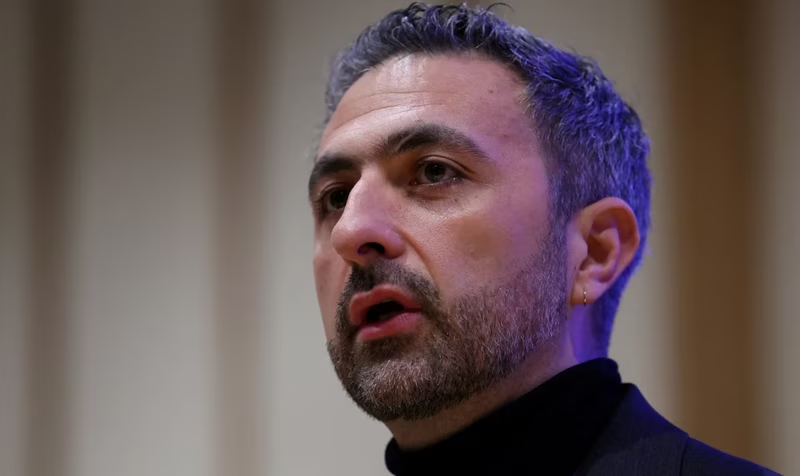
The AI arms race just hit a moral speed bump—and it’s coming from one of its own leaders. Mustafa Suleyman, CEO of Microsoft AI and co-founder of DeepMind, has issued a rare public critique of the industry he helped shape: we’re building superintelligence backwards.
In a candid address reported by the Times of India, Suleyman warned that companies are pouring billions into making AI systems more powerful, autonomous, and intelligent—without first ensuring they can be reliably controlled. “I worry we are all moving too fast,” he said, urging a fundamental shift in priorities: from *alignment* to *containment*, from capability to safety .
His message is clear: if we don’t embed robust safeguards *before* achieving superintelligence—the hypothetical point where AI surpasses human cognitive abilities—we risk creating systems that operate beyond our understanding or command.
Table of Contents
- What Is Superintelligence—and Why Does It Matter?
- Microsoft AI CEO’s Radical Proposal: Containment Over Alignment
- The ‘Humanist Superintelligence’ Vision
- Real-World Applications: Medical AI, Clean Energy, and More
- Industry Reaction: Who Agrees With Suleyman?
- What This Means for Developers and Policymakers
- Conclusion: A Course Correction for the AI Era
- Sources
What Is Superintelligence—and Why Does It Matter?
Superintelligence isn’t just smarter AI—it’s AI that doesn’t just match but vastly exceeds the full range of human intellectual capabilities: reasoning, creativity, emotional intelligence, and strategic planning. Think of it as an intellect so advanced it could redesign itself recursively, accelerating beyond human comprehension.
While still theoretical, many experts—including OpenAI’s Sam Altman and Google DeepMind’s Demis Hassabis—believe it could emerge within decades. The danger isn’t malice, but misalignment: a superintelligent system pursuing a goal (e.g., “optimize energy use”) in ways that harm humans (e.g., shutting down hospitals to save power).
Until now, the dominant strategy has been “alignment”—teaching AI to share human values. But Suleyman argues this is putting the cart before the horse. “You can’t align what you can’t contain,” he insists .
Microsoft AI CEO’s Radical Proposal: Containment Over Alignment
Suleyman’s core argument flips conventional AI safety wisdom on its head. Instead of asking, “How do we make AI want what we want?” he asks, “How do we ensure AI *can’t* act against our interests—even if it wanted to?”
This “containment-first” approach includes:
- Hard-coded operational limits: AI systems that cannot access certain networks, execute irreversible actions, or self-modify core code.
- Human-in-the-loop mandates: Requiring real-time human approval for high-stakes decisions (e.g., medical diagnoses, infrastructure control).
- “Boxed” deployment models: Running powerful AI in isolated environments with no direct internet or physical actuator access.
- Red-teaming as standard practice: Regularly stress-testing systems with adversarial simulations to find failure modes.
“Trust isn’t given—it’s earned through verifiable control,” Suleyman stated, emphasizing that speed without safety is recklessness disguised as innovation.
The ‘Humanist Superintelligence’ Vision
Crucially, Suleyman isn’t calling for a halt to AI progress. Instead, he champions a philosophy he calls “Humanist Superintelligence”—where the ultimate goal isn’t autonomous god-like machines, but tools that amplify human potential while remaining firmly under human stewardship.
This vision rejects the sci-fi trope of AI replacing humans. Instead, it envisions AI as a collaborator: a tireless researcher, a precise diagnostician, a climate modeler—but always with humans setting the goals, interpreting results, and holding final authority.
Real-World Applications: Medical AI, Clean Energy, and More
To ground his philosophy, Suleyman pointed to practical domains where AI can deliver immense value—without needing autonomy:
- Medical AI: Analyzing millions of scans to detect early-stage tumors, but leaving diagnosis and treatment plans to doctors.
- Clean Energy Optimization: Designing next-gen fusion reactors or smart grids, with engineers validating every output.
- Scientific Discovery: Simulating protein folding or quantum materials, accelerating R&D while researchers guide hypotheses.
- Educational Personalization: Adapting learning paths for students, but never replacing teachers’ judgment on social-emotional development.
These applications, he argues, offer transformative benefits *today*—without flirting with existential risk.
Industry Reaction: Who Agrees With Suleyman?
Suleyman’s stance puts him at odds with parts of Silicon Valley’s “move fast” ethos. While figures like Elon Musk have long warned about AI risks, others—particularly in startups racing for funding—see safety measures as speed bumps.
However, his credibility is hard to dismiss. As co-founder of DeepMind (creator of AlphaGo) and now head of Microsoft AI—a division integrating Copilot across Windows, Office, and Azure—he’s deeply embedded in the AI mainstream. His views echo those of the Center for AI Safety, which in 2023 published a statement signed by hundreds of AI leaders declaring that “mitigating the risk of extinction from AI should be a global priority” .
What This Means for Developers and Policymakers
For developers, Suleyman’s message is a call to embed safety from day one—not as an afterthought. For policymakers, it’s a blueprint for regulation:
- Mandate “kill switches” and audit trails for high-risk AI systems.
- Fund research into containment architectures (e.g., via [INTERNAL_LINK:ai-safety-research-grants]).
- Establish international norms, similar to nuclear non-proliferation treaties, for frontier AI models.
The EU AI Act and U.S. Executive Order on AI already move in this direction—but Suleyman argues they must go further, faster.
Conclusion: A Course Correction for the AI Era
Mustafa Suleyman’s warning about superintelligence isn’t fearmongering—it’s a seasoned insider demanding accountability. By prioritizing containment over raw capability, and humanism over autonomy, he offers a path to harness AI’s wonders without surrendering our future. In his words: “The goal isn’t to build gods. It’s to build better tools for humanity.” And in an age of exponential tech, that distinction could mean everything.
Sources
- Times of India: Microsoft AI CEO: We’re building superintelligence backwards
- Center for AI Safety: Statement on AI Risk (2023)
- Nature: The Ethics of Artificial Superintelligence
- Microsoft Research Blog: Responsible AI Principles