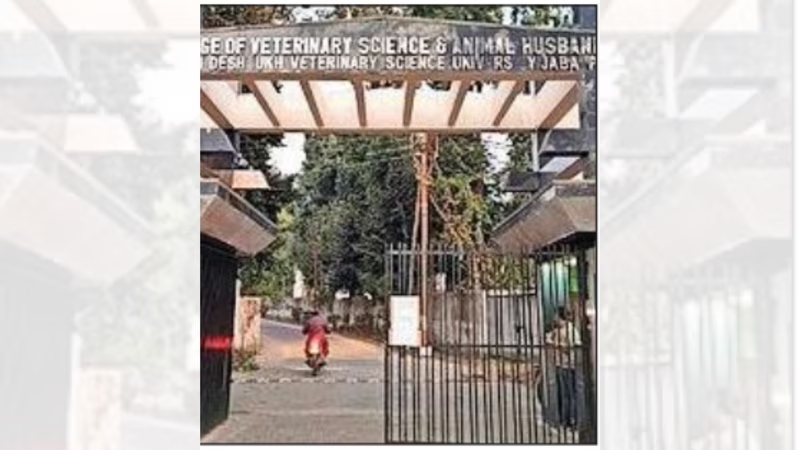
It was sold as a revolutionary, homegrown solution to one of humanity’s most feared diseases: a cancer treatment derived from gau mutra (cow urine) and gobar (cow dung). Backed by a sitting Member of Parliament and promoted under the banner of traditional Indian medicine, the project promised hope to rural communities with limited access to modern healthcare.
But a recent government investigation has blown the lid off this ambitious scheme, revealing a starkly different reality. Instead of funding clinical trials or building treatment centers, crores of rupees from the Gau Mutra cancer project were allegedly splurged on purchasing luxury SUVs and financing extensive domestic and international travel .
This isn’t just a case of poor budgeting—it’s a potential betrayal of public trust on a massive scale. For citizens who believed in the promise of affordable, indigenous healthcare, this revelation is a bitter pill to swallow. Let’s dissect what went wrong, how the system failed, and what this means for future public health initiatives.
Table of Contents
- The Gau Mutra Project: A Noble Promise?
- Probe Findings: From Cures to Cars
- How Were Public Funds Diverted?
- Political and Social Fallout
- The Scrutiny of Traditional Medicine Claims
- What Happens Next?
- Conclusion: Accountability Over Hype
- Sources
The Gau Mutra Project: A Noble Promise?
The concept of using cow products for medicinal purposes has deep roots in Ayurveda and other traditional Indian systems of medicine. Proponents claim that gau mutra has detoxifying and anti-carcinogenic properties. While these claims remain scientifically unproven for cancer treatment, the cultural and religious significance of the cow in India has lent them significant political and social weight .
The specific Gau Mutra cancer project in question was launched with much fanfare, securing substantial funds from a central government scheme aimed at rural development and healthcare innovation. The MP championing the project positioned it as a cost-effective, accessible alternative to expensive chemotherapy, promising to bring relief to thousands in his constituency.
Probe Findings: From Cures to Cars
The recent probe, initiated after whistleblower complaints, paints a damning picture. Auditors found that a significant portion of the allocated budget was not spent on its stated objectives. Instead, the money was used for:
- Purchasing high-end SUVs for project officials, far exceeding any reasonable transportation needs for fieldwork.
- Funding lavish domestic and foreign trips under the guise of “research collaboration” and “study tours,” with little to no documented outcomes.
- Hosting expensive events and seminars with minimal participation from actual medical or scientific experts in oncology.
Critically, there was no evidence of any structured clinical trials, peer-reviewed research, or even a functional treatment facility being established with the project funds . The core mission—developing a cancer therapy—appeared to be an afterthought.
How Were Public Funds Diverted?
The scheme reportedly exploited loopholes in the disbursement process of central government grants. By categorizing vehicle purchases as “field equipment” and travel as “essential research activities,” the project managers were able to justify expenses that had no direct link to cancer research or patient care.
This highlights a systemic vulnerability: the lack of robust, real-time monitoring mechanisms for specialized projects. While large infrastructure schemes have stringent oversight, smaller, niche initiatives often fly under the radar until a scandal erupts.
Political and Social Fallout
The fallout from this scandal is multi-layered. Politically, it’s a major embarrassment for the MP involved and the party that backed the project, which had used it as a symbol of their commitment to both indigenous knowledge and rural welfare.
Socially, the damage is even deeper. It risks eroding public faith not just in this specific project, but in the entire ecosystem of government-funded health initiatives. When funds meant for life-saving research are spent on luxury cars, it cynically exploits the desperation of vulnerable populations who are seeking hope .
For a broader look at how public health funds are managed in India, see our analysis on [INTERNAL_LINK:public-health-funding-transparency].
The Scrutiny of Traditional Medicine Claims
This scandal also reignites the debate around integrating traditional medicine with modern science. There’s immense value in exploring India’s rich heritage of natural remedies, but it must be done through a rigorous, evidence-based framework.
Reputable institutions like the Central Council for Research in Ayurvedic Sciences (CCRAS) conduct controlled studies on various formulations. However, bypassing this scientific process in favor of politically-driven, unverified projects does a disservice to both traditional knowledge and modern medicine .
What Happens Next?
The probe’s findings are expected to trigger several actions:
- A formal show-cause notice to the MP and project authorities demanding an explanation.
- Potential recovery of misused funds from those responsible.
- A review of the approval and monitoring process for all similar niche health projects across the country.
- Stronger guidelines requiring third-party audits and scientific validation before releasing funds for medical research claims.
Conclusion: Accountability Over Hype
The Gau Mutra cancer project scandal is a cautionary tale about the dangers of mixing unverified claims with public money. While the cultural reverence for the cow is undeniable, it cannot be a substitute for scientific rigor and financial accountability, especially when human lives are at stake. The path forward isn’t to abandon traditional knowledge, but to subject it to the same standards of proof and transparency we demand from any other medical intervention. Only then can we build health initiatives that are both genuinely Indian and truly effective.
Sources
- Times of India: MP’s ‘gau mutra, gobar cancer project’ funds splurged on cars, travel: Probe
- The Hindu: MP govt orders probe into alleged fund misuse
- National Center for Biotechnology Information (NCBI): Review of Cow Urine Pharmacological Activities
- India Today: Public outrage over diverted health funds
- Central Council for Research in Ayurvedic Sciences (CCRAS)