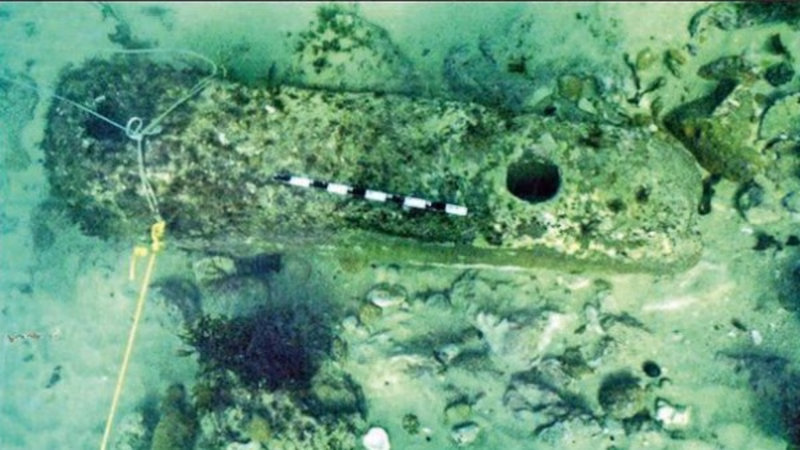
For centuries, the story of Dwarka—the magnificent coastal city ruled by Lord Krishna—has lived in the verses of the Mahabharata and the Harivamsa as a divine metropolis that vanished beneath the waves after Krishna’s departure from Earth. Now, the Archaeological Survey of India (ASI) is taking a bold scientific leap to separate myth from history. In a landmark move, the ASI has announced plans for deeper, more technologically advanced excavations—both on land and underwater—to finally trace the physical remains of Krishna’s Dwarka.
Table of Contents
- The Legend of Dwarka: Myth Meets History
- Krishna’s Dwarka Excavation: ASI’s New Mission
- Past Discoveries and Scientific Evidence
- Cutting-Edge Technology in the Search for Dwarka
- Why Finding Dwarka Matters for Indian Heritage
- Conclusion: The Quest for a Divine City
- Sources
The Legend of Dwarka: Myth Meets History
According to Hindu scriptures, Dwarka was a marvel of urban planning—built on reclaimed land off the coast of modern-day Gujarat, with golden spires, fortified walls, and harbors teeming with trade ships. After Krishna’s death, the city was said to have been swallowed by the sea in a single night, fulfilling a prophecy .
While skeptics long dismissed this as allegory, growing archaeological and oceanographic evidence suggests that a sophisticated port city may have indeed existed in the region over 3,000 years ago—and could have been submerged due to rising sea levels or tectonic shifts .
Krishna’s Dwarka Excavation: ASI’s New Mission
The ASI’s renewed push comes after decades of intermittent exploration. This time, the agency is collaborating with the National Institute of Oceanography (NIO) and using satellite imagery, ground-penetrating radar, and sonar mapping to target high-probability zones both near present-day Dwarka town and offshore in the Gulf of Khambhat .
“We are not chasing mythology—we are following material evidence,” said a senior ASI official involved in the project. “Previous findings of stone anchors, pottery shards, and submerged structural alignments warrant a systematic, large-scale investigation.” The team plans to drill core samples from the seabed and analyze sediment layers for organic material that can be carbon-dated.
Past Discoveries and Scientific Evidence
Excavations since the 1960s have yielded tantalizing clues:
- In the 1980s, marine archaeologists discovered a 560-meter-long wall-like structure 20 meters underwater off Dwarka’s coast .
- Ceramic artifacts dated to 1500–2000 BCE were recovered, matching timelines described in ancient texts.
- Stone anchors and ship ballasts suggest Dwarka was a major maritime hub connected to Mesopotamia and the Persian Gulf.
Notably, a 2002 NIO-led survey using side-scan sonar revealed geometric formations resembling man-made structures at depths of 30–40 meters—far older than any known historical port in the region . While not conclusive proof of Krishna’s city, these findings align with descriptions of a once-thriving coastal civilization lost to the sea.
Cutting-Edge Technology in the Search for Dwarka
The upcoming phase will deploy tools rarely used in Indian archaeology until now:
- Multibeam Echo Sounders: To create 3D maps of the seabed with centimeter-level precision.
- ROVs (Remotely Operated Vehicles): Equipped with HD cameras and robotic arms to retrieve samples without disturbing the site.
- LIDAR and Drone Surveys: For high-resolution topographical analysis of coastal erosion patterns.
These methods minimize invasive digging while maximizing data collection—critical for preserving fragile underwater heritage. The ASI also plans to consult with geologists to model sea-level changes over the last 4,000 years, helping pinpoint when and how Dwarka might have submerged.
Why Finding Dwarka Matters for Indian Heritage
Beyond religious significance, confirming Dwarka’s existence would rewrite chapters of South Asian history. It could prove that the Indus Valley Civilization wasn’t the only advanced urban culture in ancient India—and that Vedic-era societies had sophisticated engineering, naval capabilities, and international trade networks [[INTERNAL_LINK:indus-valley-civilization-legacy]].
Moreover, it would validate oral and textual traditions that Western academia has often marginalized. As Dr. R.S. Bisht, former ASI joint director, once noted: “If Troy can be found, why not Dwarka?” The search is not just about one city—it’s about reclaiming the depth and antiquity of India’s civilizational memory.
Conclusion: The Quest for a Divine City
The Krishna’s Dwarka excavation represents a rare convergence of faith, science, and national identity. Whether the ASI uncovers temple foundations, harbor walls, or simply more questions, the journey itself reaffirms India’s commitment to exploring its past with rigor and reverence. As technology dives deeper into the Arabian Sea, the world watches—waiting to see if legend will rise from the waves as history.