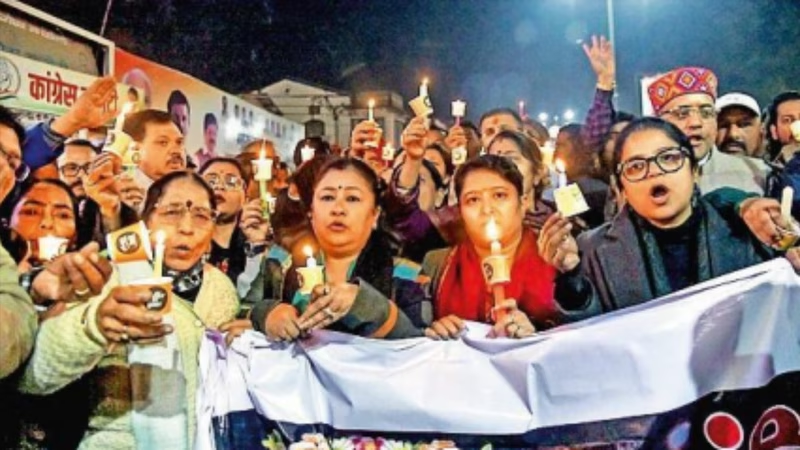
A serene riverside resort in Rishikesh—the global yoga capital—has become the epicenter of a chilling murder investigation with explosive political undertones. In a dramatic turn of events, a **Rishikesh resort murder** case that had stalled for weeks has suddenly gained momentum after a Padma Bhushan awardee and renowned environmentalist filed a formal complaint directly accusing a ‘VIP’ of shielding the real culprits. The Dehradun police have now registered an FIR, igniting public outrage and demands for a transparent probe.
Table of Contents
- The Murder at the Rishikesh Resort
- Padma Bhushan Environmentalist Steps In
- Rishikesh Resort Murder: FIR and VIP Allegations
- Why This Case Is Different: Public Trust and Power
- Legal Process and Next Steps
- Conclusion: A Test for Uttarakhand’s Justice System
- Sources
The Murder at the Rishikesh Resort
The incident occurred at a private resort nestled along the banks of the Ganges in Rishikesh, a town known for its spiritual retreats and eco-tourism. According to initial reports, a man was found dead under suspicious circumstances inside his room . While local police initially treated it as a possible case of natural death or suicide, inconsistencies in the scene and witness accounts soon pointed toward foul play.
Despite growing suspicion from locals and the victim’s family, the investigation appeared to stall. No arrests were made, and official updates were scarce—fueling rumors of external pressure and deliberate inaction by authorities .
Padma Bhushan Environmentalist Steps In
The breakthrough came when a highly respected figure—a Padma Bhushan recipient known for decades of environmental activism in the Himalayan region—filed a formal written complaint with senior police officials in Dehradun . The activist, who has chosen to remain unnamed in media reports but is widely recognized in policy circles, alleged that a “high-profile individual” (referred to only as a ‘VIP’) was actively using influence to suppress the investigation.
In his complaint, the environmentalist claimed to have credible information about the involvement of powerful individuals connected to the resort’s ownership or management. He further accused local law enforcement of turning a blind eye due to fear of political or bureaucratic reprisal—a serious charge in a state where tourism and real estate often intersect with influential networks .
Rishikesh Resort Murder: FIR and VIP Allegations
Faced with mounting pressure and the credibility of the complainant, the Dehradun police finally registered an FIR on January 10, 2026, under relevant sections of the Indian Penal Code, including Section 302 (murder) and Section 201 (destruction of evidence) . Notably, while the FIR does not name the ‘VIP’ directly, it explicitly references the environmentalist’s allegations of obstruction and undue influence.
This move marks a significant escalation. Until now, the case had languished in ambiguity. The registration of an FIR transforms it from a passive inquiry into an active criminal investigation, opening the door for forensic re-examination, witness summonses, and potential arrests—even if powerful figures are involved.
Why This Case Is Different: Public Trust and Power
What makes the Rishikesh resort murder case stand out isn’t just the brutality of the crime—it’s the collision between grassroots justice and elite impunity. Rishikesh, though a spiritual haven, has seen rapid commercialization, with luxury resorts often operating in legal gray zones regarding land use and environmental clearances [[INTERNAL_LINK:uttarakhand-environmental-laws]].
When a figure of national stature like a Padma Bhushan awardee publicly challenges the system, it signals a crisis of confidence in local governance. Citizens are left wondering: if even such a respected voice must intervene to get basic police action, what hope do ordinary people have?
Key concerns raised by civil society groups include:
- Lack of transparency in resort licensing in ecologically sensitive zones
- Potential collusion between business interests and local administration
- Erosion of public trust in law enforcement when VIPs are involved
These aren’t just theoretical—they’re urgent governance issues that this case has brought to the forefront.
Legal Process and Next Steps
With the FIR now in place, the investigation will likely be handed over to a specialized team or even the Uttarakhand Special Task Force (STF) to ensure impartiality. Under Indian law, any attempt to shield an accused—especially in a murder case—is itself a criminal offense under Section 212 (harboring an offender) and Section 120B (criminal conspiracy) of the IPC.
Moreover, if the allegations of VIP interference are substantiated, it could trigger wider scrutiny from state vigilance departments or even the National Human Rights Commission (NHRC), which has previously intervened in cases of alleged institutional bias . The environmentalist’s standing may also lend weight to calls for a judicial inquiry.
Conclusion: A Test for Uttarakhand’s Justice System
The Rishikesh resort murder is no longer just about one victim—it has become a litmus test for whether justice in India can prevail over power. The courage of a single citizen, armed only with truth and moral authority, has forced the machinery of law back into motion. Now, the onus is on investigators to follow the evidence wherever it leads, without fear or favor. For a state that markets itself as a sanctuary of peace and purity, how it handles this case will define its true character.
Sources
- Times of India: Rishikesh resort murder: FIR registered after Padma Bhushan environmentalist lodges plaint against VIP
- NDTV: Rishikesh Resort Murder Case: FIR Registered After Padma Bhushan Awardee’s Complaint
- Ministry of Home Affairs: The Criminal Law (Amendment) Act, 2013
- National Human Rights Commission of India