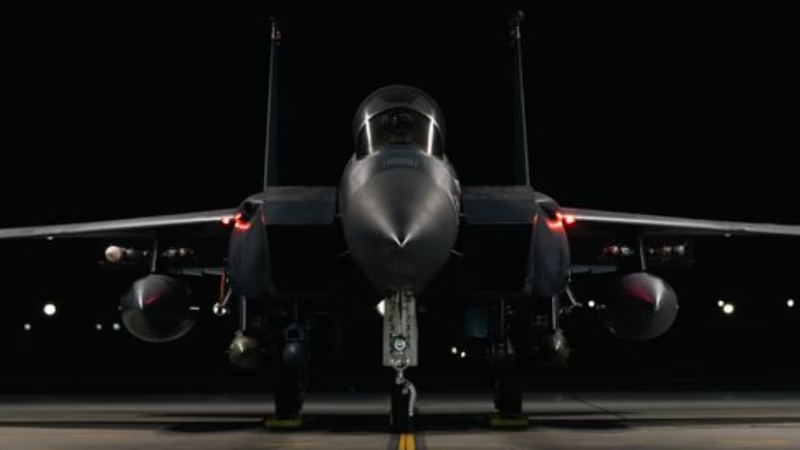
The drums of war have sounded again in the Syrian desert. Following a brazen and deadly attack that killed two American soldiers and a U.S. civilian interpreter near the ancient city of Palmyra, the U.S. military has responded with overwhelming force. Dubbed Operation Hawkeye Strike, this coordinated campaign of airstrikes represents one of the most significant U.S. military actions in Syria in recent years—a clear message that attacks on American personnel will be met with immediate and decisive consequences .
The operation, carried out by U.S. Central Command (CENTCOM) in conjunction with allied forces, targeted a network of ISIS command centers, weapons depots, and training camps across multiple regions in eastern Syria . This isn’t just a retaliatory strike; it’s a strategic effort to dismantle the remnants of an organization that continues to pose a lethal threat despite being declared territorially defeated years ago. Here’s everything you need to know about the attack that triggered this response, the scope of the operation, and what it means for the future of U.S. involvement in the region.
Table of Contents
- The Palmyra Ambush That Sparked Operation Hawkeye Strike
- Operation Hawkeye Strike: Targets and Execution
- CENTCOM’s Zero-Tolerance Message
- The Resurgence of ISIS in Syria
- Historical Context: US Military Presence in Syria
- Global Reactions and Strategic Implications
- Conclusion: A Warning Shot Across the Bow
- Sources
The Palmyra Ambush That Sparked Operation Hawkeye Strike
The catalyst for this major military action was a sophisticated ambush near Palmyra, a UNESCO World Heritage site that has been a flashpoint in the Syrian conflict. A joint U.S.-partner patrol was attacked by a well-armed ISIS cell using a combination of small arms fire and improvised explosive devices (IEDs) .
The attack resulted in the tragic deaths of two U.S. service members and a valued civilian interpreter who worked closely with American forces. Several others were wounded. This incident marked one of the deadliest single attacks on U.S. personnel in Syria since the withdrawal of major combat units, serving as a stark reminder that the threat from ISIS is far from over.
Operation Hawkeye Strike: Targets and Execution
In response, CENTCOM launched Operation Hawkeye Strike within 72 hours—a testament to its rapid-response capabilities. The operation involved a combination of fighter jets, drones, and intelligence assets to strike a coordinated set of high-value targets. According to official statements, the strikes hit:
- ISIS command and control nodes used to plan and coordinate attacks.
- Weapons storage facilities containing IED components and heavy munitions.
- Training camps where new recruits were being indoctrinated and prepared for operations.
- Logistical hubs that support the group’s movement and supply chain across the Syrian desert.
The precision of these strikes was designed not only to inflict maximum damage on ISIS infrastructure but also to minimize civilian casualties, a key concern in any modern military operation.
CENTCOM’s Zero-Tolerance Message
General Michael Erik Kurilla, the commander of CENTCOM, issued a stern and unambiguous statement following the operation: “We will pursue every individual responsible for this cowardly attack. Our commitment to our partners and our personnel is absolute. There is zero tolerance for those who target U.S. forces” .
This message serves a dual purpose: it reassures U.S. troops and their allies on the ground, while simultaneously warning any hostile actor that the cost of attacking American interests will be severe and immediate. It’s a classic application of deterrence theory in a complex, asymmetric battlefield.
The Resurgence of ISIS in Syria
While ISIS lost its territorial caliphate in 2019, the group has been steadily regrouping in the remote deserts of eastern Syria and western Iraq. Exploiting the power vacuum left by the Syrian civil war and the reduced international focus on counter-terrorism, ISIS cells have increased their frequency of attacks on both local security forces and coalition personnel .
[INTERNAL_LINK:isis-resurgence-middle-east-2026] explores the factors behind this troubling comeback, including prison breaks, funding from illicit trade, and the exploitation of local grievances.
Historical Context: US Military Presence in Syria
The U.S. maintains a limited but strategically important presence in Syria, primarily focused on two missions: countering the remnants of ISIS and preventing the expansion of Iranian influence. With approximately 900 troops stationed in the country, mostly in the northeast, their role is officially “advise and assist,” working alongside the Syrian Democratic Forces (SDF) .
Operations like Operation Hawkeye Strike are a critical part of this mission, demonstrating that even a small footprint can project significant power when necessary.
Global Reactions and Strategic Implications
The international response has been largely supportive, with NATO allies praising the U.S. for its swift action to protect its personnel and degrade a global terrorist threat. However, the strikes have also drawn criticism from the Syrian government and its Russian backers, who view any U.S. military activity on Syrian soil as a violation of sovereignty.
Strategically, this operation reinforces the U.S. commitment to its counter-terrorism objectives in the region, even as global attention shifts to other crises. It sends a clear signal that the U.S. will not allow its hard-won gains against ISIS to be reversed.
Conclusion: A Warning Shot Across the Bow
Operation Hawkeye Strike is more than just a retaliatory measure; it’s a calculated demonstration of American military resolve. By swiftly and precisely targeting the infrastructure that enables ISIS to operate, the U.S. has not only avenged its fallen but also disrupted the group’s ability to launch future attacks. In the volatile landscape of the Middle East, such a show of force is a necessary reminder that while the nature of the war may have changed, the commitment to defeating terrorism remains unwavering.
Sources
- Details of the Palmyra ambush and casualties .
- Official CENTCOM statement on Operation Hawkeye Strike and its objectives .
- Analysis of ISIS’s current operational capacity in Syria .
- [INTERNAL_LINK:us-troop-deployment-syria-explained]
- U.S. Central Command (CENTCOM) – Official Website