Table of Contents
- The Deadly Palmyra Ambush That Sparked It All
- Operation Hawkeye Strike: A Swift and Decisive Response
- Scale and Strategy of the US Strikes in Syria
- Why This Retaliation Matters for Global Security
- What Comes Next for ISIS and US Forces?
- Conclusion: A Clear Message Sent to Terror Networks
- Sources
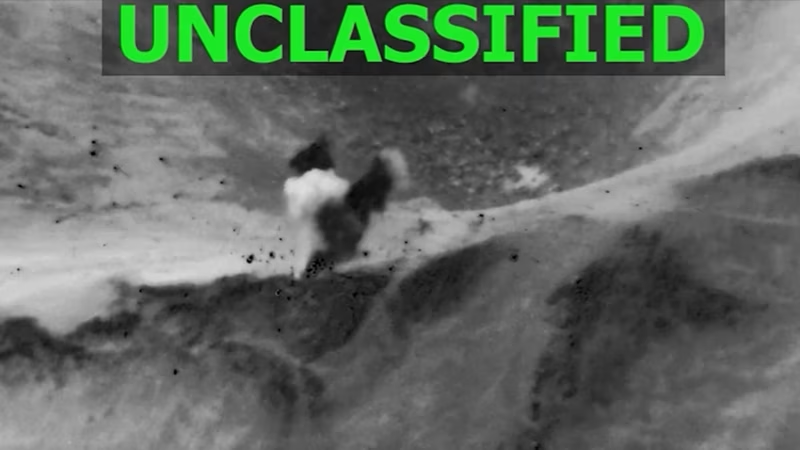
The Middle East is once again a flashpoint of tension as the United States executes a major military operation in response to a brazen terrorist attack. The catalyst was a deadly ambush by the Islamic State (ISIS) near the ancient city of Palmyra, which resulted in the tragic deaths of two U.S. service members and their interpreter. In direct retaliation, the Pentagon launched a sweeping campaign of US strikes Syria, under the codename Operation Hawkeye Strike, to dismantle ISIS infrastructure and send an unambiguous message .
The Deadly Palmyra Ambush That Sparked It All
On December 13, 2025, a joint patrol of U.S. and Syrian forces was ambushed near Palmyra, a region long known as a former stronghold for ISIS . The attack was meticulously planned and executed, resulting in the loss of two American soldiers and their local interpreter—a stark reminder of the persistent threat posed by the terrorist group, even years after its territorial defeat .
This incident marked one of the deadliest attacks on U.S. personnel in Syria in recent years, immediately triggering a high-level review within the Department of Defense. The Palmyra area, despite being under coalition surveillance, remains a complex and volatile zone where sleeper cells can still operate with alarming effectiveness .
Operation Hawkeye Strike: A Swift and Decisive Response
Just six days after the ambush, on December 19, 2025, the U.S. military launched Operation Hawkeye Strike . This was not a symbolic gesture but a full-throated, large-scale retaliatory operation designed to degrade ISIS’s operational capabilities and prevent future attacks .
The operation’s name itself—Hawkeye—suggests precision, vigilance, and lethal intent. Its primary objective was clear: to hold ISIS accountable for its actions and to demonstrate that any attack on American forces would be met with overwhelming and immediate force .
Scale and Strategy of the US Strikes in Syria
The US strikes Syria campaign was extensive and well-coordinated. According to official reports, the initial wave of attacks hit approximately 70 ISIS targets across central Syria . These targets were carefully selected to cripple the group’s command structure, logistics networks, and weapons caches.
The strategy behind these strikes was multi-faceted:
- Deterrence: To deter future attacks by showing the severe consequences of targeting U.S. personnel.
- Disruption: To disrupt ISIS’s ability to plan and execute complex operations by destroying their physical infrastructure.
- Degradation: To systematically degrade the group’s overall fighting capacity, pushing them further into irrelevance .
The use of precision-guided munitions and intelligence gathered from multiple sources ensured that the strikes were both effective and minimized collateral damage, a critical consideration in the complex Syrian theater .
Why This Retaliation Matters for Global Security
This isn’t just about avenging a single attack; it’s about maintaining the fragile security architecture in the region. A failure to respond decisively could have been interpreted as a sign of weakness, potentially emboldening not just ISIS but other hostile actors in the area.
The US strikes Syria serve as a crucial reminder of America’s ongoing commitment to its allies and its own national security interests in the Middle East. They reinforce the principle that the U.S. will not tolerate attacks on its forces, no matter how remote the location . For more on the geopolitical implications of such military actions, the Council on Foreign Relations provides an excellent analysis of U.S. policy in the region.
What Comes Next for ISIS and US Forces?
While Operation Hawkeye Strike has dealt a significant blow, the fight against ISIS is far from over. The group has proven its resilience, often shifting from a conventional army to a clandestine insurgency. The next phase will likely involve intensified intelligence operations, special forces raids, and continued support for local partner forces on the ground .
For U.S. troops stationed in Syria, the security posture will undoubtedly be reviewed and hardened. The Palmyra ambush exposed vulnerabilities that must be addressed to prevent a repeat tragedy. This includes enhanced surveillance, better coordination with local allies, and a constant state of readiness .
Conclusion: A Clear Message Sent to Terror Networks
The US strikes Syria under Operation Hawkeye Strike are a textbook example of a swift, proportional, and strategically sound military response. They have successfully communicated a powerful message to ISIS and other terrorist organizations: attacks on American personnel will be met with a devastating and precise counter-offensive. While the long-term battle against extremism continues, this operation stands as a firm assertion of U.S. resolve in a volatile region.
Sources
[INTERNAL_LINK:us-military-operations-in-syria] | [INTERNAL_LINK:history-of-isis-in-palmyra]
For a deeper understanding of the history and tactics of ISIS, refer to the comprehensive resources provided by the Council on Foreign Relations.