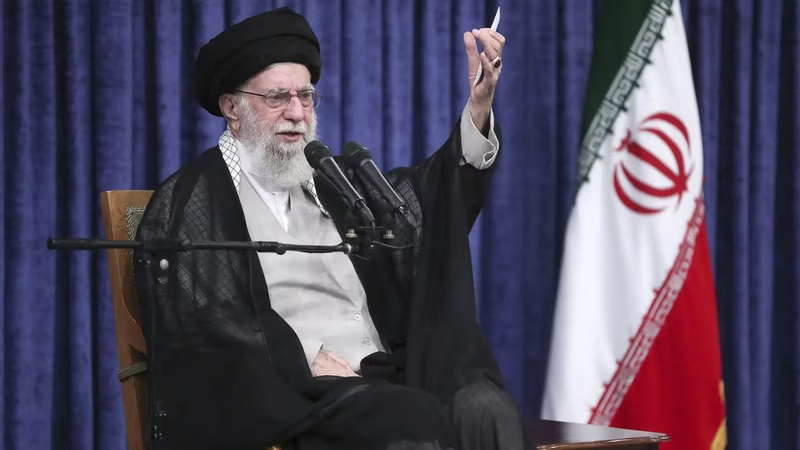
In a stark and terrifying turn of events, Iran has issued a dire warning to citizens taking to the streets in protest. The nation’s Attorney General, Mohammad Movahedi Azad, has declared that demonstrators will be considered “enemies of God”—a label that is not merely rhetorical but a formal charge under Iranian law that can lead directly to the death penalty . This announcement, made as protests enter their second week in January 2026, signals a severe intensification of the government’s crackdown, which already includes widespread internet blackouts and mass arrests .
Table of Contents
- What Does ‘Enemies of God’ Mean in Iran?
- The Moharebeh Charge: A History of Political Repression
- Why Is Iran Issuing This Warning Now in 2026?
- International Response and Human Rights Concerns
- Conclusion: The Stakes for Iranian Citizens
- Sources
What Does ‘Enemies of God’ Mean in Iran?
The phrase “enemies of God” is a direct translation of the Arabic term moharebeh, which in the context of the Islamic Republic of Iran is a capital offense. It is formally defined as “waging war against God” or “corruption on Earth” (efsad-e fel-arz) . While the concept has roots in classical Islamic jurisprudence, its application in modern Iran has been heavily criticized by human rights organizations as a tool for political repression.
According to Article 190 of Iran’s Islamic Penal Code, a conviction for moharebeh can result in one of four punishments: execution, crucifixion, amputation of the right hand and left foot, or exile . In practice, the death penalty is the most common outcome for those charged with this crime, especially when it is applied to political dissidents or protesters.
This isn’t an empty threat. Iranian state television has broadcast the Attorney General’s statement, leaving no room for ambiguity: anyone participating in or even aiding the protests will be tried on these charges .
The Moharebeh Charge: A History of Political Repression
The use of moharebeh as a legal instrument to silence opposition is a well-established pattern in Iran. Critics argue that the regime has consistently weaponized this religious charge for political ends . Historically, it has been used against a wide range of individuals, from armed insurgents to peaceful activists and journalists.
For example, in 2022, during another wave of nationwide protests, numerous demonstrators were sentenced to death under this very charge . The charge is so severe and broadly defined that it grants the judiciary immense power to target anyone deemed a threat to the state’s authority. As one report on Iran’s political prisoners notes, moharebeh is “one of the gravest in Iran’s political-security cases, usually carrying harsh judicial and prison conditions” .
This historical context makes the current warning far more than just a statement; it is a prelude to a potentially deadly legal process.
Why Is Iran Issuing This Warning Now in 2026?
The timing of this threat is critical. The protests in early 2026 appear to be fueled by a combination of deep-seated economic grievances and political frustration . With the country facing significant internal pressure, the regime, led by Supreme Leader Ayatollah Ali Khamenei, is determined to project an image of absolute control. Khamenei himself has framed the protests as the work of foreign agents, stating the Islamic Republic “won’t tolerate people acting as mercenaries for foreign powers” .
By invoking the ultimate religious and legal sanction—the enemies of God Iran charge—the government aims to achieve several goals:
- Instill Fear: The primary objective is to terrify potential protesters into staying home, effectively quelling the movement before it can grow.
- Demonstrate Resolve: It sends a clear message to both domestic and international audiences that the regime is willing to use its most extreme measures to maintain power.
- Frame the Narrative: By labeling protesters as enemies of God, the state attempts to delegitimize their cause, painting them not as citizens with grievances but as existential threats to the Islamic order.
International Response and Human Rights Concerns
The international community has a long history of condemning Iran’s use of the death penalty for political purposes. Organizations like Amnesty International and Human Rights Watch have repeatedly documented how charges like moharebeh are used in trials that lack basic due process, often based on confessions extracted under torture .
While a formal global response to the January 2026 warning is still unfolding, past precedent suggests a wave of condemnation is likely. The United Nations and various Western governments have previously called on Iran to halt executions of protesters and to respect the fundamental right to peaceful assembly .
For readers interested in the broader geopolitical landscape, this crackdown is a significant development in [INTERNAL_LINK:Middle East politics]. The situation in Iran remains a critical flashpoint for regional stability.
Conclusion: The Stakes for Iranian Citizens
The Iranian government’s declaration that protesters are “enemies of God” is a grave and dangerous escalation. It is not a mere figure of speech but a direct invocation of a legal framework designed to eliminate dissent through the ultimate punishment. For the citizens of Iran, the choice is now stark: risk everything for their voice or submit to a regime that equates protest with a capital crime. The world is watching as this crisis unfolds, and the coming days will be pivotal in determining the fate of the protest movement and the lives of countless Iranians.
Sources
- Associated Press. (2026). Iran attorney general warns anyone taking part in protests death-penalty charge.
- Times of India. (2026). ‘Enemies of God’: Iranian officials’ shocking remark on protesters – does it mean death penalty? https://timesofindia.indiatimes.com/world/middle-east/enemies-of-god-iranian-officals-shocking-remark-on-protesters-does-it-mean-death-penalty/articleshow/126453447.cms
- Amnesty International. (2024). Iran: the world’s worst executioner? https://www.amnesty.org/
- United Nations Human Rights Office. (2022). Iran: UN rights experts condemn protestor’s execution, raise alarm over others at risk. https://www.ohchr.org/