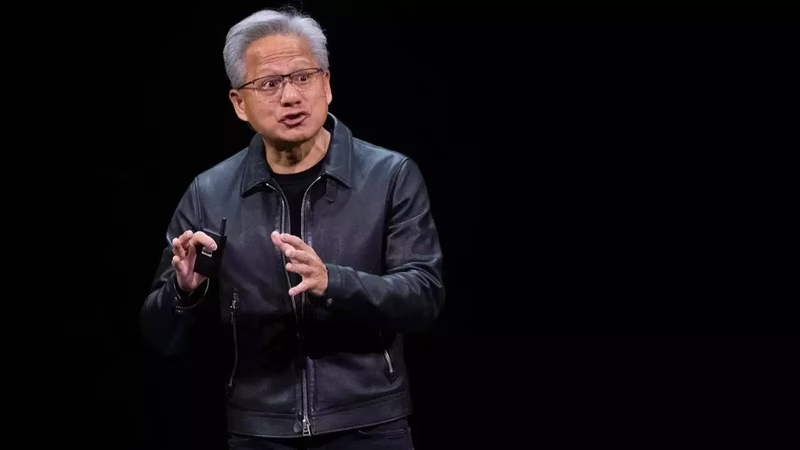
Good news for AI enthusiasts and Nvidia shareholders: Jensen Huang isn’t going anywhere. The 62-year-old visionary who turned a graphics card startup into the world’s most valuable company has officially confirmed he has no plans to step down as Nvidia CEO. In a candid reflection on his 31-year tenure, Huang emphasized his enduring passion, sharp performance, and deep sense of responsibility toward the company that now sits at the epicenter of the global artificial intelligence revolution .
Table of Contents
- Why Jensen’s Continued Leadership Matters
- Jensen Huang Nvidia CEO: The Architect of Modern AI
- No Retirement in Sight: Performance and Passion
- What This Means for Nvidia’s Future Strategy
- Investor Confidence and Market Reaction
- Conclusion: A Steady Hand at the Helm
- Sources
Why Jensen’s Continued Leadership Matters
In an era where tech CEOs cycle in and out with alarming frequency, Jensen Huang’s longevity is a rare anomaly—and a strategic advantage. Under his guidance, Nvidia evolved from a gaming GPU specialist into the undisputed engine of generative AI, powering everything from ChatGPT to self-driving cars. His decision to stay on sends a powerful message: stability, vision, and technical depth still matter in Silicon Valley.
Jensen Huang Nvidia CEO: The Architect of Modern AI
Huang co-founded Nvidia in 1993 with a simple but bold idea: accelerate computing through parallel processing. For years, this was seen as niche—until the AI explosion of the 2010s proved him prophetic. Today, Nvidia’s H100 and upcoming Blackwell chips are so critical to AI infrastructure that major cloud providers like AWS, Microsoft Azure, and Google Cloud compete fiercely for supply .
Under Huang’s leadership, Nvidia’s market cap surpassed $3 trillion in 2024, briefly making it the world’s most valuable company—surpassing even Apple and Microsoft . This isn’t just financial success; it’s validation of a decades-long bet on accelerated computing.
No Retirement in Sight: Performance and Passion
When asked about retirement, Huang didn’t dodge the question—he reframed it. “As long as I can meet performance expectations and maintain my interest, I’ll continue,” he stated . This pragmatic yet passionate stance reflects his engineering mindset: leadership isn’t about tenure; it’s about delivering results.
Notably, Huang emphasized the “great responsibility” of steering a company that now influences national security, scientific research, and global economic competitiveness. With governments from the U.S. to India racing to secure AI chip supplies, Nvidia’s role has transcended commerce—it’s become geopolitical.
What This Means for Nvidia’s Future Strategy
Huang’s continued presence likely means:
- No radical pivots: Expect steady execution on the AI data center roadmap, including next-gen Blackwell Ultra and Rubin architectures.
- Deep vertical integration: Nvidia will keep expanding beyond chips into full-stack AI solutions—software (CUDA), networking (InfiniBand), and even robotics.
- Global expansion with caution: While building fabs in Japan, India, and Europe, Nvidia will navigate U.S.-China tech tensions carefully—a balance Huang has mastered.
Crucially, there’s still no public heir apparent. While COO Debora Shoquist and CTO Michael Kagan hold key roles, Huang remains the undisputed face and brain of Nvidia. This lack of a named successor could concern some investors—but for now, performance speaks louder than succession plans.
Investor Confidence and Market Reaction
The market reacted positively to Huang’s confirmation. Nvidia stock (NVDA) has consistently outperformed the Nasdaq, and analysts at firms like [INTERNAL_LINK:ai-stock-outlook] note that Huang’s leadership is a key “moat” protecting Nvidia’s valuation .
Unlike companies that stumble after founder departures (e.g., Tesla without Musk rumors, or Intel post-Grove), Nvidia’s identity is so intertwined with Huang that his presence reassures stakeholders. As one investor put it: “You don’t replace the conductor while the orchestra is playing the symphony of the century.”
Conclusion: A Steady Hand at the Helm
Jensen Huang staying on as Nvidia CEO isn’t just a personal choice—it’s a strategic anchor for the entire AI ecosystem. In a volatile tech landscape, his blend of technical mastery, long-term vision, and operational discipline offers rare continuity. As AI moves from hype to real-world transformation—in healthcare, climate modeling, and autonomous systems—having its chief architect still at the wheel may be exactly what the world needs.