Table of Contents
- The Storm Around Vijay’s Farewell Film
- Jana Nayagan Censor Row: What Happened?
- Film Fraternity Unites Against CBFC
- The Human Cost of the Delay
- Is Indian Censorship Outdated?
- Conclusion: A Battle for Creative Freedom
- Sources
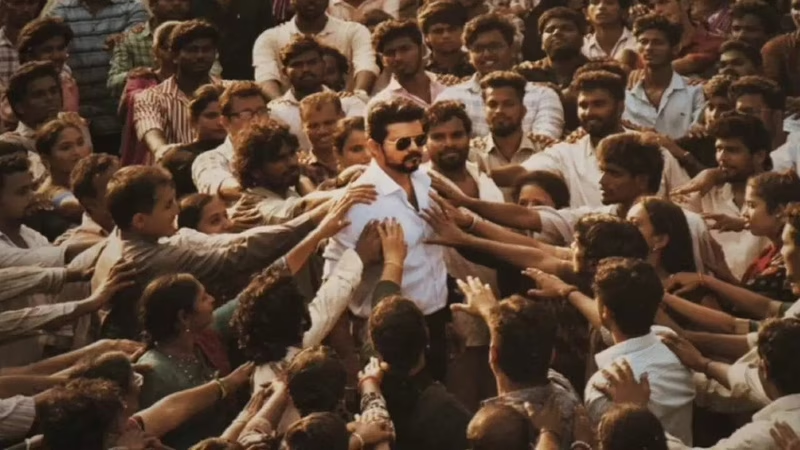
The release of Jana Nayagan, touted as superstar Vijay’s grand swan song before a potential political leap, was supposed to be a celebration. Instead, it’s become a flashpoint in a much larger war—one between artistic expression and bureaucratic control. The Jana Nayagan censor row has not only halted the film’s release but has also galvanized India’s entire film community into a rare, unified protest against what they call an “injustice” by the Central Board of Film Certification (CBFC).
This isn’t just about one movie. It’s about the future of storytelling in a democracy.
The Storm Around Vijay’s Farewell Film
Directed by H. Vinoth, Jana Nayagan is a hard-hitting political drama that many believe mirrors Vijay’s own rumored transition from cinema to politics. Given its sensitive subject matter, industry insiders expected some scrutiny. But no one predicted the current crisis: an indefinite postponement stemming from certification delays and, crucially, an interim stay order from the Madras High Court .
The court’s intervention, reportedly linked to concerns over the film’s content and its potential political messaging, has thrown the entire project into limbo. For a film with a meticulously planned global release, this delay is more than inconvenient—it’s potentially catastrophic.
Jana Nayagan Censor Row: What Happened?
The trouble began when the CBFC, after reviewing the film, reportedly sought significant cuts or modifications before granting a certificate. The producers, led by AGS Entertainment, contested these demands, arguing they compromised the film’s core narrative and directorial vision.
Before a resolution could be reached, a petition was filed in the Madras High Court, leading to an interim stay on the film’s certification process. This legal barrier means the CBFC cannot even issue a final verdict until the court lifts the stay—a timeline that remains uncertain .
For fans who have waited years for this film, and for the thousands of crew members who worked on it, this legal purgatory is deeply frustrating.
Film Fraternity Unites Against CBFC
The backlash has been swift and severe. Renowned Tamil filmmaker Mari Selvaraj was among the first to speak out, calling the situation a “gross injustice.” He argued that such censorship stifles the very soul of cinema, which should be a mirror to society, not a filtered postcard .
Even veteran director Ram Gopal Varma, known for his provocative films, weighed in from Mumbai, labeling the CBFC’s approach as “archaic” and “out of touch with modern democratic values.” He emphasized that in an era of streaming and global content, such heavy-handed regulation only pushes audiences toward unregulated platforms .
This cross-industry solidarity—from Kollywood to Bollywood—shows that the Jana Nayagan censor row has transcended regional cinema and become a national issue of creative rights.
The Human Cost of the Delay
Beyond the headlines and celebrity statements, there’s a real human toll. Hundreds of daily-wage workers—lighting technicians, makeup artists, background performers—have already completed their work but may not receive their final payments if the film’s financial model collapses under prolonged delay.
Producers are facing mounting losses from marketing expenses, venue bookings, and contractual obligations with international distributors. As one insider put it, “Every day this film doesn’t release, we lose crores. And it’s not just money—it’s livelihoods.”
- Key stakeholders affected:
- Over 500 crew members
- Distributors across 15+ countries
- Theatre owners who pre-booked screens
- Vijay’s fan clubs, who organized massive promotional events
Is Indian Censorship Outdated?
This controversy reignites a long-standing debate: Is the CBFC, established in 1952, fit for purpose in 2026? Critics argue that its mandate—to certify, not censor—is routinely ignored in favor of moral policing and political caution.
In contrast, many democracies use classification systems (like the MPAA in the U.S.) that inform audiences rather than dictate content. The British Board of Film Classification (BBFC), for example, focuses on age-appropriate ratings without demanding narrative changes.
The Jana Nayagan case may be the catalyst India needs for a comprehensive overhaul of its film certification framework—one that respects both public sensibilities and artistic integrity.
Conclusion: A Battle for Creative Freedom
The Jana Nayagan censor row is far more than a dispute over a single film’s cuts. It’s a defining moment for Indian cinema. Will storytellers be allowed to reflect the complexities of contemporary life, or will they be forced to conform to an ever-shifting line of bureaucratic acceptability? As the Madras High Court deliberates, the entire creative community watches—and waits—with bated breath. The outcome will shape not just Vijay’s farewell, but the future of every filmmaker who dares to speak truth to power.
Sources
- Times of India: ‘Jana Nayagan’ censor row: Film fraternity slams CBFC, calls it ‘injustice’
- Statements from Mari Selvaraj and Ram Gopal Varma [[15], [16]].
- Details on Madras High Court interim stay .
- British Board of Film Classification: https://www.britishboardoffilmclassification.org/