Table of Contents
- The Bizarre Moment: Trump Hits Pause
- Trump Oil Summit Pause: The Reason Behind the Interruption
- A Private Project for a Public Stage
- What Was on the Agenda? Oil Deals and Venezuela
- Political Theater or Strategic Vision?
- Conclusion: Merging Policy, Personality, and Power
- Sources
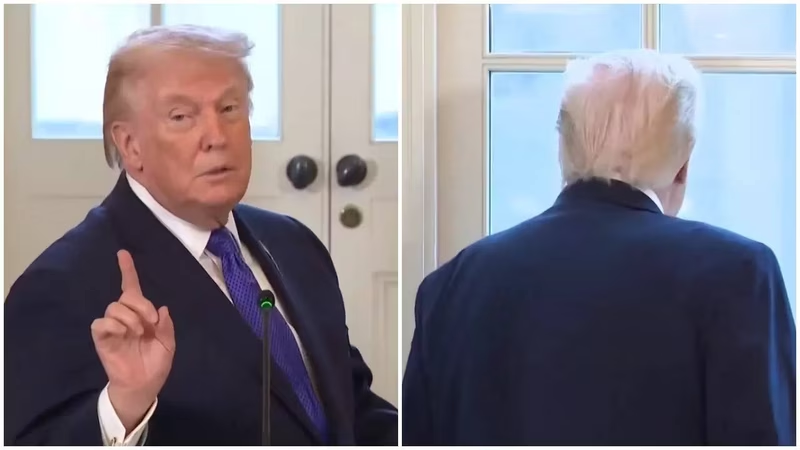
Picture this: The most powerful oil and gas executives in America are gathered in the White House for a high-level strategy session with former President Donald Trump. The conversation is intense, focused on multi-billion-dollar investments and geopolitical maneuvering. Then, out of nowhere, Trump stops everything. “Hold on, I need to look,” he says—and walks out.
This isn’t fiction. It’s a real moment from a recent meeting that perfectly encapsulates the unique blend of policy, personality, and spectacle that defines Trump’s political brand. The reason for the abrupt pause? He wanted to personally inspect the progress on his new White House ballroom—a project he insists is not only on track but actually ahead of schedule.
The Bizarre Moment: Trump Hits Pause
According to reports, the meeting was in full swing when Trump suddenly excused himself. The room full of industry titans was left waiting while the former president toured the construction site of what he envisions as a grand new venue within the White House complex . This unorthodox move immediately sparked questions: Was this a distraction? A calculated display of control? Or simply Trump being Trump?
For many observers, the incident underscores how Trump often blurs the lines between official business and personal projects—even when those projects are tied to one of the world’s most iconic government buildings.
Trump Oil Summit Pause: The Reason Behind the Interruption
The Trump oil summit pause wasn’t just a random whim. The ballroom in question is central to Trump’s long-term vision for his potential return to power. He has repeatedly stated that the current White House lacks a space large enough to host major events, including—most notably—a second presidential inauguration in 2026 .
“We’re building a ballroom that will be used for big events, for inaugurations,” Trump explained during the tour. “It’s going to be beautiful, and it’s being done with private money—no taxpayer dollars.” This emphasis on private funding is a key part of his messaging, aimed at deflecting criticism about using public office for personal or partisan gain.
A Private Project for a Public Stage
The claim of private funding is significant. While past presidents have overseen White House renovations, they’ve typically been funded through federal appropriations or the White House Historical Association. Trump’s model—relying on private donors—is unprecedented in modern times and raises ethical and legal questions about donor influence and access.
Still, if successful, the ballroom could become a powerful symbol: a physical manifestation of Trump’s ambition to reshape not just policy, but the very architecture of American power.
What Was on the Agenda? Oil Deals and Venezuela
While the ballroom stole the headlines, the substance of the oil summit was equally consequential. During the meeting, Trump and the executives discussed a bold plan: massive U.S. investment in Venezuela’s crippled oil infrastructure .
With Venezuela sitting on the world’s largest proven oil reserves, unlocking its production potential could dramatically shift global energy markets. The proposal involves American companies pouring billions into revamping refineries, pipelines, and drilling operations—contingent, of course, on a favorable political outcome in Caracas.
This strategy aligns with Trump’s long-standing “energy dominance” doctrine. By boosting non-OPEC supply, the U.S. could reduce its reliance on Middle Eastern oil and exert greater leverage over rivals like Russia and China.
- Potential Investment: Estimated in the tens of billions of dollars.
- Key Players: Major U.S. oil firms, including ExxonMobil and Chevron representatives.
- Geopolitical Goal: Counter Russian and Chinese influence in Latin America.
Political Theater or Strategic Vision?
Critics dismiss the ballroom detour as pure political theater—a distraction from substantive issues. But supporters argue it’s part of a larger, coherent vision: Trump is simultaneously laying the groundwork for his policy legacy (via Venezuela oil deals) and his ceremonial return (via the new ballroom).
In this light, the Trump oil summit pause becomes more than a quirky anecdote. It’s a microcosm of his entire approach: merging hard-nosed business deals with grand symbolic gestures, all while keeping himself firmly at the center of the narrative.
For deeper context on U.S. energy policy and presidential transitions, the non-partisan U.S. Department of Energy provides authoritative background information.
Conclusion: Merging Policy, Personality, and Power
The image of Donald Trump walking out on America’s top oil executives to check on his ballroom is unforgettable. It captures his trademark unpredictability, his flair for the dramatic, and his relentless focus on legacy-building. Whether you see it as a sign of vanity or visionary planning, one thing is clear: as the 2026 election looms, Trump is already constructing both the policy framework and the physical stage for his potential comeback. The Trump oil summit pause may have been brief—but its implications could be long-lasting.
Sources
- Times of India: ‘Hold on, I need to look’: Trump abruptly pauses oil executive summit — Here’s the reason
- Reports on Trump’s White House ballroom plans and private funding claims .
- Details on proposed U.S. oil investments in Venezuela .
- U.S. Department of Energy: https://www.energy.gov/