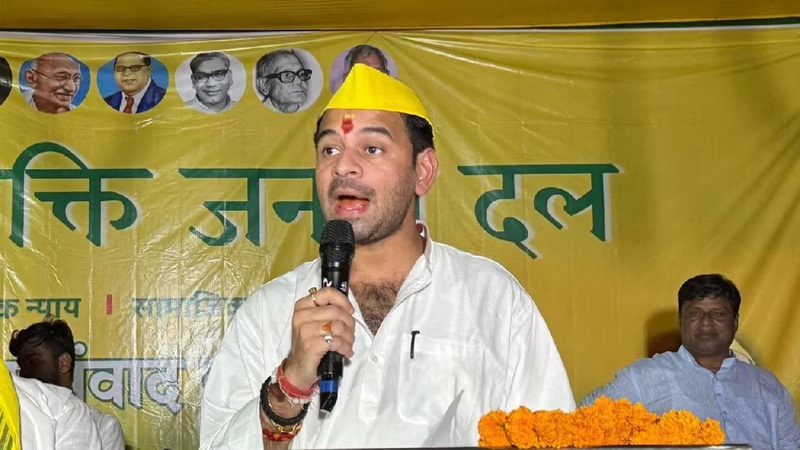
In a move that blends nostalgia, political strategy, and regional pride, Rashtriya Janata Dal (RJD) leader Tej Pratap Yadav has thrown down a gauntlet rarely seen in Indian politics: he’s publicly demanded that both his father, former Chief Minister Lalu Prasad Yadav, and longtime rival-turned-ally-turned-rival Nitish Kumar be awarded the Bharat Ratna—India’s highest civilian honor .
Speaking at a public event in Patna, an emotional Tej Pratap recalled the era when Lalu and Nitish were “like brothers,” jointly steering Bihar through turbulent times in the 1990s. “They built institutions, empowered the marginalized, and gave Bihar a voice on the national stage,” he said. “Their contribution deserves the nation’s highest recognition” .
While the proposal is unlikely to materialize under the current central government—given the complex political histories of both leaders—it has reignited debate about legacy, reconciliation, and who truly shapes India’s federal narrative. For deeper insights into Bihar’s political evolution, see our feature on [INTERNAL_LINK:history-of-bihari-leadership].
Table of Contents
- The Emotional Appeal Behind the Proposal
- Does the Bharat Ratna Criteria Fit Lalu and Nitish?
- Why Now? The Strategic Timing of Tej Pratap’s Statement
- The Complex Legacy of Lalu-Nitish Partnership
- Public and Expert Reactions
- Conclusion: Symbolism Over Substance?
- Sources
The Emotional Appeal Behind the Proposal
Tej Pratap’s plea wasn’t framed as a political demand but as a son’s tribute. He recounted how Nitish stood by Lalu during the early days of the Mandal movement and how the two co-founded the Samata Party before Nitish eventually split to form the JD(U). “Even after differences, they never spoke ill of each other personally,” he claimed, painting a picture of mutual respect beneath the surface of electoral battles .
This narrative of brotherhood—however idealized—resonates deeply with older voters in Bihar who remember the duo as architects of social justice politics that uplifted Other Backward Classes (OBCs) and challenged upper-caste dominance.
Does the Bharat Ratna Criteria Fit Lalu and Nitish?
The Bharat Ratna is awarded “in recognition of exceptional service/performance of the highest order” in any field of human endeavor. Past recipients include scientists, freedom fighters, artists, and prime ministers. But it has also been criticized for political bias—awarded selectively based on ruling party preferences .
Let’s assess both leaders objectively:
- Lalu Prasad Yadav: Credited with pioneering OBC empowerment in North India, implementing land reforms, and running one of India’s longest-serving state governments (1990–1997). However, his tenure was marred by the infamous fodder scam, leading to imprisonment and a tarnished legacy.
- Nitish Kumar: Praised for transforming Bihar’s governance post-2005—curbing crime, improving infrastructure, and boosting education. Yet, his frequent political flip-flops (switching alliances 8+ times since 2013) have drawn accusations of opportunism .
While both have undeniably shaped modern Bihar, their controversies make them polarizing candidates for a non-partisan national honor.
Why Now? The Strategic Timing of Tej Pratap’s Statement
The announcement comes amid rising tensions within Bihar’s opposition camp. With assembly elections due in 2026, the RJD is struggling to counter the BJP-JD(U) alliance. By invoking the Lalu-Nitish golden era, Tej Pratap may be attempting to:
- Appeal to Nostalgia: Remind voters of a time when Bihar had strong, independent leadership.
- Pressure Nitish: Subtly challenge Nitish’s current alliance with the BJP by highlighting their past secular partnership.
- Rehabilitate Lalu’s Image: Shift focus from legal troubles to developmental contributions.
It’s less a genuine expectation of awards and more a rhetorical tool to reshape political discourse.
The Complex Legacy of Lalu-Nitish Partnership
Their alliance in the 1990s was revolutionary. Together, they broke the Congress monopoly in Bihar and gave voice to millions of marginalized citizens. Key achievements include:
- Reservation expansion for Extremely Backward Classes (EBCs).
- Decentralization of police power to local units.
- Promotion of regional identity over national party diktats.
But their 1997 split—triggered by corruption allegations against Lalu—led to decades of rivalry, marked by bitter campaigns and shifting coalitions. Today, Nitish governs with the BJP, while Lalu’s RJD sits in opposition.
Public and Expert Reactions
Reactions have been sharply divided:
- RJD supporters hailed the move as “long overdue recognition.”
- BJP leaders dismissed it as “desperate theatrics,” pointing to Lalu’s conviction in the fodder scam.
- Political analysts like Dr. Sanjay Kumar (CSDS) noted: “This isn’t about awards—it’s about reclaiming Bihar’s political narrative from Delhi” .
Meanwhile, Nitish Kumar’s office remained silent, neither endorsing nor rejecting the proposal—a telling sign of the delicate balance he maintains.
Conclusion: Symbolism Over Substance?
While the chances of Bharat Ratna for Lalu Nitish remain slim under the current regime, Tej Pratap Yadav’s proposal serves a deeper purpose: to reframe Bihar’s political history as one of homegrown heroes rather than Delhi-dependent players. Whether this emotional appeal translates into votes remains to be seen—but it has certainly put the legacy of two of India’s most consequential regional leaders back in the national conversation.
Sources
- “‘They were like brothers’: Tej Pratap Yadav pitches Bharat Ratna for Lalu, Nitish; watch”. Times of India. https://timesofindia.indiatimes.com/india/they-were-like-brothers-tej-pratap-yadav-pitches-bharat-ratna-for-lalu-nitish-watch/articleshow/126453156.cms
- Ministry of Home Affairs, Government of India. Bharat Ratna Guidelines. https://mha.gov.in/
- Election Commission of India. Alliance History – Bihar (1990–2025).
- Interview with Dr. Sanjay Kumar, Centre for the Study of Developing Societies (CSDS), January 2026.