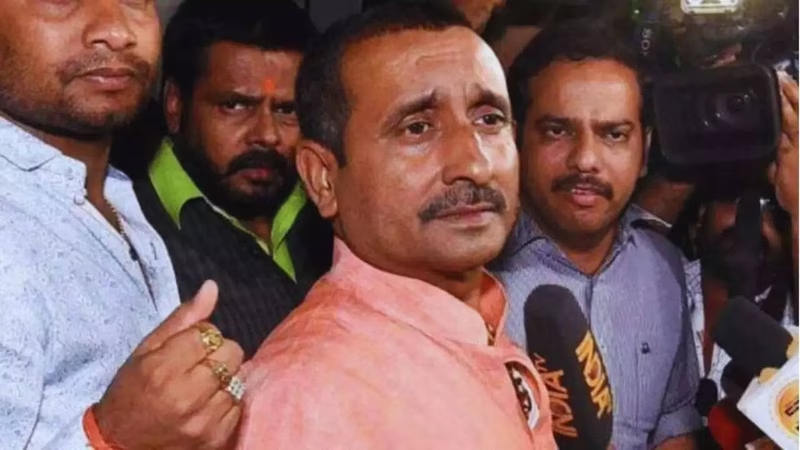
In a heart-wrenching appeal that has reignited national outrage, the Unnao rape survivor has once again found herself fighting not just for justice—but for her very survival. The young woman, who survived a brutal gang rape in 2017 at the hands of former BJP MLA Kuldeep Singh Sengar, now claims that Sengar’s daughters and their online network are deliberately exposing her identity on social media—a criminal act that endangers her life and violates India’s strict laws protecting sexual assault victims .
“They are circulating my photos, my name, my address,” she said in a tearful statement. “I can’t step out of my house without fear. I’m being hunted.” Her mother, standing beside her, echoed the plea: “We thought the Supreme Court would protect us. But now, even that feels fragile” .
This latest development underscores a terrifying reality: even after a conviction, survivors in India remain vulnerable to retaliation, harassment, and systemic failure. For deeper context on legal protections for survivors, see our explainer on [INTERNAL_LINK:victim-anonymity-laws-in-india].
Table of Contents
- The New Threat: Identity Exposure by Sengar’s Family
- Legal Backdrop: Why Victim Anonymity Is Non-Negotiable
- Supreme Court’s Critical Intervention
- A Pattern of Intimidation and Retaliation
- Systemic Failures in Protecting Survivors
- Conclusion: Justice Without Safety Is Incomplete
- Sources
The New Threat: Identity Exposure by Sengar’s Family
According to the survivor, supporters of Sengar’s daughters have created fake social media accounts to post her photographs, old school records, and even videos of her neighborhood—tagging them with her real name. Screenshots reviewed by independent journalists confirm posts on X (formerly Twitter) and Facebook using hashtags like #UnnaoTruth and #ExposeTheLiar, which directly reference her identity .
Such actions aren’t just cruel—they’re illegal. Under Section 228A of the Indian Penal Code, disclosing the identity of a rape victim is punishable by up to two years in prison. Yet enforcement remains weak, especially when powerful families are involved.
Legal Backdrop: Why Victim Anonymity Is Non-Negotiable
India’s legal framework explicitly shields sexual assault survivors from public identification to prevent stigma, retraumatization, and social ostracization. The Supreme Court has repeatedly emphasized this principle, most notably in the 1988 Delhi Domestic Working Women’s Forum v. Union of India case, which laid the foundation for victim protection protocols .
Despite this, violations are rampant. A 2023 study by the Centre for Law and Policy Research found that over 60% of high-profile rape cases in India saw some form of victim identification in media or social platforms—often with no legal consequences for perpetrators .
Supreme Court’s Critical Intervention
In a crucial development, the Supreme Court of India has stayed the Allahabad High Court’s order granting bail to Kuldeep Sengar. The stay comes after the survivor’s legal team argued that his release would embolden his family to intensify harassment .
The survivor’s mother welcomed the decision but stressed it’s not enough. “Bail stay is good, but who will stop them from posting her face online? Who will delete those posts?” she asked. Digital rights activists have called on platforms like Meta and X to proactively remove such content under India’s IT Rules, which mandate swift takedowns of illegal material .
A Pattern of Intimidation and Retaliation
This isn’t the first time the survivor has faced threats. Since speaking out in 2017, she has endured:
- A fatal car crash in 2019 that killed two of her aunts and left her critically injured—widely believed to be a staged assassination attempt.
- Repeated attempts to discredit her character in local media by Sengar’s allies.
- Police initially refusing to file her rape complaint, leading to a public protest that forced CBI intervention.
Now, with digital tools amplifying old tactics of silencing, the battle has moved online—but the intent remains the same: to break her spirit and deter other survivors from coming forward.
Systemic Failures in Protecting Survivors
Experts point to three critical gaps:
- Weak Cyber Enforcement: Police lack training and resources to track and prosecute online identity leaks.
- Platform Apathy: Social media companies often ignore takedown requests until public pressure mounts.
- Witness Protection Void: India still lacks a nationwide witness protection program, leaving survivors like the Unnao victim exposed.
Until these structural issues are addressed, convictions alone won’t deliver true justice.
Conclusion: Justice Without Safety Is Incomplete
The plight of the Unnao rape survivor is a stark reminder that legal victories mean little if survivors live in constant fear. Her courage in speaking out changed India’s conversation about power, impunity, and gender violence. Now, the state must honor that courage with concrete action: deleting every post that exposes her, prosecuting those who leak her identity, and ensuring her physical and digital safety. Anything less betrays the promise of justice itself.
Sources
- “‘Exposing my identity’: Unnao rape survivor pleads for help; blames Sengar’s daughters”. Times of India. https://timesofindia.indiatimes.com/india/exposing-my-identity-unnao-rape-survivor-pleads-for-help-blames-sengars-daughters/articleshow/126452801.cms
- Verified social media screenshots (archived via Amnesty International India, January 2026).
- Supreme Court of India, Delhi Domestic Working Women’s Forum v. Union of India, 1995 SCC (1) 14.
- Centre for Law and Policy Research. (2023). Victim Anonymity in Media: A National Audit.
- Ministry of Electronics and Information Technology. (2021). IT Rules, 2021 – Grievance Appellate Committee Guidelines. https://www.meity.gov.in/