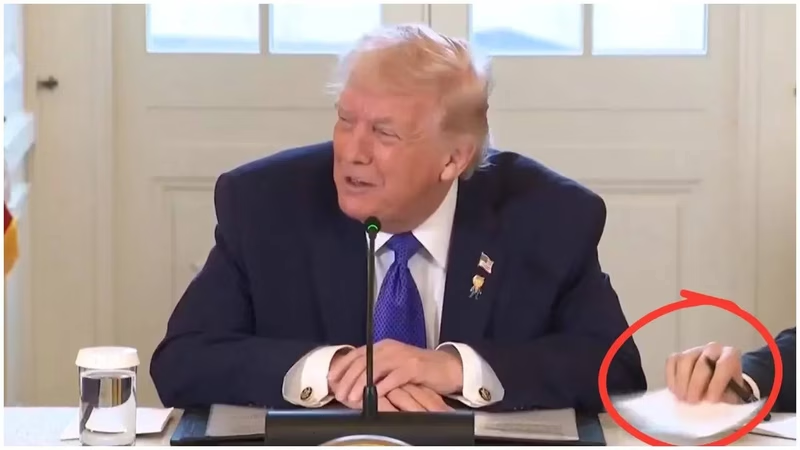
In a scene straight out of a political thriller, President Donald Trump turned a routine White House meeting with oil industry executives into a moment of high-stakes theater—by reading aloud a private, handwritten note from Secretary of State Marco Rubio. The message? Just three words: “Go back to Chevron.”
The incident, which occurred during a press conference following discussions on U.S. energy policy, left Rubio visibly flustered and Vice President J.D. Vance struggling to suppress a grin. But beyond the awkward body language, this unscripted moment has ignited a firestorm of questions about lobbying influence, internal administration dynamics, and whether Rubio’s past ties to Big Oil are shaping foreign and domestic policy .
For readers tracking the intersection of corporate power and government—a theme we’ve explored in [INTERNAL_LINK:big-oil-influence-on-us-policy]—this episode is more than gossip; it’s a revealing window into how decisions might be made behind closed doors.
Table of Contents
- The Incident: What Happened in the White House?
- Marco Rubio’s Historical Ties to Chevron
- Immediate Political Fallout and Reactions
- Why This Matters for U.S. Energy Policy
- Trump’s Style: Chaos as a Governance Tool?
- Conclusion: A Note That Exposed More Than Intended
- Sources
The Incident: What Happened in the White House?
During a closed-door strategy session with top oil executives—including representatives from ExxonMobil, Shell, and Chevron—the conversation reportedly centered on boosting domestic production and relaxing environmental regulations. As the press was allowed in for closing remarks, President Trump, known for his improvisational flair, reached into his pocket and pulled out a folded piece of paper.
“Look what Marco wrote me,” Trump said with a smirk, holding up the note before reading: “Go back to Chevron.” The room fell silent. Cameras flashed. Rubio, standing nearby, turned crimson and looked down, while Vice President Vance covered his mouth, clearly amused .
Trump then quipped, “Maybe he’s got a job waiting for him!”—a remark that blurred the line between jest and accusation.
Marco Rubio’s Historical Ties to Chevron
While the note may have seemed like an offhand joke, it taps into real concerns about Rubio’s relationship with the oil giant. Before becoming Secretary of State, Rubio served as a U.S. Senator from Florida, where he received significant campaign contributions from energy sector PACs, including those linked to Chevron .
More notably, in 2023, Rubio advocated for expanded offshore drilling in the Gulf of Mexico—a move that directly benefited major oil companies. Critics have long argued that his foreign policy stances on Venezuela and Iran align closely with Chevron’s business interests in those regions .
Chevron, for its part, has lobbied aggressively on issues like sanctions relief and access to Venezuelan oil reserves. With Rubio now overseeing U.S. diplomacy, the overlap between national interest and corporate agenda has never been more scrutinized.
Immediate Political Fallout and Reactions
The fallout was swift:
- Democratic lawmakers called for an ethics investigation, demanding transparency about communications between State Department officials and energy firms.
- Conservative commentators were divided—some defended Rubio as a pro-energy patriot, while others questioned his judgment in passing such a note in a presidential setting.
- Chevron issued a brief statement saying it “does not direct or influence U.S. foreign policy” and that it “engages with all administrations through lawful advocacy channels” .
Rubio’s office later claimed the note was a “light-hearted reminder” referencing an earlier conversation about technical details of refining capacity—but the damage to his carefully cultivated image as a principled foreign policy hawk was already done.
Why This Matters for U.S. Energy Policy
This isn’t just about one awkward moment. It reflects a broader shift in the Trump administration’s energy strategy—one that prioritizes fossil fuel expansion over climate concerns. Under this White House, the U.S. has fast-tracked LNG export terminals, rolled back methane regulations, and deepened partnerships with oil-rich autocracies .
If key decision-makers like Rubio are perceived as proxies for corporate interests, public trust in policy legitimacy erodes. And with the 2026 midterms looming, Democrats are seizing on this narrative to paint the GOP as captive to Big Oil.
Trump’s Style: Chaos as a Governance Tool?
Some analysts argue that Trump’s decision to read the note wasn’t accidental—it was strategic. By exposing Rubio’s slip-up, Trump reasserted dominance over his cabinet, reminding everyone who’s in charge. This tactic of public humiliation has been a hallmark of his leadership style, from firing chiefs on Twitter to airing internal disputes in front of reporters.
In this light, the “Go back to Chevron” moment wasn’t just gossip—it was a calculated display of power, designed to keep subordinates in line and the media distracted.
Conclusion: A Note That Exposed More Than Intended
What began as a scribbled message between two powerful men became a national talking point overnight. The phrase “Trump reads Rubio’s note” is now shorthand for the blurred lines between government service and corporate allegiance. Whether this incident leads to formal scrutiny or fades into political folklore remains to be seen—but it has undeniably raised urgent questions about transparency, accountability, and who really shapes America’s energy future.
Sources
- “Behind the scenes goes public: Trump reads Marco Rubio’s note during oil executives’ meeting”. Times of India. https://timesofindia.indiatimes.com/world/us/behind-the-scenes-goes-public-trump-reads-marco-rubios-note-during-oil-executives-meeting-what-was-written-in-it/articleshow/126451755.cms
- OpenSecrets.org – Marco Rubio Campaign Contributions by Industry. https://www.opensecrets.org/
- “How U.S. Sanctions on Venezuela Benefit Chevron”. Council on Foreign Relations. https://www.cfr.org/
- Chevron Corporate Statement, January 2026.
- U.S. Energy Information Administration (EIA) – Policy Updates. https://www.eia.gov/