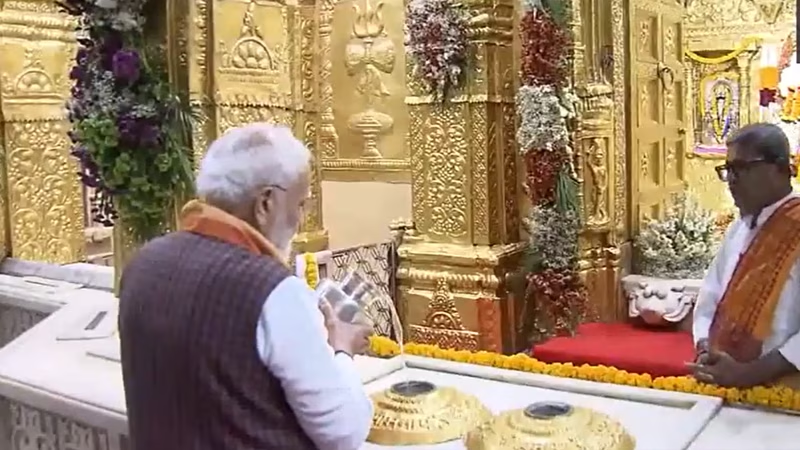
In a powerful fusion of history, faith, and national identity, Prime Minister Narendra Modi began his three-day Gujarat tour with a deeply symbolic stop at the ancient Somnath Temple. Standing before one of Hinduism’s most revered shrines, PM Modi marked the solemn yet defiant milestone of **1,000 years** since its first recorded destruction by Mahmud of Ghazni in 1026 CE .
His presence at the Somnath Swabhiman Parv wasn’t just ceremonial—it was a deliberate act of historical reclamation. With the chant “Jai Somnath!” echoing through the coastal town, the Prime Minister framed the event as a celebration of India’s enduring civilizational spirit and its triumph over repeated attempts at cultural erasure.
Table of Contents
- The Historical Milestone: Why 1026 CE Matters
- Inside the Somnath Swabhiman Parv: Events & Symbolism
- PM Modi Somnath: A Political and Cultural Statement
- Beyond Ritual: Key Projects Inaugurated
- Full Gujarat Itinerary: From Faith to Foreign Policy
- Conclusion
- Sources
The Historical Milestone: Why 1026 CE Matters
The year 1026 CE marks a dark chapter in Indian history. It was then that Sultan Mahmud of Ghazni launched a brutal raid on the Somnath Temple, looting its legendary wealth and demolishing its sanctum sanctorum. Historical accounts, including those by Al-Biruni and later Persian chroniclers, describe the temple as a center of immense spiritual and economic significance .
What makes Somnath unique is its story of relentless reconstruction. Destroyed and rebuilt no fewer than **17 times**, the temple stands today as a living testament to India’s refusal to let its heritage be erased. The current structure, reconstructed in 1951 under Sardar Vallabhbhai Patel’s guidance and inaugurated by Dr. Rajendra Prasad, embodies this unbroken continuity.
Inside the Somnath Swabhiman Parv: Events & Symbolism
The Swabhiman Parv (Self-Respect Festival) was designed as a multi-layered commemoration blending devotion, technology, and national pride:
- Ceremonial Procession: A grand shobha yatra (procession) featuring cultural troupes, traditional music, and local artisans wound through the town, celebrating Gujarat’s heritage.
- Drone Light Show: Over 1,000 drones illuminated the night sky above the Arabian Sea, forming images of the temple, Lord Shiva’s trishul, and the Indian map—a modern tribute to ancient faith.
- PM’s Address: Modi shared rare archival photos and spoke of Somnath as “not just a temple, but the soul of Bharat,” linking its resilience to contemporary India’s self-reliance narrative [INTERNAL_LINK:modi-cultural-diplomacy-india].
PM Modi Somnath: A Political and Cultural Statement
This visit is far more than a religious stopover. It’s a strategic reinforcement of the BJP’s core narrative: the restoration of India’s civilizational dignity after centuries of perceived subjugation. By anchoring his Gujarat tour at Somnath on this precise historical anniversary, PM Modi is drawing a direct line from past invasions to present-day sovereignty.
Political analysts note that Somnath has long held symbolic weight for the BJP. It was here in 1990 that L.K. Advani began his Ram Rath Yatra, a movement that reshaped Indian politics. Modi’s return—now as Prime Minister—completes a full circle, positioning him as the leader who not only protects but actively revitalizes India’s sacred geography .
Beyond Ritual: Key Projects Inaugurated
True to his governance style, PM Modi coupled the cultural event with tangible development. He dedicated several infrastructure and tourism projects worth hundreds of crores, including:
- A new integrated passenger terminal at Diu Airport to boost regional connectivity.
- Upgraded ghats and lighting along the Somnath coastline to enhance pilgrim experience.
- A state-of-the-art interpretation center showcasing the temple’s 1,000-year journey of destruction and rebirth.
These initiatives align with the government’s broader “Dham-Dham” tourism push, aiming to position sites like Somnath, Kashi, and Ayodhya as global spiritual destinations.
Full Gujarat Itinerary: From Faith to Foreign Policy
The Somnath event was just the opening act. PM Modi’s three-day Gujarat schedule is packed with high-stakes engagements:
- Vibrant Gujarat Regional Summit: Focused on MSMEs and rural entrepreneurship, this conference aims to decentralize economic growth.
- Bilateral Talks with German Chancellor Friedrich Merz: Discussions will cover green energy partnerships, defense tech, and supply chain diversification away from China.
- Public Rally in Junagadh: Expected to highlight Gujarat’s development model ahead of upcoming state elections.
Conclusion
PM Modi’s Somnath visit on the 1,000th anniversary of its first desecration is a masterstroke of cultural storytelling. It weaves together memory, faith, and modernity into a compelling national narrative. More than a political rally or a religious ceremony, it’s a declaration: India remembers its wounds, honors its resilience, and is now confidently scripting its own future. As the drones formed the words “Jai Somnath” in the night sky, they weren’t just lighting up the coast—they were illuminating a vision of civilizational pride reborn.