Table of Contents
- The Raid That Sparked a Constitutional Crisis
- What Are the I-PAC Raids All About?
- ED Alleges State Interference in I-PAC Raids
- Mamata’s Counter-Move: The Caveat in Supreme Court
- Legal Battlefield: From Calcutta HC to Supreme Court
- Broader Implications for Federalism and Central Agencies
- Conclusion
- Sources
The Raid That Sparked a Constitutional Crisis
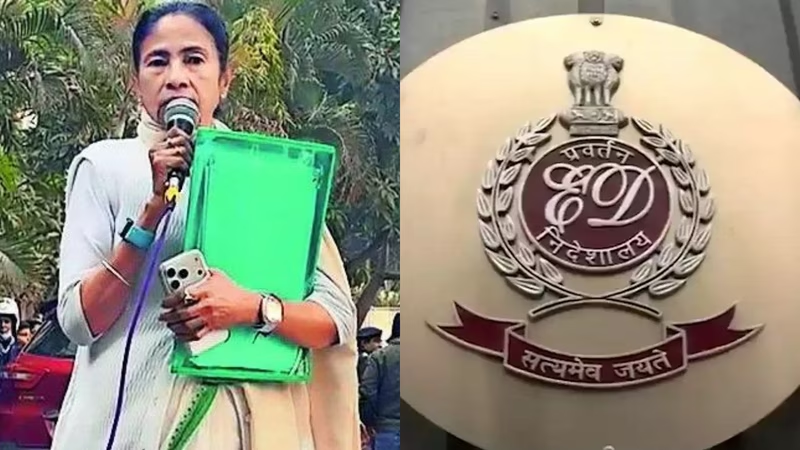
In what has rapidly escalated into one of the most contentious federal standoffs in recent Indian history, the Enforcement Directorate (ED) has approached the Supreme Court alleging deliberate obstruction by the West Bengal government during its I-PAC raids. The raids, part of an ongoing money laundering probe linked to a multi-crore coal allocation scam, have become the epicenter of a fierce political and legal tug-of-war between the Centre and the Mamata Banerjee-led state administration .
The tension reached a boiling point when the Calcutta High Court adjourned a related ED petition, pushing the hearing to January 14, 2026—just days from now . This delay has only intensified the urgency for the ED to seek direct intervention from the apex court.
What Are the I-PAC Raids All About?
The I-PAC (Indian People’s Action Committee) is a non-governmental organization that has come under the ED’s scanner in connection with alleged irregularities in coal block allocations. The agency suspects that funds generated from these dubious allocations were laundered through various shell entities, with I-PAC allegedly acting as a conduit .
The I-PAC raids are not isolated events. They are part of a larger, nationwide investigation into corruption in the energy sector. The ED’s mandate under the Prevention of Money Laundering Act (PMLA) gives it sweeping powers to investigate and attach assets derived from criminal activity, often putting it on a collision course with state governments that view such actions as politically motivated .
ED Alleges State Interference in I-PAC Raids
The core of the ED’s complaint to the Supreme Court is its claim of systematic obstruction by the West Bengal police and, by extension, the state government led by Chief Minister Mamata Banerjee. According to the agency, its officials faced repeated hurdles during their search operations:
- Delayed Permissions: Local police allegedly delayed granting necessary permissions for the raid to commence.
- Intimidation Tactics: ED personnel reported being surrounded and questioned aggressively by large contingents of state police, creating an atmosphere of intimidation .
- Political Rhetoric: Public statements by senior TMC leaders condemning the raids as a “witch hunt” are seen by the ED as an attempt to incite local resistance .
The ED argues that this conduct amounts to a direct violation of the Supreme Court’s previous rulings, which have affirmed that central investigative agencies must be allowed to function without fear or favor from state machinery .
Mamata’s Counter-Move: The Caveat in Supreme Court
Not one to back down, Chief Minister Mamata Banerjee’s government has filed a caveat in the Supreme Court. A caveat is a formal notice that allows a party to be heard before any order is passed against them. This strategic legal maneuver ensures that the Bengal government will have its day in court before the Supreme Court can grant any interim relief sought by the ED .
The state’s position, as articulated in its filings, is that it is merely upholding law and order and ensuring that the ED operates within the bounds of the law. They deny any malicious intent and frame their actions as a necessary check on what they perceive as the overreach of a central agency .
Legal Battlefield: From Calcutta HC to Supreme Court
This isn’t the first time the ED and the Bengal government have clashed in court. The Calcutta High Court has been a frequent venue for their disputes. However, the adjournment of the ED’s petition there has forced the agency to bypass the high court and seek immediate relief from the Supreme Court—a move that underscores the gravity of the situation .
The upcoming hearing on January 14 at the Calcutta High Court will now happen against the backdrop of this parallel battle in the Supreme Court. Legal experts suggest that the apex court’s stance could set a crucial precedent for how similar conflicts between central agencies and state governments are handled in the future [INTERNAL_LINK:federalism-in-india].
Broader Implications for Federalism and Central Agencies
Beyond the immediate political drama, this standoff raises profound questions about India’s federal structure. Can a state government legally impede a central agency operating under a parliamentary law like the PMLA? Or does the Union’s legislative competence in matters of finance and economic offences override state authority?
The Supreme Court has historically leaned towards empowering central agencies to ensure a uniform fight against financial crime across state lines . However, the current political climate, with many non-BJP ruled states accusing the Centre of using these agencies as political tools, adds a layer of complexity that the court cannot ignore. The outcome of this case will be closely watched by every state government in the country.
Conclusion
The controversy surrounding the I-PAC raids is far more than a simple law enforcement operation gone awry. It is a flashpoint in the ongoing struggle for power between the Centre and the states. With the ED seeking the Supreme Court’s intervention and the Mamata Banerjee government filing a strong caveat, we are witnessing a high-stakes legal duel that will test the very foundations of cooperative federalism in India. The nation awaits the judiciary’s verdict, which will have ramifications that echo far beyond the confines of a single investigation.