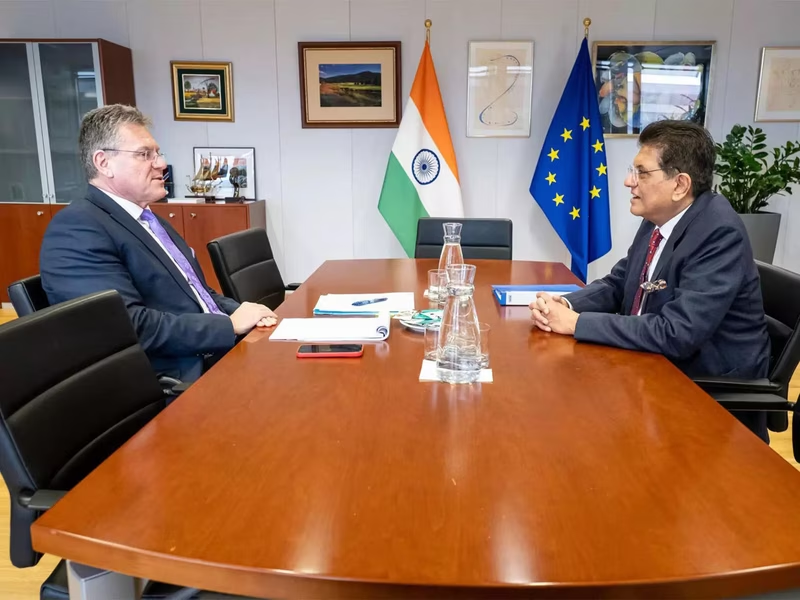
After nearly two decades of stop-and-go negotiations, the **India-EU FTA** may finally be gathering real steam. In a pivotal development, India’s Commerce and Industry Minister Piyush Goyal wrapped up a crucial visit to Brussels this week, signaling a renewed sense of urgency from both sides to close the deal. But this isn’t just about tariffs and quotas—it’s about positioning India as a trusted alternative in an increasingly fragmented global economy.
Goyal’s mission was clear: cut through bureaucratic inertia and fast-track a balanced agreement that protects vulnerable domestic sectors while unlocking unprecedented access to Europe’s $18 trillion market. And by all accounts, the talks delivered tangible momentum.
Table of Contents
- Brussels Breakthrough: Key Outcomes
- Why the India-EU FTA Matters Now More Than Ever
- Safeguarding Farmers and MSMEs: A Non-Negotiable
- Beyond the EU: Goyal Eyes Liechtenstein and the EFTA Deal
- Challenges Ahead: Tariffs, Data, and Geopolitics
- What This Means for Indian Businesses
- Conclusion: A New Era of Strategic Trade?
- Sources
Brussels Breakthrough: Key Outcomes
During his meetings with European Commission Vice-President Valdis Dombrovskis and Trade Commissioner Maroš Šefčovič, Goyal emphasized India’s commitment to resolving “outstanding issues” that have stalled the **India-EU FTA** since formal talks resumed in 2022 . Both sides agreed to intensify technical discussions across key sticking points—including market access for agricultural goods, rules of origin, and digital trade frameworks.
Critically, the EU acknowledged India’s concerns about protecting its small farmers and micro, small, and medium enterprises (MSMEs)—a major political and economic priority for New Delhi. In return, India signaled greater openness to integrating its manufacturing and services sectors into European-led global supply chains, particularly in green tech, pharmaceuticals, and IT.
Why the India-EU FTA Matters Now More Than Ever
This deal isn’t happening in a vacuum. With rising U.S.-China tensions and Europe’s push to “de-risk” from overreliance on Beijing, India has emerged as a strategic partner of choice. The **India-EU FTA** is less a traditional trade pact and more a geopolitical alignment tool.
For the EU, India offers a democratic, English-speaking, digitally advanced economy with a young workforce and growing consumer base. For India, the EU represents its largest trading partner after the U.S.—with bilateral trade already exceeding $130 billion in 2023 . A finalized FTA could boost that figure by 30–40% within five years, according to independent estimates from the World Trade Organization.
Safeguarding Farmers and MSMEs: A Non-Negotiable
One of Goyal’s strongest messages in Brussels was that any final agreement must include ironclad protections for India’s agricultural sector and MSMEs. These groups form the backbone of India’s rural and semi-urban economies—and are highly sensitive to import surges.
To address this, negotiators are exploring:
- Sensitive List Expansion: Keeping key agricultural products like dairy, poultry, and certain fruits off the tariff-reduction table.
- Gradual Liberalization: Phasing in tariff cuts over 10–15 years to give domestic producers time to adapt.
- Anti-Dumping Safeguards: Strengthening mechanisms to counter unfair trade practices if EU imports flood the market.
This cautious approach reflects lessons from past FTAs—like the one with ASEAN—that led to unexpected import spikes and local industry distress.
Beyond the EU: Goyal Eyes Liechtenstein and the EFTA Deal
Goyal didn’t stop in Brussels. He also traveled to Liechtenstein—a tiny but economically powerful principality—as part of his outreach to the European Free Trade Association (EFTA), which includes Switzerland, Norway, Iceland, and Liechtenstein.
Here, the focus was on finalizing the long-pending India-EFTA Trade and Economic Partnership Agreement (TEPA). This separate deal, which has been in negotiation since 2008, is reportedly in its final stages. Goyal urged EFTA nations to increase investments in Indian infrastructure, renewable energy, and precision engineering—sectors where Liechtenstein and Switzerland hold global leadership.
A successful TEPA would complement the **India-EU FTA**, creating a broader European trade corridor for Indian goods and services.
Challenges Ahead: Tariffs, Data, and Geopolitics
Despite the positive tone, hurdles remain. The EU continues to press India on lowering tariffs on automobiles, wines, and spirits—sectors where Indian duties remain among the highest globally. Meanwhile, India seeks better visa access for its professionals and stronger intellectual property protections for traditional knowledge.
Data localization and digital services taxes are another flashpoint. The EU wants assurances that Indian regulations won’t unfairly target European tech giants—a concern amplified by recent Indian data laws.
What This Means for Indian Businesses
If finalized, the **India-EU FTA** could be transformative:
- Pharma & IT firms gain easier entry into regulated European markets.
- Textile and leather exporters benefit from reduced tariffs and streamlined customs.
- MSMEs get access to EU funding programs for green and digital transitions.
- Farmers receive protection while select high-value agri-exports (like basmati rice and spices) see duty-free access.
For entrepreneurs, this could mean new partnerships, joint ventures, and export opportunities previously out of reach.
Conclusion: A New Era of Strategic Trade?
Piyush Goyal’s Brussels visit marks a turning point. The **India-EU FTA** is no longer a theoretical exercise—it’s a live, high-priority negotiation with political will on both sides. While challenges persist, the shared goal of building resilient, diversified supply chains offers a powerful incentive to compromise. For Indian businesses watching from the sidelines, the message is clear: prepare now. A historic trade gateway to Europe may soon swing open.
Sources
- Times of India: India-EU FTA: Piyush Goyal wraps up Brussels visit; focus on expediting agreement
- European Commission – Trade: EU-India Trade Relations
- Ministry of Commerce and Industry, Government of India: [INTERNAL_LINK:india-eu-trade-negotiations]
- World Trade Organization (WTO): World Trade Statistical Review 2023