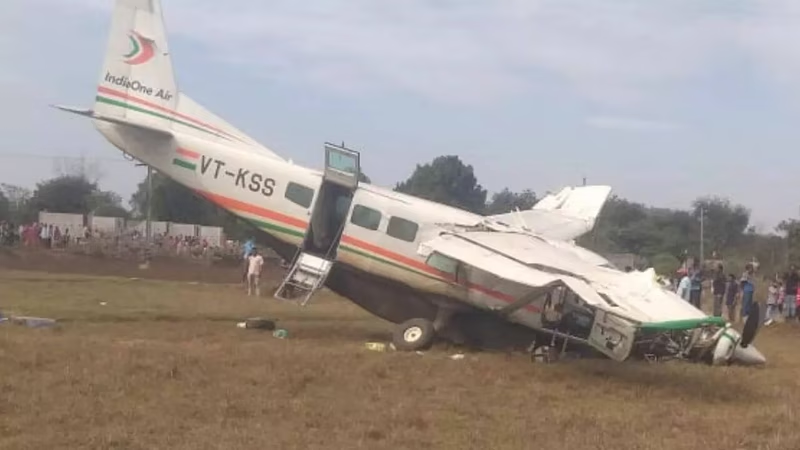
In a heart-stopping incident that unfolded on Saturday, January 10, 2026, the skies over Odisha’s industrial city of Rourkela turned tense as a small aircraft was forced to make an emergency landing following a sudden and severe technical malfunction. The event, now widely reported as the Rourkela aircraft crash, has sparked conversations about aviation safety, pilot training, and sheer human resilience in the face of disaster [[1], [4]].
Initial reports confirm the aircraft, en route from Bhubaneswar to Rourkela, developed a critical fault mid-flight. With no time to spare, the pilot executed a controlled belly landing—a maneuver that is as dangerous as it is impressive—on an open grassland approximately nine to ten kilometers from the Rourkela airstrip [[3], [4]].
Table of Contents
- The Incident Unfolds: A Timeline of Events
- What Is a Belly Landing? Understanding the Emergency Maneuver
- Inside the Rourkela Airstrip: Location and Capabilities
- Heroics or Protocol? The Pilot’s Critical Decision-Making
- Aftermath and Ongoing Investigation
- Conclusion: A Stark Reminder of Aviation’s Fragile Balance
- Sources
The Incident Unfolds: A Timeline of Events
The chartered aircraft, believed to be a nine-seater, was on its final approach to Rourkela when the technical snag occurred [[6], [10]]. Passengers on board reported a sudden change in the aircraft’s behavior, followed by the pilot’s calm but urgent announcement of an emergency.
Demonstrating remarkable presence of mind, the pilot scanned the terrain below and identified a suitable open area in the Jalda A Block of the Raghunathpali area, a crucial decision that likely saved everyone on board [[7], [8]]. The aircraft touched down without its landing gear deployed, skidding across the grassy field before coming to a halt.
While all passengers emerged with minor or no injuries, the pilot sustained serious injuries and was immediately rushed to a nearby hospital for urgent medical care [[5], [9]]. This stark contrast in outcomes highlights the immense physical and mental strain placed on the pilot during such a high-stakes emergency.
What Is a Belly Landing? Understanding the Emergency Maneuver
A belly landing, also known as a gear-up landing, is one of the most challenging emergency procedures a pilot can face. It occurs when an aircraft lands without its landing gear extended, forcing the fuselage—the plane’s “belly”—to make direct contact with the ground [[11], [14]].
This maneuver is typically a last resort, employed when the landing gear fails to deploy due to hydraulic issues, electrical failures, or other mechanical problems. The primary risks include:
- Structural Damage: The aircraft’s underside is not designed for impact, leading to potential fuel leaks, fire, or catastrophic structural failure.
- Loss of Control: Skidding on an uneven surface can cause the aircraft to veer off course or even flip.
- Passenger Safety: The violent nature of the landing can cause significant injury if not executed with extreme precision.
The fact that this belly landing near Rourkela resulted in only the pilot being seriously hurt is a testament to the skill involved .
Inside the Rourkela Airstrip: Location and Capabilities
The Rourkela Airport (IATA: RRK, ICAO: VERK) is a domestic airport located near Chhend Colony, roughly 6 kilometers west of the city center [[21], [22]]. Historically a private airstrip for the Rourkela Steel Plant, it has since been developed for commercial use, though its facilities remain basic [[23], [30]].
The airport is certified to handle smaller aircraft like the ATR-72, which aligns with the type of plane involved in this incident . Its single terminal can manage up to 100 passengers at a time, and amenities are limited to essentials like vehicle parking and a snack bar [[23], [24]].
The crash site being 9-10 km from the airstrip suggests the aircraft was either on its final approach or had just taken off, placing it in a critical phase of flight where options for an emergency landing are severely limited .
Heroics or Protocol? The Pilot’s Critical Decision-Making
Was the pilot’s action a moment of individual heroism, or simply the execution of rigorous training? The answer is likely both. Aviation protocols for engine or system failure are incredibly detailed. Pilots are trained to follow a strict sequence of actions: maintain control of the aircraft, identify the problem, attempt a restart if possible, and, most critically, select a safe landing site [[34], [35]].
In this case, the “technical snag” may have rendered the landing gear inoperable, leaving a belly landing as the only viable option. The pilot’s ability to remain calm, assess the terrain, and execute a controlled descent under extreme duress goes beyond mere protocol—it’s the embodiment of professional excellence .
This incident serves as a powerful reminder of the split-second decisions that can mean the difference between life and death in the air. For more on how pilots are trained for such scenarios, see our guide on [INTERNAL_LINK:aviation-emergency-procedures].
Aftermath and Ongoing Investigation
In the wake of the Rourkela aircraft crash, authorities from the Directorate General of Civil Aviation (DGCA) have launched a full investigation. Their primary focus will be to determine the exact nature of the “technical snag” that precipitated the emergency.
Investigators will meticulously examine the wreckage, analyze the aircraft’s black box data (if available), and interview the pilot and passengers once the pilot is stable enough to provide a statement. The goal is not just to understand what went wrong, but to prevent a similar incident in the future.
Local residents near the crash site in Raghunathpali have expressed their shock, while also praising the pilot’s quick thinking for preventing a far worse tragedy in a populated area .
Conclusion: A Stark Reminder of Aviation’s Fragile Balance
The emergency belly landing near the Rourkela airstrip is a dramatic event that underscores the complex interplay between advanced technology, rigorous human training, and unpredictable mechanical failure. While the passengers’ safety is a huge relief, the pilot’s injuries are a sobering cost of their heroic actions.
This Rourkela aircraft crash is not just a local news story; it’s a case study in aviation safety and the extraordinary skill of professional pilots. As the investigation continues, the aviation community and the public alike will be watching closely for answers that can make the skies even safer.
Sources
- Times of India: Small aircraft crashes near Odisha’s Rourkela airstrip
- Aviation Safety Network: General Aviation Safety Protocols
- Air Charter Service: Understanding Aircraft Emergencies