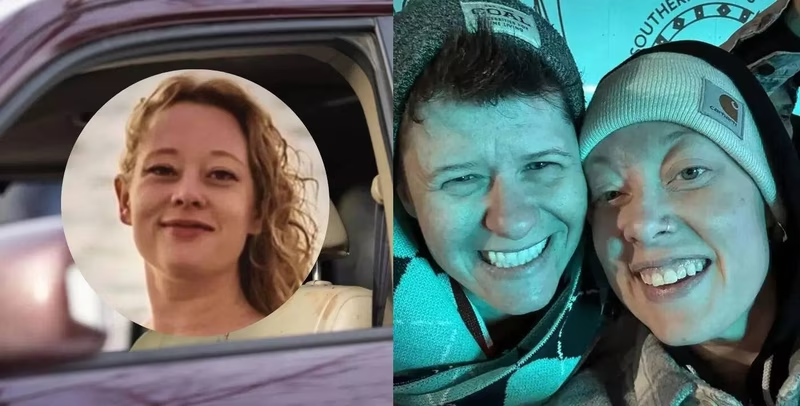
When tragedy strikes, the media has a choice: report with empathy or exploit for narrative. In the case of Renee Nicole Good—a Minneapolis mother who died following an encounter with federal immigration agents—that choice was made starkly clear. Instead of focusing on the circumstances of her death or the conduct of law enforcement, several prominent pro-Trump media outlets launched into a campaign that critics are now calling a textbook case of Renee Nicole Good vilification.
The backlash was swift and widespread. Social media users, journalists, and advocacy groups condemned the coverage as not just inaccurate, but deeply harmful—painting a grieving family’s loss as a political talking point while ignoring systemic questions about ICE operations. This isn’t just about one story; it’s about how marginalized victims are framed in America’s polarized media landscape .
Table of Contents
- Who Was Renee Nicole Good?
- The Incident and Initial Reports
- Renee Nicole Good Vilification by Conservative Media
- Public and Social Media Backlash
- The Danger of Dehumanizing Language in Media
- ICE Enforcement and Accountability Concerns
- Conclusion: A Call for Responsible Journalism
- Sources
Who Was Renee Nicole Good?
Renee Nicole Good was a 38-year-old Minneapolis resident, a loving mother, and a member of the LGBTQ+ community. Friends and family described her as kind, resilient, and deeply devoted to her children. She lived with her partner, whom some outlets crudely labeled a “lesbian partner” in headlines—an unnecessary and sensationalized detail that served no journalistic purpose other than to other her identity .
Her life, like many others navigating complex immigration and legal systems, was not defined by a single event. Yet in death, she became a pawn in a larger political battle—one she never signed up for.
The Incident and Initial Reports
According to local authorities and eyewitnesses, federal ICE agents arrived at Good’s residence for an enforcement action. During the operation, she experienced a medical emergency and was rushed to the hospital, where she later passed away. The exact sequence of events—and whether force or distress played a role—remains under scrutiny .
What should have followed was a sober inquiry into protocol, transparency, and accountability. Instead, certain media ecosystems chose a different path.
Renee Nicole Good Vilification by Conservative Media
Within hours of her death, outlets aligned with the pro-Trump media sphere began publishing stories that twisted facts and emphasized inflammatory labels. Headlines referred to her as an “ICE warrior” or highlighted her relationship status in ways that implied moral judgment. One outlet even suggested she “resisted” agents without providing evidence, framing her as a threat rather than a person in crisis .
This pattern fits a broader trend documented by media watchdogs: when victims of state violence belong to marginalized groups—especially women of color, immigrants, or LGBTQ+ individuals—they are often portrayed as “deserving” of scrutiny, their humanity stripped away to justify institutional actions .
Public and Social Media Backlash
The response was immediate. On X (formerly Twitter), hashtags like #JusticeForRenee and #StopVictimBlaming trended nationally. Users shared screenshots of the offensive headlines alongside messages condemning the dehumanization:
- “They couldn’t mourn her. They had to make her the villain.”
- “Why is her sexual orientation relevant to an ICE raid? Answer: it’s not. It’s just dog-whistling.”
- “If this were a white suburban mom, the tone would be completely different.”
Even mainstream journalists and former editors weighed in, calling the coverage a “failure of basic journalistic ethics” and a “textbook example of othering” .
The Danger of Dehumanizing Language in Media
Language matters. Describing someone as a “lesbian partner” in a crime or enforcement context—when it has no bearing on the event—activates unconscious biases. It signals to readers that the person is “different,” less relatable, and perhaps less worthy of sympathy.
Studies from institutions like the Nieman Foundation at Harvard show that such framing directly influences public perception and policy support. When victims are vilified, calls for reform lose urgency. Accountability fades. And cycles of harm continue.
ICE Enforcement and Accountability Concerns
Beyond the media firestorm lies a deeper issue: the lack of transparency in ICE operations. Unlike local police departments, ICE is not consistently required to release bodycam footage, incident reports, or use-of-force data. This opacity makes it nearly impossible for families—or the public—to get answers after incidents like Good’s death .
Advocacy groups like the American Civil Liberties Union (ACLU) have long called for greater oversight of immigration enforcement, citing patterns of excessive force and inadequate medical response. The Renee Nicole Good vilification episode distracts from these critical systemic questions—but it also underscores why they matter more than ever.
Conclusion: A Call for Responsible Journalism
The story of Renee Nicole Good should be about a life lost too soon, a family shattered, and the need for humane, transparent immigration enforcement. Instead, it became a cautionary tale about how media narratives can weaponize identity and silence grief.
As consumers of news, we must demand better. As publishers, we must uphold standards that center truth, dignity, and justice—not political convenience. The backlash over the Renee Nicole Good vilification isn’t just anger—it’s a collective insistence that every life deserves to be remembered with respect. For more on ethical reporting in crisis situations, see our guide on [INTERNAL_LINK:responsible-journalism-standards].