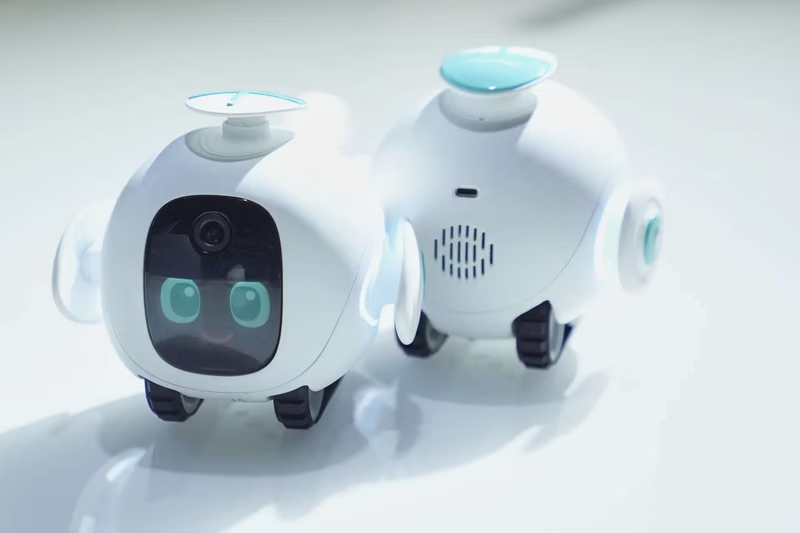
The bright lights of Las Vegas at CES 2026 weren’t just illuminating the latest TVs and smartphones—they were shining a harsh spotlight on a new global tech battleground. And on this battlefield, one nation is charging ahead with astonishing speed: China. The evidence was everywhere you looked: sleek, agile, and surprisingly affordable humanoid robots, most of them proudly bearing a “Made in China” badge.
This overwhelming presence wasn’t just a showcase of innovation; it was a stark validation of a long-held fear expressed by none other than Elon Musk. His warning about China’s potential to dominate the critical field of artificial general intelligence (AGI) and its physical embodiment—humanoid robots—was on full, undeniable display. The phrase Chinese robots dominate CES isn’t hyperbole; it’s the new reality of the tech world .
Table of Contents
- Elon Musk’s China Worry, Realized at CES
- The Numbers Don’t Lie: China’s Humanoid Robot Supremacy
- Who’s Leading the Chinese Charge? Key Players at CES
- The US Cost Challenge and Strategic Gap
- What This Means for the Future of Robotics
- Conclusion: A New Tech Cold War?
- Sources
Elon Musk’s China Worry, Realized at CES
For years, Elon Musk has been vocal about his concerns that China could outpace the United States in the development of foundational AI technologies. He’s argued that the physical manifestation of this AI—the humanoid robot—will be the ultimate test of a nation’s technological prowess. At CES 2026, his prediction came to life in the most tangible way possible.
While American companies like Tesla are still working towards mass production of their Optimus robot, Chinese firms didn’t just bring concepts—they brought commercially viable products ready for deployment . The scale of their presence was staggering, turning the show floor into a de facto Chinese robotics expo.
The Numbers Don’t Lie: China’s Humanoid Robot Supremacy
The dominance wasn’t just visual; it was backed by hard data. Of the 38 companies exhibiting humanoid robots at CES 2026, a remarkable 21 were from China . This isn’t a fluke. It’s the result of a concerted national strategy and a thriving ecosystem of startups and manufacturers.
The story gets even more compelling when you look at global shipments. In 2025 alone, Chinese firms accounted for the vast majority of the roughly 13,000 humanoid robots shipped worldwide, far outstripping their US rivals . One company, Shanghai-based AgiBot, shipped over 5,100 units by itself, capturing a massive 39% of the global market share . These aren’t just prototypes; they are products rolling off assembly lines at a pace the US can’t yet match.
Who’s Leading the Chinese Charge? Key Players at CES
The Chinese delegation at CES was a who’s who of the burgeoning robotics industry. Companies that were relatively unknown outside of Asia just a year ago are now global contenders:
- Unitree Robotics: Known for its incredibly agile and dynamic robots, Unitree drew massive crowds with its lifelike mobility demonstrations [[7], [13]].
- AgiBot: The market leader in shipments, AgiBot showcased its practical, work-ready humanoid designed for logistics and manufacturing .
- EngineAI: Focused on the AI brain behind the robot, EngineAI demonstrated advanced interaction and learning capabilities .
- Other Notable Names: Limx Dynamics, MagicLab, Daimon Robotics, and GALAXEA AI all made significant impressions, highlighting the depth and diversity of China’s robotics talent pool .
The US Cost Challenge and Strategic Gap
So, what’s holding the US back? The primary hurdle appears to be cost and a different strategic focus. While Chinese startups are leveraging their country’s unparalleled manufacturing infrastructure to produce robots at a fraction of the projected cost of an American-made counterpart, US companies are often still in the R&D phase.
Elon Musk’s own Tesla Optimus is a prime example. Despite its promise, it remains a work in progress, with mass production and a competitive price point still on the horizon. Meanwhile, Chinese firms are already selling their robots for tasks in warehouses, factories, and even customer service, creating a real-world feedback loop that accelerates their development—a classic first-mover advantage .
This isn’t just about economics; it’s about a fundamental difference in approach. The Chinese strategy seems to be “build, deploy, and iterate,” while the US often leans towards “perfect in the lab before release.” In a fast-moving market, the former can be a decisive advantage.
What This Means for the Future of Robotics
The implications of this shift are profound. The nation that leads in humanoid robotics won’t just control a lucrative market; it will set the standards for human-robot interaction, workplace safety, and the ethical frameworks that govern these powerful machines. It will also have a significant edge in the broader AI race, as real-world data from millions of deployed robots becomes the ultimate training ground for more advanced AI systems.
For businesses and consumers, this competition could be a good thing, driving down prices and accelerating innovation. However, for national security and economic leadership, the current trajectory is a clear warning sign for the United States. For more on the global AI landscape, see our deep dive on [INTERNAL_LINK:global-ai-race].
Conclusion: A New Tech Cold War?
The sight of so many advanced Chinese robots dominate CES is more than a headline; it’s a geopolitical signal. Elon Musk’s worry has moved from the realm of speculation to observable fact. China has not only entered the humanoid robot race but has taken a commanding lead in production, deployment, and market penetration.
The US now faces a critical choice: double down on its investments, streamline its path from lab to market, and find ways to compete on cost, or risk ceding leadership in one of the most transformative technologies of the 21st century. The robots have spoken at CES, and their message is clear.
Sources
- Times of India: One of Elon Musk’s biggest worry about China was on full display at America’s top tech show
- South China Morning Post: Chinese humanoid robot firms make up half of exhibitors at CES 2026
- Bloomberg: China’s Humanoid Bots Were Everywhere at America’s Top Tech Show
- International Data Corporation (IDC): Worldwide Humanoid Robotics Tracker, 2025