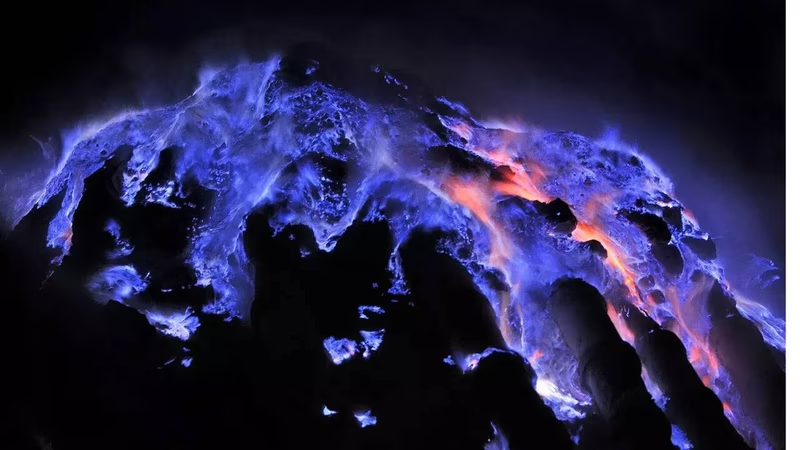
Imagine a volcano that doesn’t spew red lava—but instead burns with an eerie, electric blue flame that looks like it’s straight out of a sci-fi movie. This isn’t fantasy. It’s real. And it happens at one of Earth’s most extraordinary—and dangerous—natural sites: the Kawah Ijen volcano in East Java, Indonesia.
But here’s the twist: those mesmerizing blue flames aren’t lava at all. In fact, they’re the result of something even more volatile: burning sulfuric gases escaping from deep within the Earth. This rare phenomenon has turned Kawah Ijen into a bucket-list destination for photographers and adventurers—but for the local miners who work there daily, it’s a life-threatening reality they face for just a few dollars a day.
Table of Contents
- What Makes Kawah Ijen Glow Blue?
- The Science Behind the Blue Fire
- Life and Danger for Sulfur Miners
- Why Scientists Are Fascinated by Kawah Ijen
- Visiting Kawah Ijen Responsibly
What Makes Kawah Ijen Glow Blue?
The iconic blue glow of the Kawah Ijen volcano occurs only at night and only under specific conditions. During the day, the crater appears as a stunning turquoise lake—the largest acidic crater lake in the world, with a pH as low as 0.5 . But when darkness falls, something magical—and deadly—happens.
High-pressure volcanic gases, rich in sulfur dioxide (SO₂), escape through cracks in the volcano’s surface. When these gases reach temperatures above 600°C (1,112°F) and come into contact with oxygen in the air, they ignite spontaneously. The combustion of sulfur produces a brilliant blue flame that can shoot several meters into the air [[1], [4]].
Crucially, this is **not** molten rock. True lava typically glows red or orange due to its temperature (700–1,200°C). The blue color is a signature of sulfur combustion—a chemical reaction, not a thermal emission from magma.
The Science Behind the Blue Fire
The phenomenon at Kawah Ijen is a textbook example of chemiluminescence—light produced by a chemical reaction rather than heat. Here’s how it works:
- Gas Emission: Sulfur-rich gases are released from fumaroles (volcanic vents) under extreme pressure and heat.
- Ignition: Upon exposure to atmospheric oxygen, the sulfur vapor ignites, creating blue flames.
- Condensation: As the gas cools, it condenses into liquid sulfur, which then solidifies into bright yellow deposits near the vents.
This process is so intense that it creates rivers of molten sulfur that flow like lava before hardening—adding to the illusion. The U.S. Geological Survey (USGS) notes that while other volcanoes emit sulfur, few produce such dramatic, visible combustion due to the unique combination of gas concentration, temperature, and vent geometry at Kawah Ijen .
Life and Danger for Sulfur Miners
Beneath the tourist allure lies a harsh human story. Every day, hundreds of local miners—known as penambang—descend into the crater to extract raw sulfur. They carry loads of up to 90 kilograms (200 lbs) on their shoulders, making two trips a day for less than $10 total pay .
They work without proper protective gear, breathing air laced with toxic sulfur dioxide and hydrogen sulfide—gases that can cause respiratory damage, eye irritation, and even death with prolonged exposure. Many suffer from chronic bronchitis and dental erosion due to the acidic environment .
Yet, for these men, it’s the only livelihood available. Their resilience in the face of such danger adds a profound layer of humanity to the geological spectacle. Photographers may capture the blue fire, but it’s the miners’ headlamps weaving through the smoke that tell the real story of Kawah Ijen.
Why Scientists Are Fascinated by Kawah Ijen
Beyond its visual drama, the Kawah Ijen volcano is a natural laboratory for volcanologists and geochemists. Its hyper-acidic lake and high gas flux provide critical insights into:
- Volcanic monitoring: Changes in gas composition can signal impending eruptions.
- Acid mine drainage analogs: Helps scientists understand environmental impacts of industrial mining.
- Extremophile ecosystems: Microorganisms that survive in the lake offer clues about life in extreme environments—relevant to astrobiology .
Researchers from institutions like the Smithsonian’s Global Volcanism Program actively study Kawah Ijen to better predict volcanic hazards and understand Earth’s geochemical cycles [INTERNAL_LINK:volcanic-monitoring-technologies].
Visiting Kawah Ijen Responsibly
Tourism has boomed at Kawah Ijen, with thousands hiking the 3-km trail to the crater rim before dawn to witness the blue flames. While this brings economic benefits, it also raises concerns about environmental degradation and the ethics of “disaster tourism.”
If you plan to visit:
- Wear a proper gas mask (not just a scarf)—sulfur fumes are no joke.
- Hire a local guide; it supports the community and ensures safety.
- Respect the miners—ask permission before taking photos.
- Carry out all trash; the ecosystem is fragile.
Remember: you’re not just visiting a natural wonder—you’re entering a workplace and a sacred landscape for many Javanese people.
Conclusion
The Kawah Ijen volcano is a place where science, danger, beauty, and human struggle converge. Its electric blue flames are a stunning reminder of Earth’s raw power—but they’re also a warning. This phenomenon isn’t magic; it’s chemistry in its most volatile form. By understanding the truth behind the blue fire, we gain not only scientific knowledge but also a deeper respect for the people who live and work in its shadow.
Sources
- Times of India: Why this volcano glows electric blue instead of red lava
- National Geographic & BBC Reports on Kawah Ijen sulfur miners
- Smithsonian Institution – Global Volcanism Program: Kawah Ijen Volcano Profile
- Scientific studies on volcanic sulfur combustion and acid crater lakes [[1], [3], [4]]