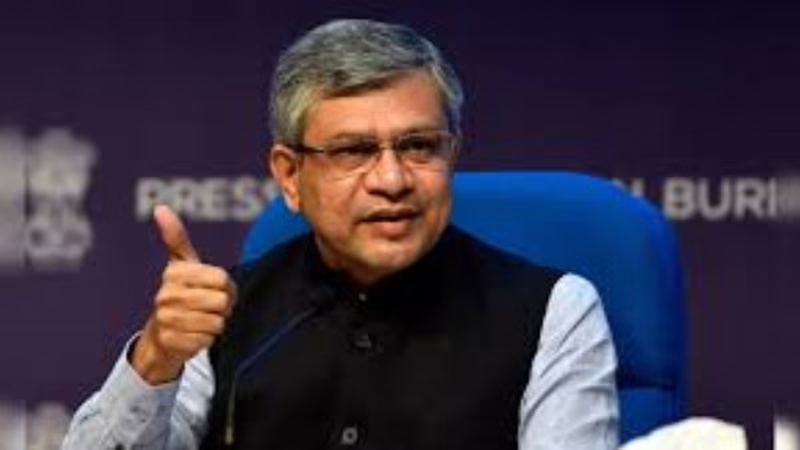
For decades, the sharp silhouette of the bandhgala coat—elegant, structured, and steeped in history—was synonymous with authority in India. Worn by railway officers, diplomats, and even prime ministers, it projected gravitas. But now, that era is officially over.
In a landmark decision aligned with a nationwide cultural reset, the Ministry of Railways has discontinued the mandatory use of bandhgala coats for its officials, citing their origins in colonial-era dress codes. This move isn’t just about fashion—it’s a deliberate act of reclaiming national identity, stripping away sartorial symbols of subjugation and replacing them with attire that reflects modern, independent India.
As the government accelerates its “Atmanirbhar” (self-reliant) vision across sectors, even the threads on officials’ backs are being reimagined. But what does this change really mean—and why now?
Table of Contents
- The End of an Era: Why Bandhgala Was Scrapped
- Colonial-Era Dress Codes: A Brief History
- What Will Railway Officials Wear Now?
- Broader Government Drive to Decolonize Indian Institutions
- Public and Expert Reactions: Mixed Emotions
- Global Trends: Shedding Colonial Symbols
- Conclusion: More Than Just a Uniform Change
- Sources
The End of an Era: Why Bandhgala Was Scrapped
The bandhgala—a high-necked, buttoned formal coat—traces its roots to 19th-century British India. Originally adapted from the Jodhpuri suit worn by Rajput royalty, it was later co-opted and standardized by the colonial administration as part of “respectable” native attire for elite Indians working under the Raj .
Post-independence, India retained many such symbols, often out of habit or perceived prestige. But in recent years, the government has launched a quiet yet determined campaign to identify and phase out practices rooted in colonial subservience—including language, architecture, and yes, colonial-era dress codes.
Railways, as one of India’s largest and most visible public institutions, became a natural starting point. The move signals that national pride now trumps inherited tradition.
Colonial-Era Dress Codes: A Brief History
Under British rule, dress was a tool of hierarchy:
- European officials wore full military or civil service regalia.
- Indian elites were encouraged to adopt “anglicized” versions of native wear—like the bandhgala—to appear “civilized” yet distinct.
- Lower-ranking staff were given standardized uniforms that erased regional identity.
Even after 1947, these norms persisted. The bandhgala became a staple at Republic Day parades, diplomatic functions, and official portraits—not because it was authentically Indian, but because it had been institutionalized as “formal Indian wear” by colonial design.
What Will Railway Officials Wear Now?
The Railways hasn’t mandated a single replacement but has granted flexibility. Officers may now opt for:
- Nehru jackets (a post-independence symbol championed by PM Jawaharlal Nehru).
- Kurta-pyjamas with waistcoats in neutral tones.
- Indigenous formal wear reflecting regional heritage (e.g., Pathani suits, Mysore silk kurtas).
This shift empowers individual expression while promoting handloom and local textile industries—aligning with the “Vocal for Local” initiative. [INTERNAL_LINK:indian-handloom-revival-movement] could see a major boost from such policy changes.
Broader Government Drive to Decolonize Indian Institutions
The bandhgala ban is just one thread in a larger tapestry of decolonization:
- Renaming cities and roads (e.g., Bombay → Mumbai, Dalhousie Road → Dr. Zakir Hussain Marg).
- Replacing British-era statues with national icons like Netaji Subhas Chandra Bose.
- Revising school curricula to highlight pre-colonial Indian achievements in science, math, and governance.
According to a 2025 Ministry of Culture directive, all central ministries must audit and eliminate “symbols of colonial subservience” by 2027 . Railways is among the first to act decisively.
Public and Expert Reactions: Mixed Emotions
Reactions have been polarized:
- Supporters hail it as “long overdue,” calling the bandhgala a “costume of mental slavery.”
- Critics argue it’s “symbolic politics” that distracts from real issues like rail safety or punctuality.
- Fashion historians note the irony: the bandhgala itself evolved from Indian royalty—so is discarding it truly “decolonizing”?
Designer Ritu Kumar commented, “We must distinguish between colonial imposition and Indian adaptation. The bandhgala, as worn today, is ours—but its mandatory use in state functions was indeed a relic.”
Global Trends: Shedding Colonial Symbols
India isn’t alone. Around the world, nations are reevaluating inherited symbols:
- Canada and Australia have removed royal insignia from police badges.
- Barbados abolished the monarchy and became a republic in 2021.
- South Africa redesigned its military uniforms to reflect African heritage post-apartheid.
As noted by UNESCO, “Decolonizing public space—including attire—is essential for psychological liberation and cultural sovereignty” .
Conclusion: More Than Just a Uniform Change
The discontinuation of the bandhgala coat by Indian Railways is far more than a wardrobe update. It’s a conscious rejection of colonial-era dress codes that quietly reinforced hierarchies long after independence. While some may dismiss it as performative, the deeper message is clear: India is actively rewriting its visual and cultural narrative. In doing so, it invites every citizen to ask—what other invisible chains from the past are we still wearing?