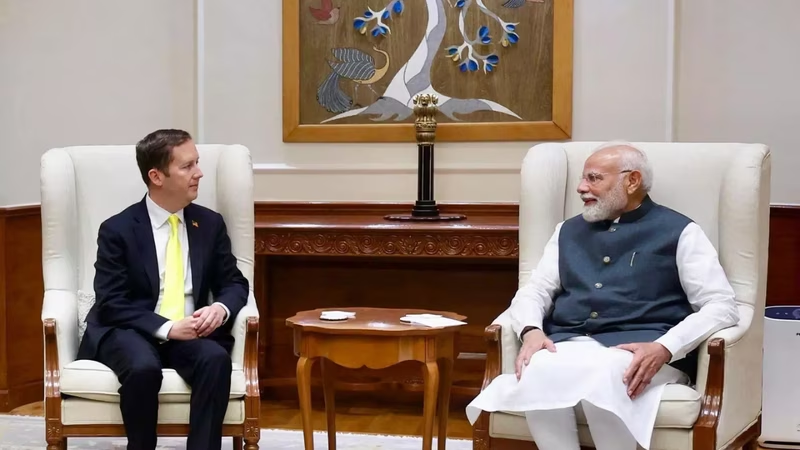
In a move loaded with both symbolism and substance, U.S. ambassador-designate Sergio Gor has landed in India at a pivotal moment in bilateral relations. His arrival—marking the start of what’s expected to be a high-stakes diplomatic tenure—comes just as Washington and New Delhi navigate growing friction over trade tariffs, market access, and digital taxation . Yet, rather than framing the visit through conflict, Gor struck an optimistic chord, describing India as a nation brimming with “incredible opportunities” for American businesses and strategic collaboration.
But can optimism alone bridge the widening gaps? With U.S. tariffs on Indian steel and aluminum still in place—and India’s proposed equalization levy on foreign tech firms drawing sharp criticism from Silicon Valley—the Sergio Gor India visit is less a ceremonial handover and more a critical test of whether the world’s oldest and largest democracies can align their economic visions without compromising sovereignty.
Table of Contents
- Who Is Sergio Gor? The New U.S. Face in India
- Timing of the Visit: Tariff Tensions and Trade Barriers
- Key Agenda Items for Sergio Gor India Visit
- The Broader Strategic Partnership: Beyond Trade
- Challenges Ahead: Domestic Politics on Both Sides
- What Success Looks Like for Gor’s Mission
- Conclusion: A Delicate Balancing Act
- Sources
Who Is Sergio Gor? The New U.S. Face in India
A seasoned diplomat with over two decades of experience in South Asia and trade policy, Sergio Gor is no stranger to complex negotiations. Previously serving as Deputy Assistant Secretary of State for South and Central Asian Affairs, he played a key role in shaping the Biden administration’s Indo-Pacific strategy .
His nomination as ambassador—a position vacant since Eric Garcetti’s departure in late 2024—signals Washington’s intent to deepen engagement with New Delhi, especially as China’s influence grows across the region. Fluent in Hindi and well-versed in India’s political landscape, Gor is seen as a pragmatic consensus-builder, not an ideologue.
Timing of the Visit: Tariff Tensions and Trade Barriers
Gor’s arrival couldn’t be more timely—or tense. Key irritants include:
- U.S. Section 232 Tariffs: 25% duty on Indian steel and 10% on aluminum, imposed in 2018 and never fully lifted, despite India’s removal from the Generalized System of Preferences (GSP) list.
- India’s Digital Services Tax: A proposed 2% equalization levy on foreign e-commerce operators like Amazon and Google, which the U.S. argues discriminates against American firms.
- Pharmaceutical Regulations: Stringent data exclusivity and patent laws that U.S. pharma giants claim stifle innovation.
These issues have stalled progress on a long-pending Bilateral Trade Agreement (BTA). While both nations tout $191 billion in annual trade , the relationship remains unbalanced—with India running a $40 billion surplus, fueling protectionist sentiment in Washington.
Key Agenda Items for Sergio Gor India Visit
During his week-long trip, Gor is expected to engage with senior officials from the Ministry of External Affairs, Commerce, and Finance. His core objectives include:
- De-escalating Trade Friction: Pushing for mutual tariff reductions and a framework to resolve digital tax disputes.
- Advancing iCET: Accelerating the U.S.-India Initiative on Critical and Emerging Technology, particularly in semiconductors, AI, and quantum computing.
- Defense Industrial Cooperation: Finalizing co-production deals for jet engines and drones under the Defense Technology and Trade Initiative (DTTI).
- People-to-People Ties: Addressing visa backlogs for Indian students and professionals—a major concern for the diaspora.
Notably, Gor will also meet representatives from U.S. chambers of commerce and Indian industry bodies like CII and FICCI to gauge private-sector sentiment.
The Broader Strategic Partnership: Beyond Trade
While economics dominate headlines, the U.S.-India alliance is increasingly defined by geopolitics. Both nations are key members of the Quad (with Japan and Australia), sharing concerns over China’s assertiveness in the Indo-Pacific.
Gor’s visit reinforces this alignment. Expect discussions on joint naval exercises, supply chain resilience, and clean energy partnerships—areas where cooperation has flourished even as trade talks stall. As the U.S. State Department notes, “Our partnership with India is one of the most consequential of the 21st century” [[EXTERNAL_LINK:https://www.state.gov/countries-areas/india/]].
Challenges Ahead: Domestic Politics on Both Sides
Gor’s mission won’t be easy. In the U.S., election-year politics could harden positions on outsourcing and trade deficits. In India, upcoming state elections may amplify nationalist rhetoric against “foreign interference” in economic policy.
Moreover, bureaucratic inertia in both capitals often slows implementation. Past agreements—like the 2019 Basic Exchange and Cooperation Agreement (BECA)—took years to operationalize. Gor will need to build trust not just with ministers, but with mid-level officials who control day-to-day execution.
What Success Looks Like for Gor’s Mission
Realistic wins in the short term could include:
- A joint statement committing to suspend new tariffs for 6 months.
- An MoU on semiconductor supply chain collaboration.
- Streamlined visa processing for STEM PhDs from India.
Longer-term, Gor’s legacy will be measured by whether he can transform the relationship from transactional to transformational—moving beyond crisis management to co-creating global norms in tech, climate, and security.
Conclusion: A Delicate Balancing Act
The Sergio Gor India visit arrives at a crossroads. On one path lies deeper integration—economic, technological, and strategic. On the other, escalating protectionism and mutual suspicion. Gor’s blend of experience, cultural fluency, and policy pragmatism makes him uniquely suited to steer the partnership forward. But even the best diplomats can’t override political headwinds. All eyes will be on whether “incredible opportunities” translate into concrete outcomes—or remain just another diplomatic phrase.
Sources
- Times of India. “‘Incredible opportunities’: US ambassador-designate Sergio Gor arrives in India.” https://timesofindia.indiatimes.com/…/articleshow/126443063.cms
- U.S. Department of State. “Biography: Sergio Gor, Nominee for Ambassador to India.” November 2025.
- Ministry of Commerce and Industry, Government of India. “India-U.S. Trade Statistics 2025.”
- U.S. State Department – India Country Page. https://www.state.gov/countries-areas/india/