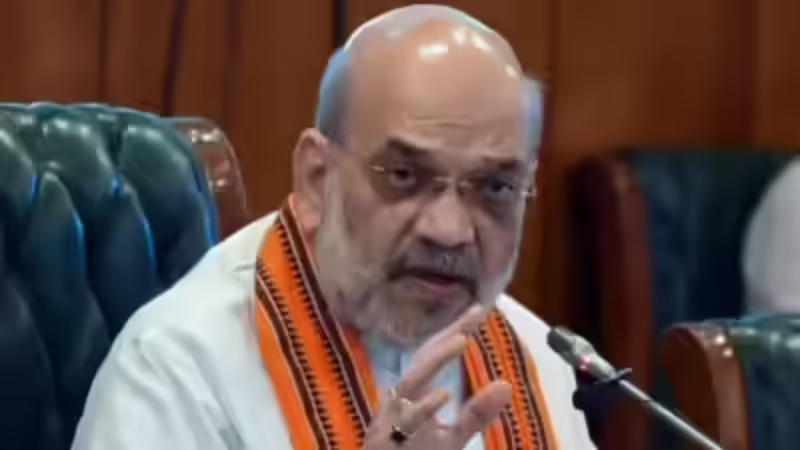
“This is not just crime—it is narco-terrorism.” With these stark words, Union Home Minister Amit Shah has reframed one of India’s most persistent social crises as a direct assault on the nation’s sovereignty and internal security . Speaking at a high-level review meeting on drug trafficking, Shah accused hostile external actors of using narcotics as a weapon to destabilize Indian society—particularly targeting youth in border states like Punjab, Rajasthan, and Manipur.
This isn’t mere rhetoric. By elevating the drug trade from a criminal justice matter to a national security threat, the government is signaling a dramatic escalation in its response—one that could reshape policing, intelligence operations, and even foreign policy. But what exactly does “narco-terrorism” mean in the Indian context? And how will this new doctrine translate into action?
Table of Contents
- What Is Narco-Terrorism?
- Why Amit Shah Called India’s Drug Problem ‘Narco-Terrorism’
- Narco-Terrorism India: The Evidence Behind the Claim
- Current Hotspots: Punjab, Manipur, and Beyond
- Government Response: New Strategy and Tools
- Global Precedents and India’s Unique Challenge
- Criticism and Concerns
- Conclusion: A Paradigm Shift in Combating Drugs
- Sources
What Is Narco-Terrorism?
Narco-terrorism refers to the use of drug trafficking to finance, support, or directly carry out terrorist activities. It also includes state-sponsored or proxy networks that flood a rival nation with narcotics to weaken its social fabric, drain its economy, and corrupt its institutions.
Globally, the term gained prominence during the U.S.-led wars in Afghanistan and Colombia, where militant groups like the Taliban and FARC used opium and cocaine revenues to fund insurgency. Now, Shah argues, India faces a similar hybrid threat—one where cartels, terror outfits, and adversarial intelligence agencies operate in concert.
Why Amit Shah Called India’s Drug Problem ‘Narco-Terrorism’
Shah’s declaration stems from mounting intelligence reports linking cross-border drug smuggling to funding for separatist and extremist groups in India’s northeast and Jammu & Kashmir. According to the Narcotics Control Bureau (NCB), over 80% of seized heroin and synthetic drugs like methamphetamine originate from the Golden Crescent (Afghanistan-Pakistan-Iran) and enter India via porous borders .
Crucially, investigators have found financial trails connecting drug profits to arms purchases and propaganda campaigns by banned outfits. “When drugs destroy our youth and the money fuels terror, it becomes an act of war,” Shah stated—a sentiment echoed by top officials from the NCB, BSF, and RAW .
Narco-Terrorism India: The Evidence Behind the Claim
Recent operations lend credence to this theory:
- In 2025, the NCB uncovered a network in Punjab where Pakistani handlers used encrypted apps to coordinate drone drops of heroin, with proceeds routed to Hurriyat-linked accounts.
- A 2024 seizure of 3,000 kg of ephedrine (a meth precursor) in Gujarat was traced to a shell company with ties to a designated terrorist financier.
- Manipur’s hill districts have seen a surge in both drug abuse and ethnic militia activity, with local gangs acting as distribution arms for transnational syndicates.
These aren’t isolated incidents—they form a pattern of convergence between organized crime and subversion.
Current Hotspots: Punjab, Manipur, and Beyond
While drugs are a nationwide issue, three regions bear the brunt:
- Punjab: Long considered the epicenter, with over 23 lakh estimated users. Border drones and riverine smuggling remain key challenges.
- Manipur: Synthetic drug labs have proliferated, often protected by armed groups exploiting ethnic tensions.
- Rajasthan-Gujarat Border: Emerging as a major transit corridor for Afghan heroin heading to metros like Mumbai and Delhi.
The human cost is staggering. According to the Ministry of Social Justice, drug-related deaths in Punjab alone rose by 40% between 2020 and 2025 .
Government Response: New Strategy and Tools
In response, the Centre is rolling out a multi-pronged strategy:
- Integrated Anti-Narcotics Grid: Real-time data sharing between NCB, state police, BSF, and DRI.
- Drone Surveillance & Jamming: Deployment of anti-drone systems along the Pakistan border.
- Financial Intelligence Units: Tracking suspicious transactions under PMLA to dismantle funding chains.
- Rehab Over Jail: Emphasis on de-addiction centers for users, while targeting kingpins with NDPS Act’s stringent provisions.
For deeper insights into India’s evolving counter-narcotics framework, see our explainer on [INTERNAL_LINK:india-drug-policy-reforms].
Global Precedents and India’s Unique Challenge
India’s approach mirrors global best practices. The U.S. State Department explicitly defines narco-terrorism and sanctions entities involved [[EXTERNAL_LINK:https://www.state.gov/narcotics/]]. Similarly, the UN Office on Drugs and Crime (UNODC) warns that “illicit drugs and terrorism are mutually reinforcing threats” .
Yet India’s challenge is distinct: it faces not just non-state actors, but potential state-enabled trafficking from neighbors unwilling to curb production. This geopolitical dimension makes enforcement far more complex than in purely domestic contexts.
Criticism and Concerns
Not everyone agrees with the “narco-terrorism” label. Civil society groups warn it could lead to:
- Over-militarization of public health issues
- Stigmatization of addicts as security threats
- Erosion of federal balance, as the Centre assumes greater control over state policing
Experts urge a balanced approach—combining security measures with robust rehabilitation and crop-substitution programs for farmers in poppy-growing regions.
Conclusion: A Paradigm Shift in Combating Drugs
Amit Shah’s declaration of narco-terrorism India as a national security emergency marks a definitive break from treating drugs as a mere social evil or petty crime. It acknowledges the sophisticated, transnational machinery behind the trade—and demands an equally sophisticated response. Whether this leads to lasting change or becomes another slogan depends on execution, inter-agency coordination, and, most importantly, compassion for the millions caught in addiction’s grip.
Sources
- Times of India. “Drugs problem is narco-terrorism, not a mere issue of crime: Shah.” https://timesofindia.indiatimes.com/…/articleshow/126443544.cms
- Narcotics Control Bureau (NCB). Annual Report 2024–25.
- Ministry of Social Justice & Empowerment. “Magnitude of Substance Use in India 2025.”
- United Nations Office on Drugs and Crime (UNODC). “World Drug Report 2025.” https://www.unodc.org/
- U.S. Department of State. “International Narcotics Control Strategy Report.” https://www.state.gov/narcotics/