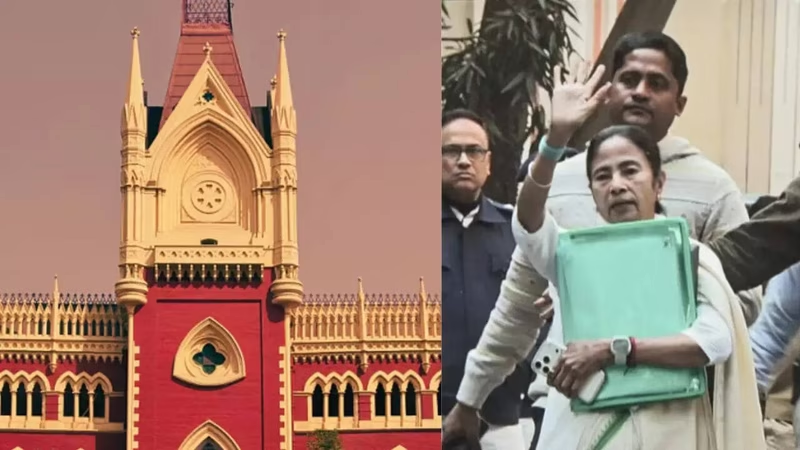
In a stunning display of courtroom disorder that has sent shockwaves through India’s legal and political corridors, the Calcutta High Court chaos reached a boiling point on Friday, January 10, 2026. The hearing, which was meant to address the Enforcement Directorate’s (ED) plea regarding alleged interference by West Bengal Chief Minister Mamata Banerjee during raids on her party’s consultancy firm, I-PAC, was abruptly adjourned. Justice Suvra Ghosh, visibly exasperated by the “enormous disturbance and commotion,” declared the courtroom environment “not conducive” for a hearing and walked out, rescheduling the matter for January 14 .
This wasn’t just a minor disruption; it was a full-blown breakdown of courtroom decorum, pitting lawyers, apprentices, and political supporters against the very institution of justice itself. The incident raises serious questions about the rule of law in high-stakes political cases and the ability of the judiciary to function under intense pressure.
Table of Contents
- The Day the Courtroom Lost Control
- Decoding the “Calcutta High Court Chaos”
- The Core of the Controversy: ED vs. Mamata over I-PAC
- Why This Hearing Mattered So Much
- Reactions and Fallout from the Judicial Meltdown
- What Happens Next on January 14?
- Conclusion
- Sources
The Day the Courtroom Lost Control
The scene inside the courtroom was described as pandemonium. A massive crowd of lawyers, law students, and political activists had gathered, creating what was officially termed an “unmanageable crowd” . Repeated pleas from the bench for order were completely ignored. The shouting match between opposing counsel became so loud and aggressive that it drowned out any possibility of a coherent legal argument .
Faced with this complete lack of decorum, Justice Ghosh had no choice but to suspend proceedings. His statement that the “environment in the court room is not conducive to commence/continue with the hearing” is a rare and damning indictment of the situation . This isn’t just about a delayed hearing; it’s a direct challenge to the authority of the court itself.
Decoding the “Calcutta High Court Chaos”
The Calcutta High Court chaos didn’t happen in a vacuum. It is the culmination of weeks of escalating tension between the Trinamool Congress (TMC) government and the central agency. The root cause lies in the ED’s raids on the Indian People’s Action Council (I-PAC), a consultancy firm linked to the TMC.
The ED has alleged that Chief Minister Mamata Banerjee personally intervened to obstruct their investigation, a claim the TMC has vehemently denied, calling it a politically motivated witch hunt . This high-voltage political backdrop turned a routine legal hearing into a battleground, with supporters on both sides determined to make their presence felt, regardless of judicial protocol.
The Core of the Controversy: ED vs. Mamata over I-PAC
At the heart of this legal storm is the I-PAC. The ED’s investigation is focused on potential money laundering activities connected to this entity. Their core allegation is that during the raids, Mamata Banerjee arrived at the scene and actively hindered their work, which could constitute a criminal offense .
The ED has formally sought the registration of an FIR against the Chief Minister for this alleged obstruction. The TMC, on the other hand, argues that the CM was merely performing her duty to ensure the raids were conducted within the bounds of the law and without harassment. This fundamental clash of narratives is what has fueled the intense emotions spilling into the courtroom.
Why This Hearing Mattered So Much
This wasn’t just another date on the court calendar. The outcome of this hearing could have set a critical precedent:
- For the ED: A favorable ruling would have legitimized their request for an FIR, significantly escalating the legal pressure on the Chief Minister.
- For the TMC: A dismissal of the ED’s plea would have been a major political victory, framing the entire investigation as baseless.
- For the Judiciary: The court’s ability to manage this hearing was a test of its independence and its power to hold even the most powerful figures accountable.
The fact that the hearing couldn’t even begin due to the Calcutta High Court chaos is a setback for all parties and, more importantly, for the public’s faith in the judicial process.
Reactions and Fallout from the Judicial Meltdown
The immediate fallout has been a war of words. The TMC has blamed the ED for creating a volatile atmosphere, while the central government and its allies have pointed fingers at the TMC for allegedly inciting its supporters to disrupt the court . Legal experts across the country have expressed deep concern, calling the incident a “grave assault on judicial dignity.”
For the average citizen, this spectacle is deeply troubling. It suggests that in politically charged cases, the courtroom can become just another extension of the political arena, where legal arguments are drowned out by noise and numbers. This perception is incredibly damaging to the long-term health of India’s democracy. As noted by legal scholars at the National Law School of India University, such incidents erode the foundational principle that everyone, regardless of position, is equal before the law.
What Happens Next on January 14?
All eyes are now on the rescheduled hearing on January 14. The Calcutta High Court will undoubtedly implement much stricter security measures to prevent a repeat of the chaos. There are also reports that the ED has requested the case be heard by a different bench, given the extraordinary circumstances .
The central question remains: can the court now conduct a fair and impartial hearing on the substantive legal issues, or will the shadow of the previous day’s chaos continue to loom large? The answer will have far-reaching implications not just for Mamata Banerjee and the ED, but for the very idea of justice in India. For more on the ongoing political tensions in the region, see our coverage on [INTERNAL_LINK:West Bengal Politics].
Conclusion
The Calcutta High Court chaos of January 10th was more than just a procedural hiccup; it was a stark warning. It revealed how easily the solemnity of the judicial process can be shattered by political fervor. As the nation awaits the January 14th hearing, the hope is that cooler heads will prevail, and the court can finally focus on the law, not the noise. The integrity of the institution depends on it.
Sources
- The Times of India. “Calcutta HC adjourns ED raids hearing due to court chaos; judge walks out amid shouting match.” January 10, 2026.
- The Times of India. “‘Unmanageable crowd’: Calcutta HC adjourns ED plea seeking FIR against Mamata Banerjee; hearing likely Jan 14.”
- Hindustan Times. “Chaos disrupts ED–TMC hearing at Calcutta High Court; both cases adjourned till Jan 14.”
- India Today. “Mamata Banerjee, ED with Calcutta High Court.”
- The Hindu. “I-PAC Raid Case: Calcutta HC Defers Hearing To Jan 14 After Chaos In Court, ED Seeks Another Bench.”
- Live Law. “The Calcutta High Court adjourned the hearing in the TMC vs ED case after chaos broke out inside the courtroom.”