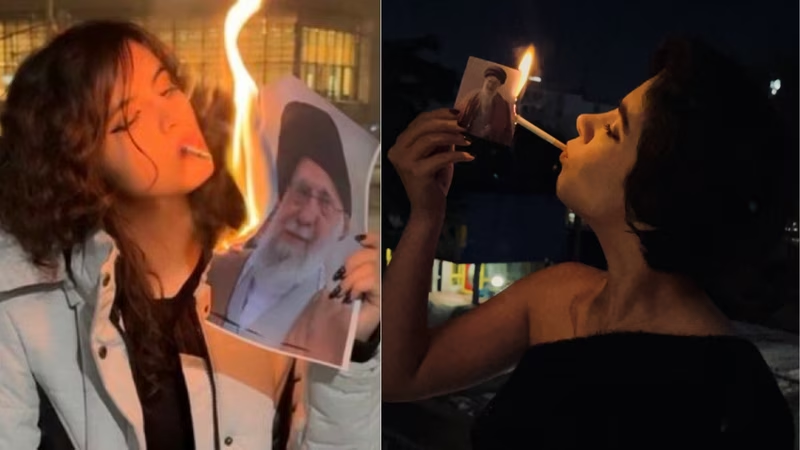
In a striking act of quiet rebellion that’s echoing across social media, Iranian women are performing a simple yet profoundly defiant ritual: they’re lighting their cigarettes with the fire from burning photographs of Supreme Leader Ayatollah Ali Khamenei. This isn’t just a provocative stunt; it’s a potent symbol of a population pushed to the brink by an economic freefall and decades of political repression .
Table of Contents
- The Symbolism Behind the Flames
- Iran Women Protests Fueled by Economic Despair
- The Numbers Behind Iran’s Economic Collapse
- From Mahsa Amini to Today’s Defiance: A Legacy of Resistance
- Conclusion: A Nation at a Crossroads
- Sources
The Symbolism Behind the Flames
Burning an image of a leader is one of the oldest and most universal forms of political protest. Historically, from draft-card burnings in the US to effigy burnings worldwide, fire has been used to communicate a complete and utter rejection of authority . In the context of Iran, where the state wields immense religious and political power, destroying the image of the Supreme Leader is not just a political statement—it’s a direct challenge to the very foundation of the Islamic Republic.
The addition of the cigarette adds another layer of meaning. In a country with strict social codes for women, smoking in public can be an act of personal autonomy. By using the fire from Khamenei’s burning portrait to light that cigarette, these women are merging a personal act of freedom with a grand political statement. It’s a declaration that their right to breathe, to live, and to make choices about their own bodies is intrinsically linked to the fall of the regime that denies them those rights .
Iran Women Protests Fueled by Economic Despair
While the imagery is powerful, it’s crucial to understand the tinder that’s making this spark catch fire. The Iran women protests we see today are not happening in a vacuum. They are the direct result of what experts are calling the deepest and longest economic crisis in Iran’s modern history .
Citizens are facing a daily reality of empty shelves, skyrocketing prices, and a currency that seems to lose value by the hour. This economic despair has created a widespread sense of hopelessness and anger that transcends gender, class, and even political affiliation. The protests that began in late December 2025 have now spread to multiple cities, uniting people under a common banner of frustration .
The Numbers Behind Iran’s Economic Collapse
The statistics paint a grim picture of a nation in freefall:
| Economic Indicator | Status (Early 2026) | Impact |
|---|---|---|
| Currency Value | 1 USD = ~1.47 million IRR | Savings wiped out, imports crippled |
| Annual Inflation Rate | Projected at 42.4% | Purchasing power evaporates |
| Food Price Inflation | Over 72% year-on-year | Basic necessities become unaffordable |
For the average Iranian family, this means that the cost of a simple loaf of bread or a carton of milk can change dramatically from one day to the next. The government’s attempts to end currency subsidies have only poured gasoline on the fire, with officials themselves warning that food prices are set to jump even higher . Some economists fear inflation could top 60% by the end of the Persian year in March 2026 . This isn’t just an economic crisis; it’s a humanitarian one.
From Mahsa Amini to Today’s Defiance: A Legacy of Resistance
The current wave of dissent is deeply rooted in the historic 2022-23 protests that erupted after the death of Mahsa Amini in police custody. The slogan “Woman, Life, Freedom” became a global rallying cry, and though the initial uprising was brutally suppressed, the spirit of resistance never died. It simply went underground, waiting for the next catalyst.
The economic collapse has provided that catalyst. The same women who were at the forefront of the “Woman, Life, Freedom” movement are now leading this new form of symbolic protest. Their actions demonstrate a sophisticated understanding of political theater and a fearless commitment to their cause. By targeting the image of Khamenei—the ultimate symbol of the regime’s patriarchal and authoritarian rule—they are directly linking their fight for personal freedom with the broader struggle against a failing state .
This evolution in protest tactics shows a strategic shift. While mass street demonstrations are met with immediate and violent crackdowns, these individual, shareable acts of defiance are harder for the state to contain. They spread virally online, inspiring others and keeping the pressure on the regime from a thousand different points at once .
Conclusion: A Nation at a Crossroads
The image of an Iranian woman calmly lighting a cigarette from a burning photo of her nation’s supreme leader is more than just a viral moment; it’s a window into the soul of a country in profound crisis. The Iran women protests are a manifestation of a deep-seated anger fueled by years of economic mismanagement, international isolation, and systemic oppression. As the rial continues to plummet and food becomes a luxury, the space for peaceful resolution narrows. These acts of symbolic defiance are a clear message to the ruling establishment: the consent of the governed has been irrevocably withdrawn. For more on the geopolitical implications of this unrest, see our analysis on [INTERNAL_LINK:middle-east-geopolitics].
Sources
- Times of India: Iran protests: Why are women lighting cigarettes from burning Khamenei photo?
- Web Search Result: Iran has entered 2026 facing one of its most acute internal crises in years.
- Web Search Result: The symbolic act challenges both Iran’s political authority and its strict social rules for women.
- Web Search Result: #FPExplained: Videos of Iranian women lighting cigarettes with burning photos…
- Web Search Result: Beginning on 28 December 2025, mass demonstrations erupted across multiple cities in Iran…
- Web Search Result: Iran’s currency slides to new low, dollar at 1.47 million rials.
- Web Search Result: Headline inflation reached 42 percent, with point-to-point inflation surging to 53 percent.
- Web Search Result: A senior Iranian economist warned… annual inflation could exceed 60%…
- International Monetary Fund (IMF): Islamic Republic of Iran and the IMF.
- Web Search Result: Draft-card burning was a symbol of protest performed by thousands of young men…
- Web Search Result: In Iran, burning images of the Supreme Leader is seen as a huge offence under the law.