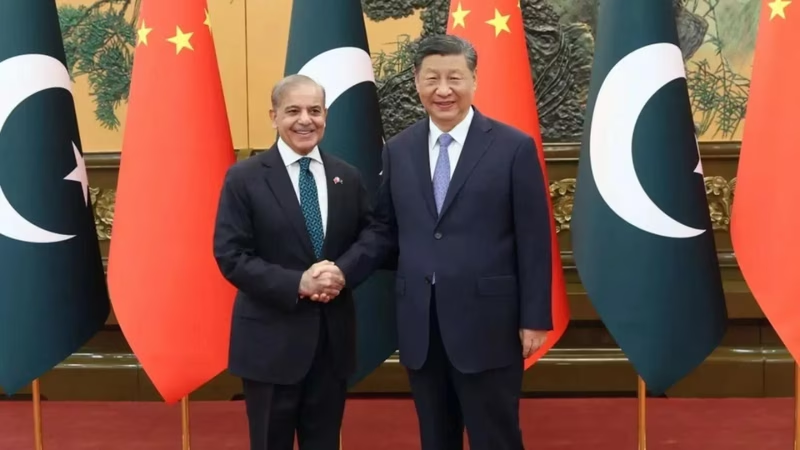
For over a decade, a massive infrastructure project has been snaking its way across Pakistan, promising economic transformation and regional connectivity. Yet, from its inception, it has been met with fierce, unwavering opposition from a powerful neighbor. India’s official stance on the China-Pakistan Economic Corridor (CPEC) is clear, blunt, and unchanging: it is “illegal and invalid.” But what lies behind this strong condemnation? Let’s dive deep into the heart of one of Asia’s most contentious geopolitical issues.
Table of Contents
- What is the CPEC Project?
- Why India Calls CPEC ‘Illegal and Invalid’
- The Gilgit-Baltistan Flashpoint
- Latest Developments in CPEC (2025)
- Geopolitical Implications for the Region
- Conclusion
- Sources
What is the CPEC Project?
Launched in 2015 as a flagship project of China’s ambitious Belt and Road Initiative (BRI), the CPEC is a colossal $62 billion infrastructure network designed to connect China’s northwestern Xinjiang region to Pakistan’s warm-water port of Gwadar on the Arabian Sea . This 3,000 km corridor isn’t just a single road; it’s an integrated web of projects including:
- Modern highways and railways to facilitate faster movement of goods and people.
- Energy projects like power plants to address Pakistan’s chronic energy shortages.
- Special Economic Zones (SEZs) to attract manufacturing and boost industrial output.
- Digital and fiber-optic networks to modernize communication infrastructure.
The strategic logic for China is clear: Gwadar offers a much shorter and more secure trade route to the Middle East and Africa, bypassing the congested and potentially vulnerable Strait of Malacca. For Pakistan, the promise was nothing short of an economic miracle—a path to rapid development and stability .
Why India Calls CPEC ‘Illegal and Invalid’
India’s rejection of the CPEC isn’t based on economic jealousy or simple rivalry. Its core objection is rooted in a fundamental principle of international law: territorial sovereignty. New Delhi’s position is that the corridor, in its current form, passes directly through a region that India claims as its own integral territory—Jammu and Kashmir .
By building infrastructure in this disputed area, India argues, both China and Pakistan are not only violating its sovereignty but also attempting to legitimize Pakistan’s administrative control over the territory through a massive, long-term project. This, from India’s perspective, sets a dangerous precedent and is therefore “illegal and invalid” in the eyes of the Indian government .
The Gilgit-Baltistan Flashpoint
The epicenter of this dispute is the stunningly beautiful but politically volatile region of Gilgit-Baltistan. This area, administered by Pakistan since 1947, is claimed by India as part of the former princely state of Jammu and Kashmir . The primary route of the CPEC traverses directly through Gilgit-Baltistan, making it impossible for India to accept the project without implicitly conceding its claim to the territory .
From India’s strategic viewpoint, Chinese presence in Gilgit-Baltistan is a direct security threat. It brings a major military and economic power right up to India’s northern borders, creating what some analysts have termed a “two-front challenge” alongside the existing border disputes with China in the east .
Latest Developments in CPEC (2025)
As of early 2026, the CPEC is entering a new phase, often referred to as “CPEC 2.0.” After a period of slowdown due to security concerns and economic instability in Pakistan, the two nations are pushing to revitalize the project. In late 2025, Chinese and Pakistani officials announced an “upgraded version” of CPEC, shifting focus from large-scale infrastructure to industrial cooperation, science & technology, and agriculture .
A significant milestone was the Pak-China B2B Conference in 2025, which reportedly resulted in $8.5 billion worth of new joint ventures and memoranda of understanding, particularly in the tech sector . However, the project continues to face internal challenges within Pakistan, including criticism over debt sustainability and uneven regional development benefits .
Geopolitical Implications for the Region
The CPEC is far more than a bilateral project between China and Pakistan. It’s a catalyst reshaping the entire geopolitical landscape of South Asia:
- Deepening Sino-Pak Alliance: The project cements a strategic partnership between Beijing and Islamabad, providing Pakistan with a powerful ally against its primary rival, India.
- India’s Strategic Dilemma: India is forced to bolster its own infrastructure along its northern borders and seek stronger partnerships with other global powers like the US and Japan to counterbalance Chinese influence. This dynamic is a key driver behind initiatives like the [INTERNAL_LINK:indo-pacific-strategy].
- Regional Tensions: The dispute over CPEC adds another layer of complexity to the already fraught India-Pakistan relationship and the broader India-China border standoff, making any form of regional cooperation extremely difficult.
For a deeper understanding of China’s broader strategy, you can explore the official overview of the Belt and Road Initiative on the Belt and Road Portal, a high-authority source on the subject.
Conclusion
The China-Pakistan Economic Corridor remains a potent symbol of ambition, strategic rivalry, and unresolved territorial conflict. While it promises economic development for Pakistan and a strategic shortcut for China, its path through the disputed territory of Gilgit-Baltistan ensures that India will never recognize its legitimacy. The “illegal and invalid” label is not just a diplomatic phrase; it’s a reflection of a deep-seated national security concern that is unlikely to fade anytime soon. As CPEC evolves into its next phase, it will continue to be a major flashpoint, influencing the delicate balance of power in Asia for years to come.
Sources
- Times of India: ‘Illegal and invalid’: India rejects China-Pakistan economic corridor – what is the project?
- Web Search Result [1]: “CPEC and Pakistan: Navigating Challenges Posed by India”
- Web Search Result [2]: “China Pakistan Economic Corridor (CPEC)”
- Web Search Result [10]: “Navigating India’s Counter Narrative over CPEC”
- Web Search Result [11]: “India’s opposition to CPEC on shaky ground”
- Web Search Result [12]: “The Strategic Ramifications of CPEC: A Disquisition on Its”
- Web Search Result [15]: “Setback for India: The China-Pak Economic Corridor”
- Web Search Result [17]: “China–Pakistan Economic Corridor relaunch exposes”
- Web Search Result [20]: “CPEC 2.0: How China-Pakistan Economic Corridor Is”
- Web Search Result [25]: “China’s Belt and Road in Pakistan: What CPEC Leaves”