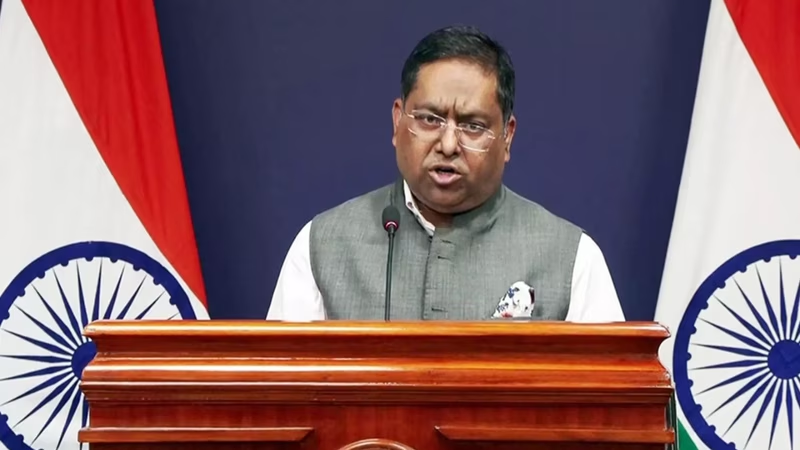
In a move that has sent ripples through South Asian diplomacy, India has issued a stern condemnation of Bangladesh’s apparent dismissal of a recent wave of brutal attacks on its Hindu minority. New Delhi isn’t just calling out the violence itself—it’s accusing Dhaka of a deliberate and dangerous denial that, according to Indian officials, is actively “emboldening perpetrators.”
This isn’t an isolated incident but part of what India describes as a “disturbing pattern” of recurring hostilities against religious minorities in its eastern neighbor. With reports of lynchings, temple vandalism, and targeted killings mounting, the situation on the ground appears to be reaching a critical juncture.
Table of Contents
- India’s Official Stance on the Crisis
- The Alarming Reality of Anti-Hindu Violence in Bangladesh
- Bangladesh’s Response and the Denial Dilemma
- A Historical Context of Persecution
- Why India’s Statement Matters for Regional Stability
- Conclusion: A Call for Accountability
- Sources
India’s Official Stance on the Crisis
The Ministry of External Affairs (MEA) has been unequivocal in its response. Spokesperson Randhir Jaiswal firmly rejected Bangladesh’s attempts to downplay the severity of the situation, stating that such denials are not only factually incorrect but also deeply counterproductive .
India has specifically condemned several recent horrific incidents, including the lynching of a Hindu youth in Mymensingh, which it described as a “horrendous act” . The MEA has repeatedly called on the Bangladeshi authorities to ensure swift justice and hold the perpetrators accountable, emphasizing that these acts of violence “cannot be brushed aside” .
This strong stance from New Delhi signals a significant shift from its usual diplomatic caution, highlighting the gravity with which it views the escalating anti-Hindu violence in Bangladesh.
The Alarming Reality of Anti-Hindu Violence in Bangladesh
While Dhaka may offer official reassurances, the on-the-ground reality for Bangladesh’s Hindu community tells a starkly different story. Data from local human rights groups paints a grim picture:
- Between August 2024 and June 2025, the Hindu Buddhist Christian Unity Council of Bangladesh documented a staggering 2,442 incidents of violence against minorities .
- December 2025 alone saw at least 51 separate incidents of communal violence .
- Since December 2025, at least four Hindus have been killed, including a journalist who was shot dead .
These aren’t just numbers; they represent a community living in fear. The violence often follows a predictable pattern: incitement on social media, mob attacks on homes and businesses, and the desecration of sacred sites. This systematic targeting has created a climate of terror for one of the world’s largest Hindu minorities outside of India.
Bangladesh’s Response and the Denial Dilemma
The Bangladeshi government’s official line is one of zero tolerance for religious violence. Prime Minister Sheikh Hasina has publicly stated that “violence in the name of religion has no place in Bangladesh” . However, this public stance is increasingly at odds with the lived experience of its minority citizens and the perception of international observers.
Critics argue that the government’s response is often too little, too late. Human rights organizations have accused Dhaka of negligence in protecting its Hindu population . While the government may condemn individual acts after they occur, there is a perceived lack of proactive measures to prevent them or to dismantle the networks of hate that fuel them.
This gap between official rhetoric and on-the-ground reality is what India is now directly challenging. By labeling Dhaka’s position as a “denial,” New Delhi is pushing the issue from a domestic concern for Bangladesh into a matter of bilateral and regional importance.
A Historical Context of Persecution
To understand the current crisis, one must look back. The persecution of Hindus in Bangladesh is not a new phenomenon but a recurring theme woven into the nation’s history since its inception . From the “Direct Action Day” violence of 1946 to the mass exodus during the 1971 Liberation War and subsequent pogroms in 1992 and 2001, the community has faced systemic discrimination and episodic, large-scale violence [[11], [15]].
Each wave of violence has contributed to a steady demographic decline, with the Hindu population shrinking from nearly 20% at independence to under 8% today. This historical backdrop makes the current surge in attacks even more alarming, as it threatens to reverse any fragile progress made towards integration and security.
Why India’s Statement Matters for Regional Stability
India’s decision to speak out so forcefully is not merely an act of solidarity with its co-religionists abroad. It carries significant strategic weight. A stable and secure Bangladesh is a cornerstone of India’s “Neighborhood First” foreign policy. Persistent internal instability, especially along sectarian lines, can have direct consequences for India’s own security, potentially leading to a refugee influx or cross-border radicalization.
Furthermore, India’s statement serves as a powerful signal to other nations and international bodies that the issue of minority rights in Bangladesh can no longer be ignored. It elevates the discourse from a humanitarian concern to a matter of geopolitical significance. For readers interested in the broader implications, our deep dive into [INTERNAL_LINK:India-Bangladesh bilateral relations] provides further context.
Conclusion: A Call for Accountability
The core of India’s message is clear: denial is not a solution. By refusing to acknowledge the scale and systematic nature of the anti-Hindu violence in Bangladesh, the Dhaka government risks creating a culture of impunity where attackers feel shielded from consequence. India’s call for accountability is not just a moral imperative but a practical necessity for ensuring long-term peace and stability in the region. The international community will be watching closely to see how Bangladesh responds to this direct and public challenge.
Sources
- Times of India: ‘Emboldens perpetrators’: India on B’desh denying attacks on Hindus
- MEA Statements & Reports: [[1], [3], [5], [6]]
- Human Rights Data: [[10], [12], [16], [22]]
- Historical Context: [[9], [11], [15]]
- US State Department: 2022 Country Reports on Human Rights Practices: Bangladesh