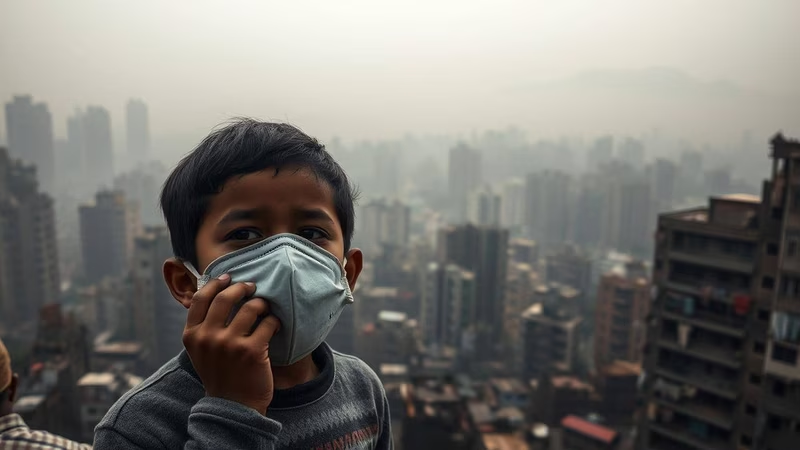
Imagine living in a city where the very air you breathe is a slow-acting poison. For millions of Indians, this isn’t a dystopian fantasy—it’s their daily reality. A stark new analysis has laid bare a terrifying truth: 44% of Indian cities are trapped in a cycle of chronic air pollution, with persistently high levels of deadly PM2.5 particles. Yet, the government’s primary weapon against this invisible killer, the National Clean Air Programme (NCAP), is only deployed in a mere 4% of these severely affected areas . This isn’t just a gap; it’s a chasm between policy and public health.
Table of Contents
- The Shocking Scale of India’s PM2.5 Crisis
- What is the NCAP and Why is its Coverage So Limited?
- The 96% Gap: Why Most Polluted Cities Are Left Behind
- Experts Demand a New Approach to India’s Air Pollution Fight
- Conclusion: A Call for Urgent and Inclusive Action
- Sources
The Shocking Scale of India’s PM2.5 Crisis
The data is unequivocal. The annual PM2.5 assessment for 2025 paints a grim picture of urban India. Cities like Byrnihat in Meghalaya, Delhi, and Ghaziabad in Uttar Pradesh consistently top the list of the nation’s most polluted urban centers, with annual PM2.5 concentrations soaring far beyond the World Health Organization’s safe limits . But the problem isn’t confined to a few notorious hotspots. The crisis is widespread, affecting a vast swathe of the country’s urban landscape.
This chronic India air pollution is driven by a toxic cocktail of persistent emission sources: unchecked industrial activity, a massive fleet of aging vehicles, rampant construction dust, and the seasonal scourge of crop stubble burning. The result is a public health emergency that shortens lifespans, burdens healthcare systems, and stifles economic potential.
What is the NCAP and Why is its Coverage So Limited?
Launched in 2019, the National Clean Air Programme (NCAP) was heralded as India’s first comprehensive national framework to tackle urban air pollution . Its ambitious goal is to achieve a 40% reduction in particulate matter concentration by 2026 across its targeted cities . On paper, it sounds promising.
However, the program’s reach is shockingly narrow. Currently, the NCAP officially covers only 131 cities . When cross-referenced with the list of cities suffering from chronic pollution, the overlap is minuscule—just 67 cities, which amounts to a mere 4% of the total number of affected urban areas . This means that hundreds of cities, home to millions of citizens, are left to fend for themselves without a coordinated, centrally-backed strategy or dedicated funding.
The 96% Gap: Why Most Polluted Cities Are Left Behind
This 96% gap is not an oversight; it’s a systemic failure. The initial selection of NCAP cities was based on data from a limited number of monitoring stations, creating a blind spot for countless other urban centers now known to be severely polluted. The program’s structure, which groups cities into “airsheds,” often fails to account for the unique and localized sources of pollution in smaller or less-monitored towns .
Furthermore, even within the 131 covered cities, implementation is patchy. Reports have shown that major metropolises like Delhi and Noida have spent only a fraction of their allocated NCAP funds, highlighting a critical disconnect between planning and on-ground action . A 2025 analysis of NCAP funding revealed that a disproportionate 67% of the budget since 2019 has been funneled into road-dust management, while other significant sources like industrial emissions and domestic fuel use remain under-addressed .
Experts Demand a New Approach to India’s Air Pollution Fight
Environmental scientists, public health experts, and policy analysts are united in their call for a radical overhaul of India’s air quality strategy. They argue that the current NCAP model is too limited in scope and lacks the necessary accountability mechanisms.
Key recommendations for a more effective “NCAP 2.0” include:
- Massive Expansion of Coverage: The program must be urgently scaled to include all cities identified with chronic PM2.5 levels, not just a select few.
- Data-Driven & Chemistry-Focused Policies: Moving beyond a one-size-fits-all approach to target the specific chemical makeup and sources of pollution in each city .
- Enhanced Accountability & Fund Utilization: Implementing strict monitoring of how allocated funds are spent and holding local authorities accountable for meeting reduction targets.
- Inclusion of Rural Areas: Recognizing that air pollution is a regional issue, strategies must also address major rural contributors like agricultural waste burning .
As one expert noted, the success of any future policy will depend on its ability to move from a reactive to a proactive, science-based, and truly inclusive framework.
Conclusion: A Call for Urgent and Inclusive Action
The fact that 96% of India’s chronically polluted cities are outside the purview of the NCAP is a national scandal. It’s a clear signal that the current approach is failing the vast majority of its citizens who are breathing some of the world’s most toxic air. Tackling India air pollution requires more than just a well-intentioned program; it demands a fundamental shift in priorities, a massive expansion of resources, and an unwavering commitment to protecting every citizen’s right to clean air. The time for incremental change is over. India needs a bold, comprehensive, and inclusive war on air pollution, and it needs to start now.
Sources
- Times of India: Air pollution crisis: 44% Indian cities face chronic PM2.5 levels; NCAP covers just 4%
- Centre for Research on Energy and Clean Air (CREA): Various reports on Indian city pollution rankings.
- Ministry of Environment, Forest and Climate Change (MoEFCC): National Clean Air Programme (NCAP)
- World Health Organization (WHO): Ambient air pollution database