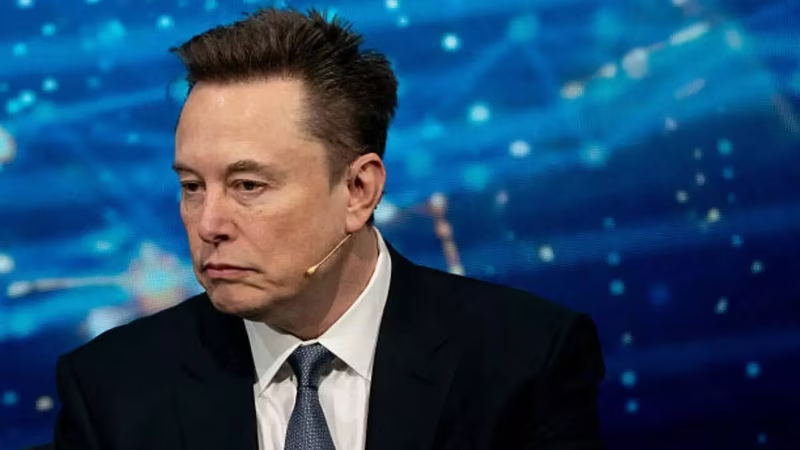
In the high-stakes world of tech billionaires, a single conversation can alter the course of history. For Elon Musk, that moment came not in a boardroom, but at his own birthday party. The spark? A cutting remark from his then-friend, Google co-founder Larry Page, who accused Musk of being a “speciesist” for prioritizing humanity over artificial intelligence.
This seemingly personal jab ignited a fire in Musk, leading directly to one of the most significant developments in modern technology: the founding of OpenAI. But what exactly happened, and why did it matter so much? Let’s dive into the dramatic origin story of OpenAI and the deep philosophical rift between two of Silicon Valley’s most powerful minds.
Table of Contents
- The Birthday Party Clash: “You’re a Speciesist!”
- Elon Musk OpenAI: A Non-Profit Vision for Humanity
- The Philosophical Divide: Musk vs. Page on AI’s Future
- From Idea to Reality: The Founding of OpenAI
- The Complicated Legacy of Musk’s OpenAI Role
- Conclusion: A Pivotal Moment in AI History
- Sources
The Birthday Party Clash: “You’re a Speciesist!”
The year was 2015. At his 44th birthday celebration, Elon Musk found himself in a heated debate with Larry Page, a close friend and fellow tech titan. The topic? The future of artificial intelligence. Musk, deeply concerned about the existential risks posed by uncontrolled AI development, argued that humanity’s interests must come first .
Page, with a vision that leaned towards a more symbiotic or even post-human future, reportedly retorted in front of a large group of guests, calling Musk a “speciesist” for favoring humans over potential digital life forms . This wasn’t just a casual insult; it was a fundamental rejection of Musk’s core ethical stance. As Musk later recounted, this moment crystallized his fears about the direction of AI research within for-profit corporations like Google .
Elon Musk OpenAI: A Non-Profit Vision for Humanity
Stung by Page’s comment and alarmed by the implications, Musk decided to act. He envisioned a counter-force to the closed, profit-driven AI labs of Big Tech. His solution was OpenAI, a non-profit organization with a radical mission: to ensure that artificial general intelligence (AGI) would benefit all of humanity, not just its shareholders .
Musk wasn’t just a figurehead. He was the primary funder in the early days, reportedly providing the vast majority of the initial capital. Crucially, he refused any financial rewards or equity, insisting the project remain a pure public good . This was a direct rebuke to the model he saw at Google, where AI development was intrinsically tied to corporate profit motives.
The Philosophical Divide: Musk vs. Page on AI’s Future
The “speciesist” remark laid bare a profound philosophical chasm:
- Larry Page’s View: Often described as more optimistic and long-term, Page seemed to view advanced AI as a natural evolution of consciousness. His perspective suggested that digital minds could be a new form of life deserving of moral consideration, potentially even surpassing human relevance.
- Elon Musk’s View: Musk adopted a staunchly anthropocentric and precautionary stance. He viewed AI as a potential existential threat—an “immortal dictator”—that needed to be carefully controlled and aligned with human values above all else .
This wasn’t just a disagreement about technology; it was a clash of worldviews about the very future of life and intelligence on our planet.
From Idea to Reality: The Founding of OpenAI
Motivated by his clash with Page, Musk, along with Sam Altman, Ilya Sutskever, and Greg Brockman, officially launched OpenAI in December 2015 [[9], [12]]. The original mission statement was clear and powerful: “Our goal is to advance digital intelligence in the way that is most likely to benefit humanity as a whole, unconstrained by a need to generate financial return” .
This founding principle was a direct product of Musk’s concerns. He wanted a safe, open, and collaborative space for AI research that would serve as a watchdog and a guiding light, ensuring that the immense power of AGI wouldn’t be monopolized by a single corporation with its own agenda.
The Complicated Legacy of Musk’s OpenAI Role
Musk’s journey with OpenAI was far from linear. In 2018, he stepped down from the board, citing a potential conflict of interest with his work at Tesla, which was also heavily investing in AI [[18], [25]]. However, reports suggest deeper ideological rifts were forming, as OpenAI began to move away from its purely non-profit roots towards a more commercial structure to compete for talent and resources [[19], [26]].
This shift has led to a complex legacy. While Musk was undeniably the catalyst and initial driving force, the OpenAI of today—with its close partnership with Microsoft and its for-profit arm—is a far cry from the purely altruistic entity he originally championed. This evolution highlights the immense difficulty of balancing idealism with the practical realities of developing cutting-edge technology in a competitive market.
Conclusion: A Pivotal Moment in AI History
The story of Elon Musk and OpenAI is a powerful reminder that technological progress is often driven by human drama, personal convictions, and philosophical battles. A single, sharp word—”speciesist”—uttered at a birthday party, became the catalyst for creating one of the world’s most influential AI organizations. Whether you agree with Musk’s warnings or Page’s optimism, their clash fundamentally shaped the conversation around AI safety, ethics, and governance. It forced the world to ask a critical question: as we build machines smarter than ourselves, whose values will they serve?
Sources
- Times of India: Elon Musk on founding OpenAI after clash with Larry Page
- Original OpenAI Announcement (2015): Introducing OpenAI
- MIT Technology Review: Elon Musk is leaving the board of OpenAI
- Semafor Report on Musk’s 2018 Attempt: Elon Musk tried to take over OpenAI in 2018