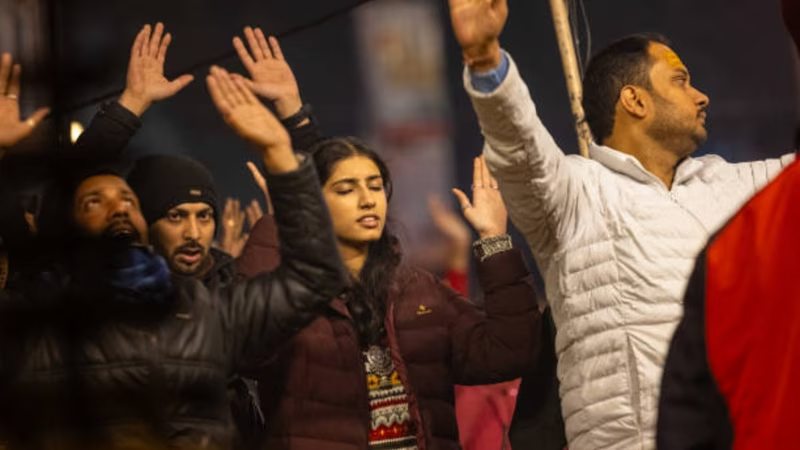
In the heart of Mumbai, a warehouse pulses not with the thump of EDM, but with the resonant, collective hum of thousands of voices singing an ancient mantra. In Delhi, young professionals gather after work not for happy hour, but for a communal session of devotional songs. This isn’t your grandparents’ quiet temple visit; this is bhajan jamming, and it’s exploding across India as a powerful, participatory form of modern spirituality.
Far from being a fleeting social media fad, this movement represents a profound shift in how younger generations connect with their faith, seek inner peace, and build community. But what’s driving this surge, and why does it feel so different from traditional religious practice? Let’s dive deep into the phenomenon that’s selling out venues and calming anxious minds.
Table of Contents
- What Exactly is Bhajan Jamming?
- Why Gen Z is Flocking to Bhajan Jamming
- The Science Behind the Spiritual Singalong
- From Ancient Roots to a Modern Twist
- Why This is More Than Just a Trend
- Conclusion: A New Language of Devotion
- Sources
What Exactly is Bhajan Jamming?
At its core, bhajan jamming is a large-scale, communal gathering where participants sing devotional songs (bhajans and kirtans) together. Think of it as a cross between a concert, a meditation circle, and a spiritual flash mob. These events often feature live bands that blend traditional Indian instruments like the harmonium and tabla with contemporary sounds—think acoustic guitars, electronic beats, and even subtle techno rhythms .
The atmosphere is intentionally inclusive and non-judgmental. You don’t need to be a trained singer or a devout scholar of scripture. All you need is an open heart and a willingness to participate. This accessibility is a key part of its massive appeal.
Why Gen Z is Flocking to Bhajan Jamming
Forget the stereotype of a disengaged, screen-obsessed youth. Today’s young Indians are actively seeking meaning, connection, and tools to manage the intense pressures of modern life. A 2023 YouGov-Mint study found that over 61% of Indian youth are now engaging in some form of spiritual practice, from meditation to spiritual reading .
Bhajan jamming hits the sweet spot for this demographic:
- It’s Social & Sober: It offers a vibrant, communal alternative to the club scene—a “sober rave” where the high comes from connection, not substances. Google Trends shows searches for terms like ‘bhajan clubbing’ and ‘sober rave India’ have skyrocketed by 400-600% since early 2024 .
- It’s Relatable: Organizers like Raghav and Prachi Agarwal have successfully repackaged ancient chants into a format that feels fresh and relevant, attracting crowds where 85% are aged between 18 and 30 .
- It’s Personal: This trend marks a “personal reclamation” of spirituality, moving away from rigid dogma towards a more intuitive, personal experience of faith .
The Science Behind the Spiritual Singalong
This isn’t just a feel-good anecdote; there’s hard science backing up why group chanting feels so transformative. Research consistently shows that participating in group singing and chanting provides significant physiological and psychological benefits.
Studies have found that these activities can:
- Reduce stress and anxiety by stimulating the vagus nerve and lowering cortisol levels [[11], [13]].
- Boost mood and well-being by increasing the release of “feel-good” neurotransmitters like dopamine and serotonin .
- Foster a powerful sense of belonging and social connection, which is crucial for mental health, especially among young adults [[10], [14]].
In essence, the act of singing together in unison creates a biological synchrony that promotes group solidarity and a shared positive emotional state . It’s a natural, accessible form of therapy that’s been embedded in human culture for millennia.
From Ancient Roots to a Modern Twist
To understand the power of bhajan jamming, we must look back. Bhajans have their roots in the ancient Vedic hymns and were popularized during the Bhakti movement (roughly 6th to 17th centuries), a period that emphasized a direct, personal, and loving relationship with the divine through music and poetry [[19], [24]].
The very word “bhajan” means “sharing” or “partaking” , highlighting its inherently communal nature. For centuries, wandering bards and village communities have used these songs as a primary vehicle for spiritual teaching and social bonding .
Today’s bhajan jamming is a natural evolution of this tradition. It takes the core principle—the power of collective devotional sound—and presents it in a language that resonates with the digital-native generation. It’s not a rejection of the past; it’s a vibrant, living continuation of it.
Why This is More Than Just a Trend
The numbers tell a compelling story. India’s spiritual market was valued at a staggering $58.5 billion in 2024 and is projected to grow at 10% annually through 2034 [[4], [6]]. This isn’t just about buying crystals; it’s about a fundamental societal shift towards seeking inner peace and purpose.
Furthermore, the demographic reach is broadening. While driven by Gen Z, a NumroVani study from 2025 revealed that 68% of people over 50 also show a strong intent to participate, suggesting this is a unifying, cross-generational phenomenon . When a practice bridges such a wide age gap, it moves beyond a simple trend and into the realm of a cultural movement.
For those looking to deepen their spiritual journey, exploring other modern interpretations of ancient wisdom can be a great next step. Check out our guide on [INTERNAL_LINK:modern-yoga-practices] for more insights.
Conclusion: A New Language of Devotion
Bhajan jamming is far more than a viral hashtag or a novel night out. It’s a powerful response to the isolation and anxiety of our times, offering a scientifically-backed path to calm, a deeply human sense of community, and a fresh, authentic way to connect with the divine. By blending ancient wisdom with a modern aesthetic, it has created a new, inclusive language of devotion that speaks directly to the heart of a new generation. This isn’t a passing fad; it’s the sound of a spiritual revolution.
Sources
- Times of India: Why bhajan jamming is more than just a trend
- NumroVani, How India Thinks 2025 Study
- Google Trends data on ‘bhajan clubbing’
- Simpson, F.M. (2021). Assessing Vocal Chanting as an Online Psychosocial Intervention
- Perry, G. (2023). Reduced Stress, Cortisol and Enhanced Social Connection
- Brill’s Encyclopedia of Hinduism on Kirtan and Bhajan
- YouGov-Mint Study (2023) on Indian youth spirituality