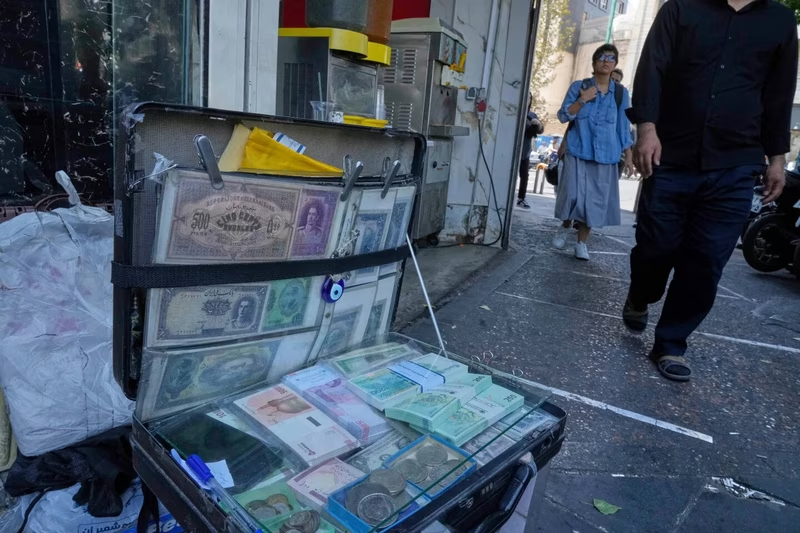
When your national currency becomes a punchline—trading at **1 US dollar = 1,400,000 Iranian Rials**—you know something has gone catastrophically wrong. In Iran, that number isn’t just an economic statistic; it’s the daily reality driving millions into despair and igniting what many analysts now call the most dangerous wave of Iran protests in decades.
Unlike the 2009 Green Movement or the 2019 fuel price riots, this uprising isn’t sparked by a single political grievance or policy blunder. It’s born from the slow, grinding erosion of ordinary life under a collapsing economy, runaway inflation, and a regime that appears increasingly out of touch—and out of options .
Table of Contents
- Why This Wave of Iran Protests Is Different
- The Currency Collapse at the Heart of the Crisis
- From Students to Shopkeepers: A Broad Coalition Rises
- Why the Regime Is More Exposed Than Ever
- International Reactions and the US Role
- What Happens Next: Scenarios for Iran
Why This Wave of Iran Protests Is Different
Past uprisings in Iran often had clear triggers: a disputed election, a sudden hike in fuel prices, or the death of a young woman in police custody. They were intense but episodic.
This time, the trigger is **continuous**. It’s the bread that costs three times what it did last year. It’s the salary that evaporates before payday. It’s the small business owner watching his life savings turn to dust. The protest slogan isn’t “Where is my vote?” or “Woman, Life, Freedom?”—it’s simply: **“Get lost!”**—a direct call for the entire leadership to step down .
This shift from reformist demands to outright regime rejection marks a profound escalation in public sentiment.
The Currency Collapse at the Heart of the Crisis
The Iranian Rial has been in freefall for years, but the recent plunge past the 1.4 million mark against the US dollar is more than symbolic—it’s systemic. Decades of mismanagement, international sanctions, corruption, and the diversion of state resources to proxy militias have hollowed out the economy.
Key economic indicators tell a grim story:
- Inflation: Estimated at over 40% annually, with food inflation exceeding 60%.
- Unemployment: Youth unemployment hovers near 25%, with women disproportionately affected.
- Foreign Reserves: Severely depleted due to US sanctions on oil exports and banking access.
- Black Market Premium: The gap between official and street exchange rates fuels speculation and erodes trust.
For ordinary Iranians, this means survival requires constant hustle—multiple jobs, side trades in gold or dollars, or reliance on remittances from abroad. When basic dignity becomes a financial impossibility, patience runs out.
From Students to Shopkeepers: A Broad Coalition Rises
Historically, protests in Iran were led by students, activists, or marginalized groups. But this movement is different because it includes the **bazaar merchants**—the traditional backbone of Tehran’s conservative support base.
These shopkeepers, once loyal to the Islamic Republic for protecting their interests, are now among the loudest voices calling for change. Their businesses are failing. Their customers can’t afford goods. And they blame the regime’s economic incompetence—not Western sanctions alone—for their ruin.
This cross-class alliance—students, workers, women, professionals, and now merchants—creates a far more resilient and threatening challenge to the regime than any previous uprising.
Why the Regime Is More Exposed Than Ever
Supreme Leader Ayatollah Ali Khamenei, now in his mid-80s, has ruled Iran for over three decades. But his authority rests on two pillars: religious legitimacy and economic stability. With the latter crumbling, the former is under unprecedented strain.
Crucially, even the Islamic Revolutionary Guard Corps (IRGC)—the regime’s enforcer—is not immune. While still loyal, its vast economic empire (from construction to telecoms) is also suffering from the broader collapse, creating internal friction.
Moreover, the usual playbook—blame America, arrest leaders, shut the internet—seems less effective. People aren’t protesting because of a foreign conspiracy; they’re protesting because they can’t feed their families. You can’t jail an entire nation for being hungry.
International Reactions and the US Role
The Biden administration has expressed solidarity with protesters but stopped short of direct intervention, wary of fueling regime propaganda about foreign plots. Still, the US maintains stringent sanctions on Iran’s oil and financial sectors, which Tehran blames for its woes—though economists argue domestic policy is the larger culprit .
Meanwhile, regional powers like Saudi Arabia and the UAE are watching closely. A destabilized Iran could reshape Middle Eastern alliances overnight. For now, most nations are adopting a wait-and-see approach, fearing both chaos and a hardened dictatorship.
What Happens Next: Scenarios for Iran
Three potential paths lie ahead:
- Brutal Crackdown & Short-Term Calm: Security forces escalate violence, temporarily silencing streets—but resentment deepens underground.
- Economic Concessions Without Political Reform: The regime offers subsidies or currency controls, but without addressing root causes, protests reignite.
- Leadership Transition or Regime Fragmentation: Internal splits within the elite lead to a power shift—either through reform or fracture.
Most experts believe scenario #1 is most likely in the immediate term. But the longer the economic pain persists, the higher the chance of irreversible systemic breakdown.
Summary
The current Iran protests represent a fundamental crisis of legitimacy driven by economic despair, not just political dissent. With the Rial collapsing to 1.4 million per dollar and even traditional regime allies turning against it, Tehran faces its most existential threat in years. This isn’t just another protest—it’s a society pushed to the edge.
Sources
- Times of India: How Iran’s protests are different this time—and why the Khamenei regime looks more exposed than ever
- International Monetary Fund (IMF): Iran: Economic Outlook and Key Indicators
- Council on Foreign Relations: What Iran’s Economic Crisis Means for Its Future
- [INTERNAL_LINK:middle-east-geopolitics]
- [INTERNAL_LINK:global-sanctions-impact]