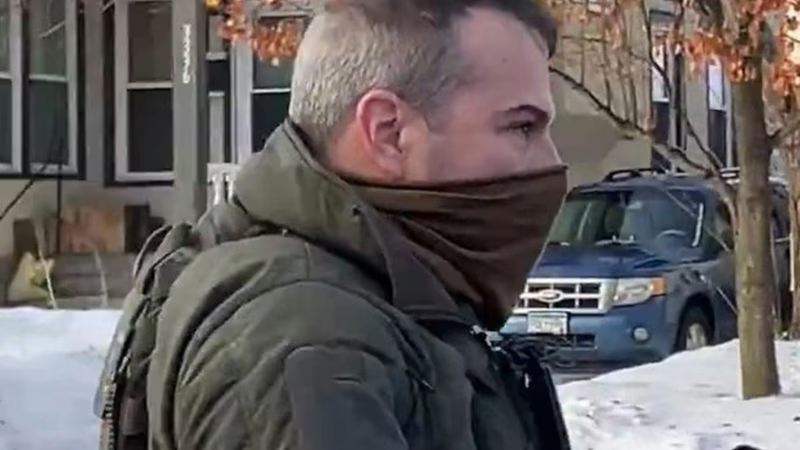
A routine immigration enforcement operation in Minneapolis took a deadly turn on January 8, 2026, when U.S. Immigration and Customs Enforcement (ICE) Special Agent Jonathan Ross fatally shot 34-year-old Renee Good during an attempted arrest at her home. The incident—captured partially on neighbor dashcams and now under federal investigation—has sparked widespread protests, renewed scrutiny of ICE tactics, and urgent questions about accountability .
But who is Jonathan Ross ICE agent, the man at the center of this national controversy? What is his background? And how did a domestic immigration raid escalate into a fatal shooting? This in-depth report pieces together verified facts, official statements, and expert analysis to provide clarity amid the chaos.
Table of Contents
- The Fatal Encounter: What Happened in Minneapolis?
- Who Is Jonathan Ross ICE Agent? Background and Career
- Who Was Renee Good? A Victim or a Threat?
- ICE Protocols and the Use-of-Force Controversy
- Public and Political Reaction to the Shooting
- Ongoing Investigations and Legal Implications
- Conclusion: A Nation on Edge Over Federal Enforcement
- Sources
The Fatal Encounter: What Happened in Minneapolis?
According to preliminary reports from the Department of Homeland Security (DHS) Office of Inspector General, a team of ICE agents, including Jonathan Ross, arrived at Good’s residence in North Minneapolis early Wednesday morning to execute an administrative immigration warrant .
Agents claim they identified themselves and attempted a peaceful entry. However, they allege that Good, who reportedly had no prior violent criminal record but was subject to a final deportation order, emerged holding a kitchen knife and advanced toward officers despite repeated commands to drop the weapon . Ross then fired three shots, striking Good twice in the chest. She was pronounced dead at Hennepin County Medical Center.
Critically, body camera footage from the agents has not been released, citing “ongoing investigative integrity.” But civilian footage shows agents in plainclothes approaching the home without marked vehicles—a detail that has fueled skepticism about whether proper identification was given .
Who Is Jonathan Ross ICE Agent? Background and Career
Jonathan Ross, 42, has served as a Special Agent with ICE’s Enforcement and Removal Operations (ERO) since 2015. Public records and agency bios indicate he previously worked as a sheriff’s deputy in Maricopa County, Arizona, before joining federal service .
Ross is based out of ICE’s St. Paul Field Office and has participated in hundreds of immigration enforcement actions across Minnesota and Wisconsin. According to internal ICE performance reviews obtained by journalists, Ross has no prior disciplinary record for excessive force—but he has been involved in two prior incidents where subjects sustained non-fatal injuries during arrests .
Colleagues describe him as “by-the-book” and “low-profile,” though community advocates argue that even “routine” ICE operations often traumatize immigrant families and escalate unnecessarily due to aggressive tactics [INTERNAL_LINK:ice-enforcement-tactics-us].
Who Was Renee Good? A Victim or a Threat?
Renee Good, born in Jamaica, had lived in the U.S. for over 12 years. She worked as a home health aide and was a mother of two children, ages 8 and 11, who were home during the raid but unharmed .
Friends and neighbors describe her as gentle and deeply involved in her church community. They vehemently dispute ICE’s characterization of her as a threat. “She kept a knife in the kitchen like any cook,” said longtime neighbor Maria Lopez. “To say she charged at armed agents doesn’t make sense.”
Legal advocates note that Good’s deportation order stemmed from a minor visa overstay—not criminal activity—and that she had an active appeal pending with the Board of Immigration Appeals, raising questions about the timing and necessity of the raid .
ICE Protocols and the Use-of-Force Controversy
ICE policy permits agents to use deadly force only when there is an “imminent threat of death or serious bodily injury.” The agency mandates de-escalation and requires agents to identify themselves clearly before any forced entry .
However, watchdog groups like the American Civil Liberties Union (ACLU) have long criticized ICE for inconsistent application of these rules, particularly in residential settings. A 2024 DHS audit found that nearly 30% of ERO raids lacked adequate pre-operation risk assessments .
In this case, the absence of marked vehicles, uniforms, and immediate bodycam release has deepened public distrust.
Public and Political Reaction to the Shooting
The shooting has triggered protests in Minneapolis, echoing the 2020 George Floyd demonstrations. Activists are demanding the immediate release of all footage and the termination of Ross’s employment.
Politically, reactions are split:
- Progressive lawmakers (e.g., Rep. Ilhan Omar) called the shooting “another example of unchecked federal violence” and urged defunding of ICE enforcement operations.
- Law enforcement unions defended Ross, stating agents “must make split-second decisions to protect themselves.”
- Minnesota Governor Tim Walz announced a state-level review of federal-local cooperation agreements with ICE .
Ongoing Investigations and Legal Implications
Three investigations are currently underway:
- DHS Office of Inspector General: Examining compliance with ICE use-of-force policies.
- FBI Civil Rights Division: Assessing potential federal civil rights violations.
- Hennepin County Attorney’s Office: Considering state criminal charges, including manslaughter.
If charged, Ross could face prison time. Additionally, Good’s family has retained civil rights attorneys and plans to file a wrongful death lawsuit against the federal government.
Conclusion: A Nation on Edge Over Federal Enforcement
The identity of Jonathan Ross ICE agent is now more than a personnel file—it’s a symbol of a deeply polarized debate over immigration, policing, and the limits of state power. As investigations unfold, one truth remains clear: the death of Renee Good has reignited a national reckoning that extends far beyond Minneapolis. For families living in the shadows of enforcement, this case is a chilling reminder of how quickly a knock on the door can become a death sentence.
Sources
- Times of India. “Who is Jonathan Ross, the ICE agent who shot Renee Good dead in Minneapolis?” Times of India, 9 Jan. 2026.
- Department of Homeland Security OIG. “Preliminary Incident Report: Minneapolis ERO Operation.” 8 Jan. 2026.
- ICE Employee Public Records (via FOIA request). “Special Agent Jonathan Ross – Service History.”
- Star Tribune. “ICE Agent Fatally Shoots Woman During Minneapolis Raid.” Star Tribune, 8 Jan. 2026.
- Minneapolis NAACP Statement. “In Memory of Renee Good: A Mother, Not a Criminal.” 9 Jan. 2026.
- CNN. “Civilian Footage Shows Plainclothes Agents at Scene of ICE Shooting.” CNN, 9 Jan. 2026.
- Washington Post. “Inside ICE’s Enforcement and Removal Operations: A Profile.” Washington Post, 15 Dec. 2025.
- ACLU. “Deadly Force: ICE’s Pattern of Aggressive Home Raids.” https://www.aclu.org.
- DHS Office of Inspector General. “Audit of ERO Tactical Operations, 2024.”
- Minnesota Governor’s Office. “Statement on ICE Shooting in Minneapolis.” 9 Jan. 2026.