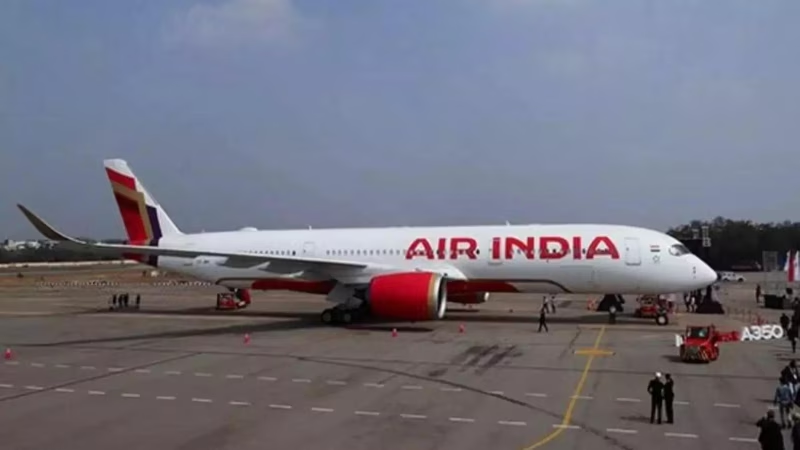
Imagine being thousands of feet in the air, halfway across the world, only to be told your destination is no longer an option. That’s exactly what happened to hundreds of passengers aboard two Air India flights bound for London this week. Due to unexpectedly severe weather conditions battering the UK, both aircraft were forced to make unscheduled landings in continental Europe—a move that left travelers stranded, frustrated, and scrambling for answers.
This incident highlights just how vulnerable even the most meticulously planned international itineraries are to the whims of Mother Nature. For Air India, which has been aggressively expanding its global network under the Tata Group’s ownership, such operational hiccups are a critical test of its customer service resilience. Let’s break down what happened, why it matters, and what passengers can do next.
Table of Contents
- What Happened: The Diverted Flights
- Why Were the Air India Flights Diverted?
- Passenger Impact: Stranded and Stressed
- Airline’s Response: Compensation and Care
- Your Rights as a Passenger
- How to Avoid or Handle Future Disruptions
- Conclusion: When Skies Turn Hostile
- Sources
What Happened: The Diverted Flights
On Thursday, January 8, 2026, Air India confirmed that two of its flagship UK-bound services—AI131 from Delhi and AI117 from Mumbai—were unable to land at their scheduled destination, London Heathrow Airport . Instead, citing safety protocols due to adverse weather, both flights were diverted:
- AI131 (Delhi to London): Diverted to Frankfurt, Germany.
- AI117 (Mumbai to London): Diverted to Amsterdam, Netherlands.
Each aircraft carries over 300 passengers, meaning more than 600 travelers were suddenly rerouted to cities they hadn’t planned to visit, with no immediate onward connections .
Why Were the Air India Flights Diverted?
The primary culprit was an intense low-pressure system that swept across the British Isles, bringing with it gale-force winds exceeding 70 km/h, heavy rain, and significantly reduced visibility at London’s major airports—including Heathrow and Gatwick .
Air traffic control authorities imposed ground stops and flow restrictions to manage the hazardous conditions. With holding patterns becoming unsustainable due to fuel constraints, pilots made the prudent decision to divert to nearby European hubs with better weather—a standard safety procedure endorsed by global aviation bodies like the [International Civil Aviation Organization (ICAO)](https://www.icao.int/).
Passenger Impact: Stranded and Stressed
For passengers, the experience was chaotic. Many were business travelers on tight schedules or families reuniting for the holidays. Upon landing in Frankfurt and Amsterdam, they faced:
- Lengthy waits for rebooking on alternative flights.
- Limited hotel accommodation due to high demand in transit hubs.
- Confusion over meal vouchers, baggage handling, and communication from ground staff.
Social media quickly filled with complaints, with one passenger tweeting, “Stranded in Amsterdam with no info. Air India promised updates every hour—radio silence for 5 hours now.”
Airline’s Response: Compensation and Care
Air India issued an official statement acknowledging the Air India flights diverted situation, calling it an “unavoidable operational decision taken purely on safety grounds” . The airline assured passengers that it was providing “necessary care,” including meals, hotel stays, and expedited rebooking on the next available flights to London.
However, the execution on the ground appears inconsistent. While some passengers reported smooth assistance, others described disorganized support, highlighting a gap between corporate policy and frontline delivery—a common challenge during large-scale disruptions.
Your Rights as a Passenger
If you’re caught in a similar situation, know your rights:
- Under EU Regulation 261/2004: Even though Air India is not an EU carrier, if your flight departs from an EU airport (like Frankfurt or Amsterdam after diversion), you may be entitled to care (meals, hotel) and, in some cases, compensation if the delay exceeds 3 hours upon final arrival in London .
- Indian Carriers’ Policy: Air India’s own terms guarantee complimentary refreshments and accommodation for delays beyond 2 hours due to reasons within their control. Weather is typically considered “extraordinary circumstances,” which may limit compensation but not care obligations.
How to Avoid or Handle Future Disruptions
While you can’t control the weather, you can prepare:
- Download airline apps for real-time alerts.
- Purchase travel insurance that covers weather-related delays and accommodation.
- Know your route alternatives: If flying to London, consider booking with a stopover in a non-UK European city as a buffer.
- Keep essential items in your carry-on, including medications and a change of clothes.
Conclusion: When Skies Turn Hostile
The diversion of these two Air India flights is a stark reminder that air travel, for all its modern efficiency, remains at the mercy of natural forces. While safety must always come first, airlines bear the responsibility of managing the human fallout with empathy, transparency, and speed. For passengers, awareness and preparation are the best defenses against the inevitable chaos when the skies turn hostile.