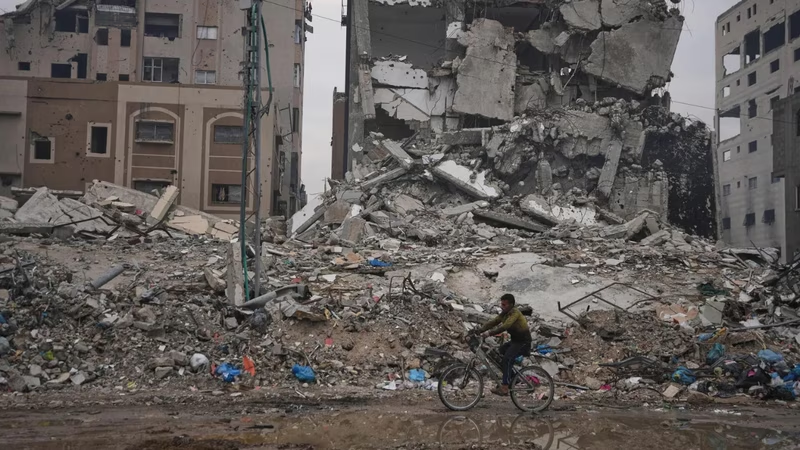
The fragile calm that had settled over Gaza was violently ripped apart on Thursday, January 8, 2026. In a stark reminder of the region’s volatility, Israeli airstrikes killed at least **13 Palestinians**, including **five children**, across the besieged territory . The attack comes just one week before the scheduled launch of a new U.S.-backed international body aimed at securing long-term peace—a timing that casts a dark shadow over its prospects.
Israel’s military claimed the strikes were a direct and necessary response to a “failed rocket attack” launched from Gaza earlier that day, which they assert constitutes a clear Gaza ceasefire violation . But for many on the ground, the disproportionate toll—especially the deaths of so many young lives—has reignited fears that the entire ceasefire framework is on the brink of total collapse.
Table of Contents
- The Deadly Strike and Its Aftermath
- Israel’s Justification: A Response to Violation
- The Human Cost: Civilians in the Crossfire
- A New Peace Initiative at a Perilous Moment
- Historical Context: Why Ceasefires Fail
- Conclusion: Can Peace Survive This Latest Blow?
- Sources
The Deadly Strike and Its Aftermath
The Israeli Defense Forces (IDF) targeted multiple locations in central and southern Gaza, with the heaviest bombardment reported in the Nuseirat refugee camp . Local health officials confirmed that the death toll included women and at least five children under the age of 12, with dozens more injured . Rescue workers struggled to pull survivors from the rubble as hospitals, already overwhelmed from months of conflict, pleaded for medical supplies.
The attack shattered a period of relative quiet that had held since the last major ceasefire agreement. While minor skirmishes had occurred, nothing on this scale had taken place in recent weeks, leading many to hope that a more permanent resolution might be possible.
Israel’s Justification: A Response to Violation
In its official statement, the IDF was unequivocal. It stated that its intelligence identified a cell preparing to launch rockets into southern Israel. Although the rocket launch itself failed and caused no damage or injuries on the Israeli side, the military deemed the mere attempt as a material breach of the existing ceasefire terms .
“We will not tolerate any violations of our sovereignty or threats to our citizens,” an IDF spokesperson said. “Our response was precise and proportionate to the threat.” However, critics, including several international human rights organizations, have questioned the definition of “proportionate” given the high civilian casualty count.
The Human Cost: Civilians in the Crossfire
The core tragedy of this latest escalation is its impact on non-combatants. Gaza, one of the most densely populated places on Earth, offers civilians little refuge during air raids. The targeting of residential areas, even if aimed at militant infrastructure, inevitably leads to catastrophic loss of innocent life.
This incident underscores a recurring pattern in the conflict:
- Disproportionate Impact: Military responses to limited attacks often result in significantly higher Palestinian casualties.
- Psychological Trauma: For children who have lived through years of conflict, each new explosion reopens deep psychological wounds.
- <Humanitarian Crisis: Each strike further degrades Gaza’s already crippled infrastructure, from water systems to healthcare, creating a cascading humanitarian emergency.
As noted by the [United Nations Office for the Coordination of Humanitarian Affairs (OCHA)](https://www.ochaopt.org/), the cycle of violence continues to push Gaza’s 2.3 million residents deeper into despair and deprivation.
A New Peace Initiative at a Perilous Moment
The timing of this Gaza ceasefire violation could not be more critical. It occurs just days before the anticipated launch of a new U.S.-led international coordination body, informally dubbed “Trump’s Board of Peace,” which is designed to oversee reconstruction efforts and broker a lasting political settlement .
This initiative, backed by key regional players, was seen as a potential turning point. However, this fresh bloodshed provides hardliners on both sides with powerful ammunition to argue that diplomacy is futile. Rebuilding trust—and the physical structures of Gaza—will be infinitely harder in an atmosphere of renewed hostilities.
Historical Context: Why Ceasefires Fail
This is far from the first ceasefire to crumble. Since the early 2000s, dozens of truces have been brokered, only to collapse within weeks or months. The reasons are systemic:
- Lack of Enforcement Mechanisms: Most ceasefires rely on mutual deterrence rather than a neutral, armed peacekeeping force.
- Internal Divisions: Factions within both Israeli and Palestinian societies often work to sabotage agreements they see as unfavorable.
- Unaddressed Core Issues: Without progress on fundamental issues like borders, the status of Jerusalem, and the right of return, ceasefires remain temporary pauses, not peace.
Without addressing these root causes, even the most well-intentioned new peace boards may be destined to repeat history.
Conclusion: Can Peace Survive This Latest Blow?
The deadly events of Thursday have dealt a severe blow to the already fragile hopes for peace in Gaza. While Israel maintains its right to self-defense, the tragic loss of civilian life, especially children, fuels a cycle of grief and retaliation that is incredibly difficult to break. The upcoming international peace initiative now faces its first and perhaps most significant test: can it restore calm and build a framework robust enough to withstand the next inevitable spark? The world watches, but for the people of Gaza, the wait is measured in lives lost.