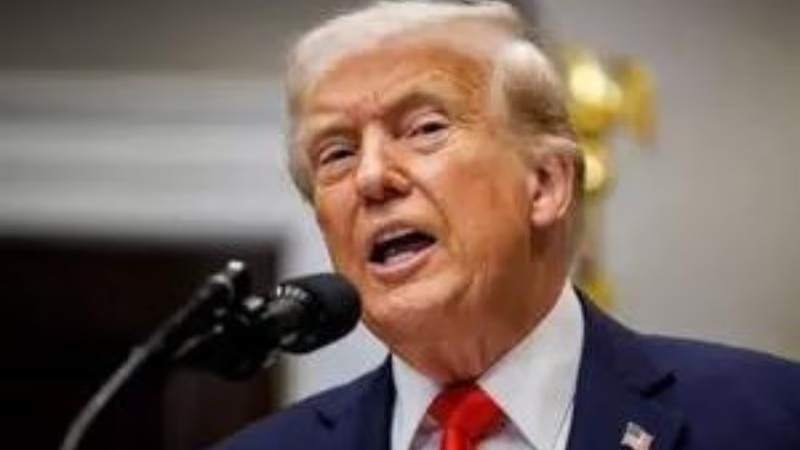
In a move that has sent shockwaves through diplomatic channels and reignited fears of a militarized southern border, Donald Trump has explicitly threatened to launch land strikes inside Mexico to combat its powerful drug cartels. This aggressive stance, coming on the heels of recent U.S. military operations in Venezuela under the banner of ‘Operation Absolute Resolve,’ marks a dangerous escalation in the long-standing war on drugs—and it’s a direct challenge to Mexico’s newly elected president, Claudia Sheinbaum [[1], [4]].
The prospect of U.S. boots on Mexican soil is not just a political bombshell; it’s a potential violation of international law and a direct affront to Mexican sovereignty. So, what’s driving this bold threat, and how is Mexico responding? Let’s break it all down.
Table of Contents
- Escalating Rhetoric: Trump’s Venezuela-to-Mexico Playbook
- What Are “Trump Mexico Land Strikes” and Why Now?
- Sheinbaum’s Firm Stance: “Mexico is Sovereign”
- Historical Context: A History of Tense Cooperation
- Potential Consequences: A Regional Crisis?
- Conclusion: A Perilous Path Forward
- Sources
Escalating Rhetoric: Trump’s Venezuela-to-Mexico Playbook
Trump’s strategy appears to be one of calibrated aggression. After authorizing strikes on suspected drug-trafficking vessels linked to Venezuela, he has now turned his full attention to Mexico, which he claims is effectively being “run” by cartels [[6], [7]]. In a recent interview with Fox News, he declared, “We are going to start now hitting land with regard to the cartels,” signaling a dramatic shift from naval or aerial interdiction to direct ground operations [[4], [9]].
This isn’t just tough talk for a domestic audience. It’s a clear signal to the Sheinbaum administration that the U.S. is willing to take unilateral, and potentially illegal, military action if it deems Mexico’s own efforts insufficient . The underlying message is simple: cooperate fully, or face the consequences.
What Are “Trump Mexico Land Strikes” and Why Now?
The term “Trump Mexico land strikes” refers to the potential deployment of U.S. special operations forces or other military assets onto Mexican territory to directly engage and dismantle drug cartel infrastructure. This could involve raids on production labs, command centers, or even targeted assassinations of key leaders.
While the U.S. has a history of providing intelligence, training, and equipment to Mexican security forces (a program known as the Mérida Initiative), direct combat operations by U.S. troops on Mexican soil have been a red line since the early 20th century. The current push is likely fueled by several factors:
- Fentanyl Crisis: The devastating impact of fentanyl, largely trafficked through Mexico, on American communities provides a powerful domestic justification.
- Political Posturing: With an eye on future elections, taking a hardline stance on border security and drugs remains a potent political tool.
- Perceived Weakness: The Trump camp may view the new Sheinbaum administration as vulnerable and in need of a strong external push to act decisively against the cartels .
Sheinbaum’s Firm Stance: “Mexico is Sovereign”
President Claudia Sheinbaum has not backed down. Her response has been swift, clear, and rooted in a deep sense of national pride and legal principle. She has categorically rejected any possibility of U.S. military intervention in Mexico’s internal affairs [[5], [8], [20]].
In a powerful statement, Sheinbaum emphasized, “We are a free, independent, and sovereign country,” directly challenging the premise of Trump’s threats . She even invoked the painful memory of the 19th-century Mexican-American War as a historical warning against U.S. territorial ambitions .
Her position is not just about pride; it’s about practicality and legality. Allowing a foreign military to operate within its borders would be a massive breach of Mexico’s constitution and could destabilize the already fragile relationship between its government and its citizens. For Sheinbaum, cooperation on intelligence and joint task forces is on the table, but unilateral U.S. military action is a non-starter .
Historical Context: A History of Tense Cooperation
The idea of U.S. military action in Mexico isn’t entirely new, but it has always been met with fierce resistance. Past efforts have been limited to advisory roles and logistical support. For instance, U.S. Special Operations Forces have partnered with Guatemalan troops near the Mexican border, but never crossed into Mexico itself .
Previous Mexican administrations have walked a tightrope, accepting U.S. aid while fiercely guarding their sovereignty. The Mérida Initiative, launched in 2007, is a prime example of this delicate balance. Any move by the U.S. to bypass this framework and conduct its own land strikes would shatter decades of established, if often strained, protocol.
Potential Consequences: A Regional Crisis?
The fallout from such a move could be catastrophic on multiple fronts:
| Potential Consequence | Description |
|---|---|
| Diplomatic Rupture | A complete breakdown in US-Mexico relations, impacting trade, immigration policy, and regional security cooperation. |
| Cartel Retaliation | Cartels could escalate violence, potentially targeting US citizens and interests both in Mexico and across the border [[15], [16]]. |
| Legal & Moral Quagmire | Such an invasion would be widely condemned as a violation of international law, damaging America’s global standing . |
| Domestic Unrest in Mexico | The Mexican public would likely see this as a national humiliation, potentially fueling anti-American sentiment and political instability. |
Conclusion: A Perilous Path Forward
The standoff between Trump’s threat of land strikes and Sheinbaum’s defense of Mexican sovereignty represents a critical juncture in North American geopolitics. While the desire to dismantle the cartels that fuel the fentanyl epidemic is understandable, a unilateral military invasion is a reckless and likely counterproductive solution. The path forward must lie in strengthened, respectful bilateral cooperation—not in the shadow of gunships. The world will be watching to see if cooler heads can prevail before this dangerous rhetoric turns into a devastating reality. For more on the complexities of cross-border security, check out our analysis on [INTERNAL_LINK:us-mexico-border-policy].
Sources
[1] Times of India. “Next target Mexico? After Venezuela, Trump eyes ‘drug cartels’; warns of land strikes.” https://timesofindia.indiatimes.com/world/us/…
[3] Reuters. “Sheinbaum cites Mexican-American War as she rejects Trump’s cartel strike threats.”
[4] Fox News. Interview with Donald Trump, January 2026.
[5] Xinhua. “Mexican president rejects U.S. intervention in Mexico to combat drug cartels.”
[8] Various news reports on Sheinbaum’s official statement, January 2026.
[12] Council on Foreign Relations. “Is the United States Preparing for a War with Drug Cartels?”
[14] Lawfare Blog. “U.S. Military Action in Mexico: Illegal, Counterproductive.”
[15] Foreign Policy. “Why US military action against Latin America’s cartels won’t work.”
[16] Modern War Institute. “Using Special Operations Forces to Counter Mexican Cartels.”
[18] Official statement from the Office of the President of Mexico, Claudia Sheinbaum.
[20] Associated Press. “Sheinbaum Uses Venezuela to Warn Trump About Mexico.”
[22] BBC News. “Mexico president baulks at possibility of US intervention to fight cartels.”