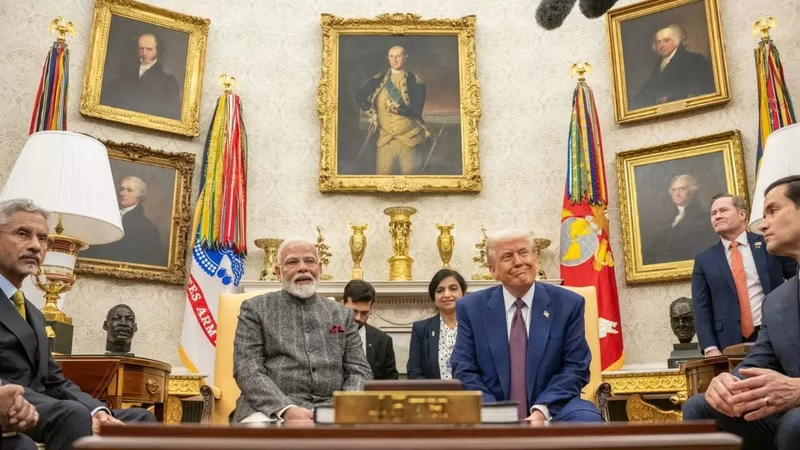
Introduction: The Phone Call That Never Happened
In the high-stakes world of global diplomacy, sometimes a single missed phone call can echo louder than a thousand speeches. A recent analysis by The Times of India raises a provocative question: Did Prime Minister Narendra Modi’s reported reluctance to directly call then-President Donald Trump ultimately cost India a critical India US trade deal?
The backdrop is familiar—rising protectionism in Washington, escalating tariffs on Indian steel and aluminum, and years of stalled negotiations over market access for dairy, medical devices, and digital services. At the heart of it all was a personal dynamic between two strong-willed leaders. And according to insiders, when Trump sought a direct line to Modi during a pivotal moment in 2019–2020, the call never came. The result? A potential breakthrough evaporated, leaving India vulnerable to unilateral U.S. trade actions.
Table of Contents
- The Staircase and the See-Saw: A Diplomatic Metaphor
- Why the India US Trade Deal Mattered
- Modi-Trump Chemistry: The Personal Diplomacy Factor
- What Was Lost: Tariffs and Missed Opportunities
- Could It Have Been Different? A Counterfactual
- Conclusion: Lessons for Future Trade Strategy
- Sources
The Staircase and the See-Saw: A Diplomatic Metaphor
The original article uses a vivid metaphor: “Between the staircase and the see-saw.” The staircase symbolizes steady, incremental progress—methodical negotiations through official channels like the USTR (Office of the United States Trade Representative). The see-saw, however, represents the volatile, personality-driven diplomacy that defined the Trump era—where deals were often made or broken in a single conversation between leaders .
India, traditionally favoring institutional processes, may have underestimated how much Trump valued direct, personal engagement. While U.S. officials reportedly urged New Delhi to have Modi pick up the phone, the Indian side hesitated—perhaps wary of appearing too eager or concerned about domestic optics. In doing so, they may have missed their window.
Why the India US Trade Deal Mattered
A comprehensive India US trade deal wasn’t just about economics—it was a strategic imperative. Here’s what was at stake:
- Market Access: Securing duty-free entry for Indian IT services, pharmaceuticals, and textiles into the massive U.S. consumer market.
- Tariff Relief: Reversing Section 232 tariffs on steel (25%) and aluminum (10%) imposed in 2018, which cost Indian exporters an estimated $200 million annually .
- Geopolitical Leverage: Strengthening the U.S.-India partnership as a counterbalance to China, especially in tech and defense supply chains.
- Investor Confidence: A formal pact would have signaled stability, attracting more American FDI into India’s manufacturing and digital sectors.
Without this framework, India remained exposed to ad-hoc trade actions—a vulnerability that continues under the Biden administration.
Modi-Trump Chemistry: The Personal Diplomacy Factor
On the surface, Modi and Trump shared a warm rapport. Trump’s grand welcome for Modi at the Houston “Howdy, Modi!” rally in 2019 was unprecedented . Yet behind the photo ops, a disconnect emerged. Trump, known for his transactional style, reportedly expected reciprocal personal outreach—especially when he floated the idea of a “mini trade deal” in late 2019.
According to sources cited in the TOI report, Trump’s team conveyed that a direct call from Modi could unlock concessions. But New Delhi, relying on bureaucratic channels and perhaps overconfident in its geopolitical value, delayed. By the time outreach intensified, Trump’s attention had shifted to re-election and other global crises . The moment passed.
What Was Lost: Tariffs and Missed Opportunities
The consequences were tangible. In June 2020, the U.S. terminated India’s designation under the Generalized System of Preferences (GSP), a program that allowed $5.6 billion worth of Indian exports to enter duty-free . While not solely tied to the lack of a call, the absence of a high-level trade agreement left India with little leverage to resist the move.
Moreover, the failure to secure a deal meant India missed a chance to lock in favorable terms before the U.S. political cycle turned. Even today, under President Biden, negotiations remain fragmented—covering specific sectors rather than a holistic pact. The opportunity for a landmark agreement during a uniquely receptive (if erratic) U.S. presidency was lost.
Could It Have Been Different? A Counterfactual
Imagine if Modi had made that call. A short, 10-minute conversation acknowledging Trump’s concerns while reaffirming India’s commitment to fair trade might have been enough to greenlight a limited deal. Such an agreement could have:
- Restored GSP benefits temporarily.
- Paved the way for mutual recognition of standards in medical devices.
- Built trust for deeper cooperation in emerging areas like AI and semiconductors.
This isn’t mere speculation. Historical precedent shows that personal diplomacy has worked—Reagan and Gorbachev, Clinton and Jiang Zemin, even Obama and Singh. In Trump’s world, relationships trumped (pun intended) procedure.
Conclusion: Lessons for Future Trade Strategy
Whether or not a single phone call would have changed history is debatable. But the episode offers a clear lesson: in an era of personalized geopolitics, even the most process-driven nations must adapt. The failure to secure an India US trade deal during the Trump window wasn’t just a bureaucratic oversight—it was a strategic miscalculation of leadership dynamics.
As India navigates complex trade talks with the EU, UK, and now the U.S. under Biden, the takeaway is clear: combine institutional rigor with timely, high-level engagement. The next big opportunity may not wait. For more on India’s evolving trade landscape, explore our deep dive on [INTERNAL_LINK:india-global-trade-agreements].
Sources
- Times of India: “Between the staircase and the see-saw: Did PM Modi’s reluctance to call Trump cost India a trade deal?”
- USTR.gov: Reports on India-U.S. Trade Relations and GSP Termination.
- Peterson Institute for International Economics (PIIE): Analysis of U.S.-India trade tensions.
- White House Archives: Statements from the Trump administration on trade.
- Ministry of Commerce & Industry, Government of India: Export data and trade policy documents.