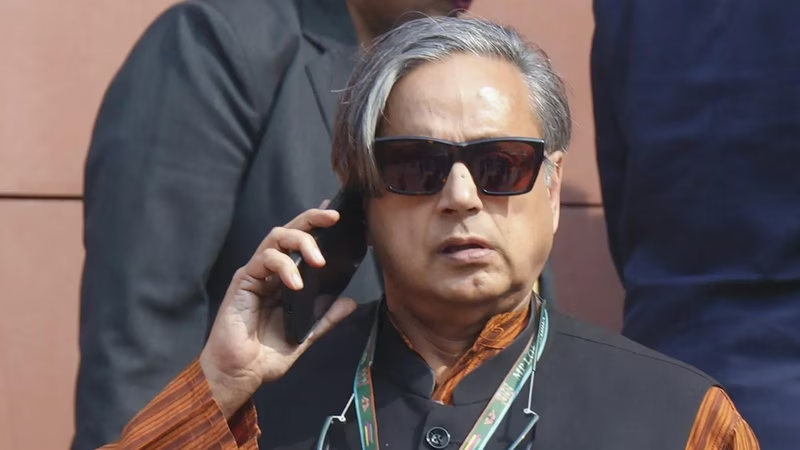
In the ever-churning cauldron of Indian political discourse, few figures are as consistently debated—and often maligned—as Jawaharlal Nehru. Now, one of his most prominent intellectual defenders, Congress MP and author Shashi Tharoor, has offered a refreshingly honest and balanced perspective. At a recent event in Kerala, Tharoor declared himself a fan of Nehru, but was quick to add a crucial caveat: he is not an “uncritical fan.”
This statement, a direct response to the relentless attacks on Nehru by the current political establishment, cuts through the noise of blind adulation and blanket condemnation alike. It’s a stance that acknowledges complexity—a rarity in today’s polarized climate.
Table of Contents
- Tharoor’s Nuanced Stance on Nehru
- The 1962 War: A Mistake, But Not the Whole Story
- BJP’s ‘Convenient Scapegoat’ Tactic
- Beyond Politics: Tharoor, Kerala, and the Love for Books
- Why This Debate Matters for Indian Democracy
- Conclusion: A Call for Historical Honesty
- Sources
Tharoor’s Nuanced Stance on Nehru
Tharoor’s core argument is simple yet powerful: respecting Nehru as the chief architect of India’s democratic institutions does not require ignoring his shortcomings. “I am a fan of Jawaharlal Nehru, but not an uncritical fan,” he stated clearly . This distinction is vital. It separates thoughtful historical analysis from partisan hero-worship.
He credits Nehru with embedding the DNA of a pluralistic, secular, and democratic republic into the very fabric of the nation—a legacy that, Tharoor argues, is under sustained assault. By framing Nehru not as a flawless deity but as a complex human leader who made monumental contributions alongside some significant errors, Tharoor provides a more credible and defensible position.
The 1962 War: A Mistake, But Not the Whole Story
When pressed on Nehru’s failures, Tharoor pointed directly to the 1962 India-China war. He conceded that the disastrous defeat was, at least in part, a result of Nehru’s misjudgment and misplaced trust in Chinese intentions . “For instance, the 1962 war… their (Modi government’s) criticism may have a basis,” he acknowledged .
However, Tharoor’s acceptance of this specific failing is immediately followed by a sharp rebuke of how it is used politically. The problem, he insists, is not the critique itself, but its weaponization. The current government, he argues, uses the 1962 debacle not as a point of historical discussion, but as a battering ram to discredit Nehru’s entire life’s work and, by extension, the foundational values of the Indian Republic.
The Danger of Retroactive Blame
Tharoor slammed the tendency to blame Nehru for every contemporary issue facing India, from economic challenges to security concerns. This, he says, is intellectually dishonest and a form of historical laziness. “Nehru has been turned into a convenient scapegoat,” he declared . The implication is clear: by focusing all blame on a long-dead leader, the present government deflects scrutiny from its own policies and performance.
BJP’s ‘Convenient Scapegoat’ Tactic
Tharoor’s most scathing criticism is reserved for the BJP’s political strategy. He accuses the party of systematically dismantling Nehru’s legacy not for a genuine historical reckoning, but for its own ideological and electoral gain. He has previously gone so far as to state that the Modi government is not merely “anti-democratic” but specifically “anti-Nehru” .
This tactic, according to Tharoor, serves a dual purpose:
- It delegitimizes the Congress party’s historical narrative by attacking its founding father.
- It creates a simplistic villain for complex, modern problems, offering voters an easy explanation that absolves the current administration of responsibility.
This approach, he warns, impoverishes public discourse and prevents a mature engagement with India’s past and present.
Beyond Politics: Tharoor, Kerala, and the Love for Books
During his Kerala address, Tharoor also took a moment to reflect on his personal journey as a writer, crediting the state’s rich reading culture for shaping his intellectual life . He shared anecdotes about his early days of writing, painting a picture of a society where literature and debate are woven into the social fabric. This personal touch served as a poignant reminder that the defense of a figure like Nehru is, at its heart, a defense of a certain kind of intellectual and cultural ethos—one that values reason, debate, and a deep engagement with ideas.
Why This Debate Matters for Indian Democracy
The fight over Nehru’s legacy is not just about history; it’s a proxy war for India’s future. Nehru’s vision of a secular, scientific, and democratic India stands in stark contrast to the majoritarian and centralized model promoted by his critics. Tharoor’s nuanced defense is, therefore, a call to protect the core constitutional values that Nehru helped enshrine. For a deeper dive into these foundational principles, see our explainer on [INTERNAL_LINK:India’s Constitutional Framework].
Conclusion: A Call for Historical Honesty
Shashi Tharoor’s message is a plea for balance and intellectual honesty. He asks us to hold two truths in our minds at once: that Jawaharlal Nehru was a flawed man who made a grave error in 1962, and that he was also the indispensable builder of the world’s largest democracy. To reduce him to either a saint or a sinner is to fail history. In an era of black-and-white narratives, Tharoor’s call for a more complex, truthful understanding of our past is not just refreshing—it’s essential for our democratic health.
Sources
- Times of India: ‘Cannot support all his beliefs’: Tharoor calls himself ‘uncritical fan’ of Nehru
- The Hindu: Analysis on Nehru’s Legacy and Contemporary Politics
- Parliament of India Debates Archive: Official Records of Parliamentary Discussions