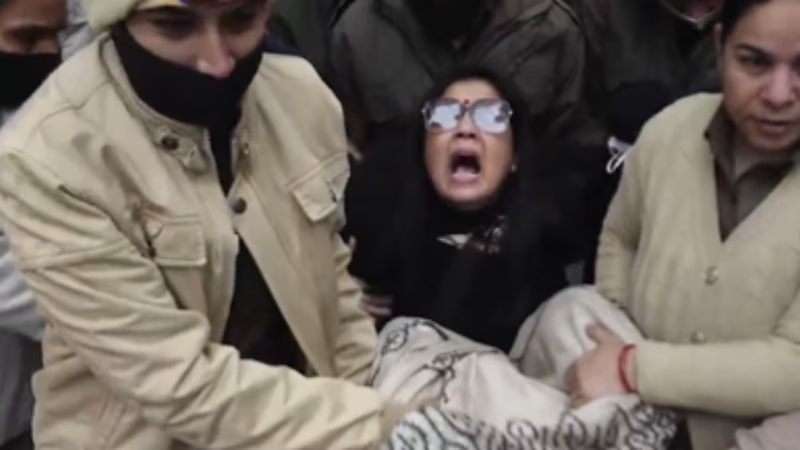
Chaos erupted in the heart of India’s power corridor this week when Trinamool Congress (TMC) MPs Mahua Moitra and Derek O’Brien were physically dragged away by Delhi Police during a protest outside Union Home Minister Amit Shah’s North Block office . The demonstration—staged in response to a recent Enforcement Directorate (ED) raid on the party’s influential think tank, the Indian People’s Action Council (I-PAC)—has ignited a fierce political battle, with the TMC accusing the BJP-led Centre of weaponizing investigative agencies for political vendetta.
The visuals of two sitting Members of Parliament being manhandled outside one of the most secure government buildings in New Delhi sent shockwaves across the nation. But beyond the drama lies a deeper story: a high-stakes confrontation over federalism, institutional independence, and the future of opposition politics in India. What exactly is I-PAC? Why is the ED targeting it? And what does this mean for West Bengal’s ruling party ahead of crucial elections?
Table of Contents
- The TMC Protest at Amit Shah’s Office: What Happened?
- What is I-PAC and Why Was It Raided?
- TMC Accusations: Political Vendetta or Legitimate Investigation?
- BJP Response: Defending the ED Action
- Historical Context of Agency Actions Against Opposition Parties
- Implications for West Bengal and National Politics
- Conclusion: A Nation Watching Its Democratic Norms
- Sources
The TMC Protest at Amit Shah’s Office: What Happened?
On January 8, 2026, a group of TMC leaders, including MPs Mahua Moitra and Derek O’Brien, gathered near North Block to stage a peaceful protest against the ED’s multi-city raids on I-PAC offices . They demanded a halt to what they called “harassment” of civil society organizations aligned with opposition parties.
However, the protest quickly turned confrontational. Despite prior notice, police deemed the gathering a security risk and ordered the group to disperse. When the MPs refused, citing their constitutional right to peaceful assembly, officers moved in and forcibly removed them—a scene captured in widely shared videos showing Moitra being pulled by her arm and O’Brien shouting, “We are elected representatives!” .
This incident has become the flashpoint for the ongoing TMC protest Amit Shah office narrative, symbolizing the growing friction between the Centre and regional opposition forces.
What is I-PAC and Why Was It Raided?
The Indian People’s Action Council (I-PAC) is a Hyderabad-based political consultancy that has worked with several opposition parties, including the TMC, to design election strategies, conduct voter outreach, and manage data analytics . It played a significant role in Mamata Banerjee’s 2021 West Bengal re-election victory.
The ED’s raid, conducted under the Prevention of Money Laundering Act (PMLA), allegedly stems from suspicions of foreign funding violations and unaccounted financial transactions linked to I-PAC’s operations . The agency claims to have found incriminating documents during its searches.
The TMC, however, dismisses these claims as baseless, arguing that I-PAC’s work is transparent and legal. They see the raid as part of a broader pattern of using central agencies to destabilize opposition strongholds.
TMC Accusations: Political Vendetta or Legitimate Investigation?
TMC leaders have been unequivocal in their condemnation. “This is not an investigation—it’s intimidation,” declared Derek O’Brien in a press conference after his release . Mahua Moitra added, “When you can’t win at the ballot, you try to jail your opponents.”
The party points to a string of similar actions against opposition figures—from Delhi’s Arvind Kejriwal to Punjab’s Bhagwant Mann—as evidence of a systematic campaign. Critics argue that while agencies must act against wrongdoing, their timing and selectivity raise serious questions about impartiality.
BJP Response: Defending the ED Action
The BJP has firmly rejected allegations of bias. “The law applies equally to all,” stated a senior party spokesperson. “If I-PAC has nothing to hide, why fear a routine inquiry?”
The government maintains that the ED operates independently and that any suggestion of political interference undermines the integrity of India’s legal institutions. They frame the TMC’s protest as a diversionary tactic to avoid accountability.
Historical Context of Agency Actions Against Opposition Parties
This is not the first time central agencies have targeted opposition-linked entities. During previous UPA and NDA regimes alike, similar accusations have flown. However, data from the Association for Democratic Reforms (ADR) shows a marked increase in ED raids on opposition leaders since 2014 .
While every case must be judged on its merits, the perception of selective enforcement has become a major point of contention in India’s democratic discourse.
Implications for West Bengal and National Politics
For Mamata Banerjee, this incident is both a challenge and an opportunity. On one hand, it risks alienating moderate voters who value institutional stability. On the other, it galvanizes her core base by reinforcing the “David vs. Goliath” narrative against the Centre.
Nationally, the event underscores the deepening polarization between the ruling coalition and the opposition bloc. As the 2029 general elections draw closer, expect more such confrontations. For deeper analysis, see our feature on [INTERNAL_LINK:centre-state_relations_india].
Conclusion: A Nation Watching Its Democratic Norms
The forcible removal of MPs during the TMC protest Amit Shah office episode is more than a political spat—it’s a stress test for India’s democratic fabric. The real question isn’t just whether I-PAC broke the law, but whether the instruments of justice are being applied fairly and without fear or favor. In a vibrant democracy, dissent must not be mistaken for defiance, and protest must never be met with suppression.
Sources
- Times of India: Watch: From Mahua to Derek, police drag away TMC MPs protesting outside Amit Shah’s office
- NDTV Video Footage: TMC MPs Removed from North Block Protest
- The Hindu: Who is I-PAC, the firm at the center of the ED raid?
- PMLA Case Documents (Public Summary via ED Press Release)
- TMC Official Statement, January 8, 2026
- BJP National Media Cell Response
- Association for Democratic Reforms (ADR): ED Raids on Political Leaders (2014–2025 Report)