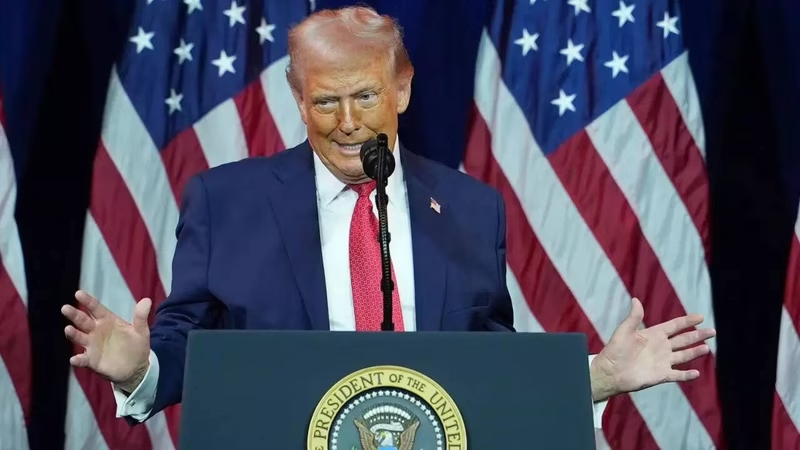
“Time will tell…”—with those three words, Donald Trump dropped a geopolitical bombshell that has analysts scrambling. In a recent statement, the former U.S. president declared that America will effectively control Venezuela’s oil reserves for the foreseeable future, framing it not as a temporary intervention but as a strategic, long-term play. The announcement comes amid unverified reports of Venezuelan President Nicolás Maduro’s capture and growing speculation that Trump may soon make a high-profile visit to Caracas.
Table of Contents
- Trump’s Bold Claim on Venezuela Oil
- What Does ‘US Control of Venezuela Oil’ Mean?
- Maduro’s Alleged Capture and the Power Vacuum
- Venezuela’s Interim Leaders Push Back
- Economic and Geopolitical Implications
- Will Trump Visit Caracas?
Trump’s Bold Claim on Venezuela Oil
Speaking at a rally in Florida—a state with deep ties to the Venezuelan diaspora—Trump stated plainly: “We’re going to run Venezuela’s oil. For how long? Time will tell.” He went on to assert that the U.S. would manage the sale of Venezuelan crude, using the proceeds to purchase American-made goods, effectively turning Venezuela’s national resource into a tool of U.S. economic policy .
This isn’t the first time Trump has eyed Venezuela’s oil. During his presidency, he imposed harsh sanctions on the Maduro regime and recognized opposition leader Juan Guaidó as interim president. But this latest rhetoric goes further—suggesting direct operational control, not just sanctions or diplomatic pressure.
What Does ‘US Control of Venezuela Oil’ Mean?
The phrase “US control of Venezuela oil” is deliberately vague—but its implications are massive. Venezuela holds the world’s largest proven oil reserves, estimated at over 300 billion barrels by the U.S. Energy Information Administration (EIA) . Historically, mismanagement, corruption, and U.S. sanctions have crippled its production, which has fallen from over 3 million barrels per day (bpd) in the early 2000s to under 800,000 bpd in recent years.
Under Trump’s proposed model, the U.S. would:
- Oversee the extraction and export of Venezuelan crude.
- Direct revenue toward repaying U.S. creditors or purchasing American goods.
- Potentially lower global oil prices by flooding the market with new supply.
- Reduce reliance on Middle Eastern or Russian oil.
Critics argue this amounts to economic colonialism, while supporters see it as a pragmatic way to stabilize a failed state and advance U.S. energy security.
Maduro’s Alleged Capture and the Power Vacuum
Trump’s comments follow swirling rumors—still unconfirmed by major international outlets—that Nicolás Maduro has been detained by internal factions within Venezuela’s military or intelligence services. If true, this would mark a seismic shift in the country’s decade-long political crisis.
However, experts urge caution. “Claims about Maduro’s capture surface periodically and often prove false,” notes the Council on Foreign Relations . Even if removed, Maduro’s departure wouldn’t automatically grant the U.S. legal authority over Venezuela’s sovereign resources. Any such arrangement would require recognition of a legitimate transitional government—and even then, face fierce legal and diplomatic challenges.
Venezuela’s Interim Leaders Push Back
Despite Trump’s confidence, Venezuela’s current interim leadership—now under different figures since Guaidó’s influence waned—has publicly rejected the notion of foreign control over national assets. “Venezuela’s oil belongs to the Venezuelan people,” said a spokesperson for the National Assembly, emphasizing that any cooperation must be based on mutual respect, not imposition .
This pushback highlights a key contradiction in Trump’s narrative: you can’t “run” a country’s oil without local consent, especially in a region historically sensitive to U.S. intervention. From Guatemala in the 1950s to Chile in the 1970s, memories of American-backed coups still fuel anti-U.S. sentiment across Latin America.
Economic and Geopolitical Implications
If the U.S. were to gain operational control—even partially—it could significantly impact global markets:
Potential Outcomes of US Control of Venezuela Oil
- Lower Global Oil Prices: Adding 1–2 million bpd of light crude could ease supply constraints.
- Weaken Russia & Iran: Both nations have propped up Maduro; losing Venezuela reduces their strategic foothold.
- Boost U.S. Refiners: Gulf Coast refineries are configured for heavy Venezuelan crude.
- Legal Battles: Creditors, including Chevron and Rosneft, may sue over asset claims.
Moreover, such a move would test the Biden administration’s stance, as current policy favors re-engagement with Caracas under strict conditions—not outright control. A Trump return to the White House in 2025 could accelerate this agenda, making his comments both a campaign promise and a foreign policy threat.
Will Trump Visit Caracas?
Perhaps the most tantalizing part of Trump’s statement was his hint about a future trip: “I’ll go to Caracas eventually… when it’s safe, and when we’re in charge.” While likely rhetorical, the idea of a sitting or former U.S. president visiting Caracas would be historic—no U.S. leader has done so in decades.
A visit would signal full normalization—or domination—depending on your perspective. For now, it remains speculative. But in Trump’s world, where symbolism often precedes strategy, the mere suggestion is a message to allies, adversaries, and voters alike.
Conclusion
Donald Trump’s remarks about the US control of Venezuela oil are more than campaign bluster—they reflect a hardline vision for American dominance in the Western Hemisphere. While legal, logistical, and diplomatic hurdles remain immense, the very fact that such a scenario is being openly discussed marks a dangerous escalation in the rhetoric around resource sovereignty. Whether this leads to stabilization or deeper conflict in Venezuela—and what it means for global energy markets—remains, as Trump himself said, something only time will tell. For deeper analysis on U.S.-Latin America relations, explore our feature on [INTERNAL_LINK:us-latin-america-energy-policy].