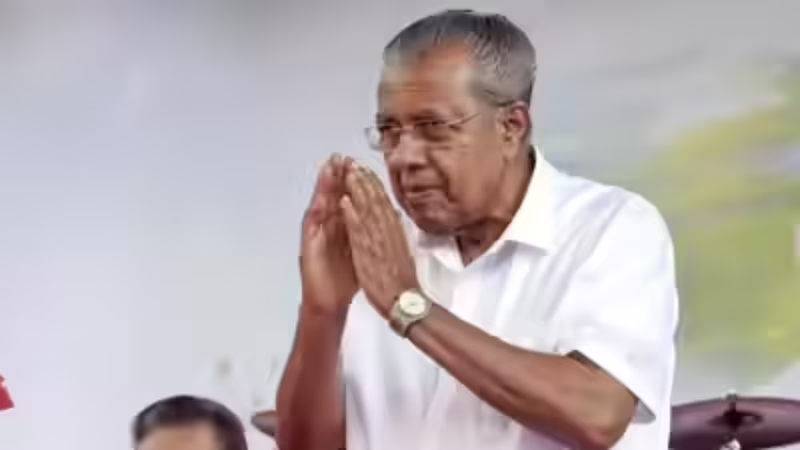
The political and bureaucratic landscape of Kerala is once again in turmoil. This time, it’s not just about a scandal, but about the fate of the very officer tasked with unraveling it. P Radhakrishnan, the Enforcement Directorate (ED) Deputy Director who was at the forefront of the explosive Kerala gold smuggling case, has been ordered to retire compulsorily by the Union government. This move has sent shockwaves through the corridors of power and raised serious questions about the independence of investigative agencies.
Table of Contents
- Who is P Radhakrishnan?
- Recap: The 2020 Kerala Gold Smuggling Case
- The Controversial Investigation and Political Fallout
- Why Was the ED Officer Forced to Retire?
- What Does Compulsory Retirement Mean for an ED Officer?
- Conclusion: A Chilling Precedent or a Necessary Action?
- Sources
Who is P Radhakrishnan?
P Radhakrishnan, a native of Thiruvananthapuram, was a senior official in the Enforcement Directorate known for handling high-profile cases . His most notable assignment was leading the ED’s probe into the 2020 diplomatic-channel gold smuggling case in Kochi . As the investigating officer, he was instrumental in building the case that eventually led to the arrest of M. Sivasankar, the then Principal Secretary to Kerala Chief Minister Pinarayi Vijayan . His work placed him directly in the crosshairs of one of the state’s biggest political controversies.
Recap: The 2020 Kerala Gold Smuggling Case
The saga began on July 5, 2020, when customs officials at Thiruvananthapuram airport seized 30 kilograms of 24-carat gold, valued at a staggering ₹14.82 crore, from a diplomatic cargo consignment originating in the UAE . This wasn’t just a routine smuggling operation; the use of a diplomatic channel immediately suggested deep-level involvement and sparked a national firestorm .
The case quickly snowballed. The National Investigation Agency (NIA) took over the primary investigation, while the ED was brought in to track the illicit financial transactions and money laundering aspects linked to the smuggled gold [[9], [15]]. The ED’s probe, under Radhakrishnan’s leadership, alleged that the accused had smuggled gold from the UAE a total of 21 times between November 2019 and June 2020 .
The Controversial Investigation and Political Fallout
The investigation took a dramatic turn when it began to implicate top state officials. In October 2020, the ED arrested M. Sivasankar, a close aide to the Chief Minister, after the Kerala High Court dismissed his anticipatory bail plea . This arrest was a direct result of the evidence gathered by Radhakrishnan’s team.
However, the probe itself soon became mired in controversy. The Kerala Police filed a First Information Report (FIR) against ED officials, accusing them of applying “mental pressure” on the prime accused, Swapna Suresh, to falsely implicate Chief Minister Pinarayi Vijayan . This created a tense standoff between the central and state governments, with the ED’s methods and motives coming under intense scrutiny.
Why Was the ED Officer Forced to Retire?
The Union government’s decision to compulsorily retire P Radhakrishnan was not taken lightly. According to official sources, the order came after a preliminary inquiry found substance in serious allegations against him, including accusations of bribery [[18], [24]]. The Ministry of Finance, based on these findings, recommended his compulsory retirement, a decision that was subsequently approved by the President of India .
This action was taken under the stringent provisions of Rule 56(j)(i) of the Fundamental Rules, which allows for the premature retirement of a government servant in the public interest, even if no formal penalty can be imposed . The timing of this decision, so soon after his high-profile role in the Kerala gold smuggling case, has inevitably fueled speculation and debate.
What Does Compulsory Retirement Mean for an ED Officer?
For an officer in a sensitive agency like the ED, compulsory retirement is a severe administrative action. It is distinct from dismissal or removal, as it doesn’t necessarily carry a formal stigma of proven misconduct, but it effectively ends their career prematurely .
This mechanism is often used when there are serious concerns about an officer’s conduct or integrity that may not be easily provable in a departmental inquiry but are significant enough to warrant their removal from service for the sake of the organization’s reputation and public trust. For someone like Radhakrishnan, who was at the center of a politically charged investigation, this move is a career-ending blow with far-reaching implications.
Conclusion: A Chilling Precedent or a Necessary Action?
The compulsory retirement of ED Deputy Director P Radhakrishnan is a complex and deeply controversial event. On one hand, if the allegations of corruption are true, it represents a necessary step to uphold the integrity of a crucial financial investigation agency. On the other hand, given his pivotal role in a case that targeted a powerful state government, many fear this could set a dangerous precedent of political retribution against honest officers doing their duty.
Only a transparent and independent review of the circumstances surrounding his retirement can provide clarity. Until then, this incident will remain a stark reminder of the immense pressures and risks faced by investigators operating at the intersection of crime, finance, and high-stakes politics in India. For more on how central agencies operate in politically sensitive environments, see our analysis on [INTERNAL_LINK:central-agency-independence-in-india].