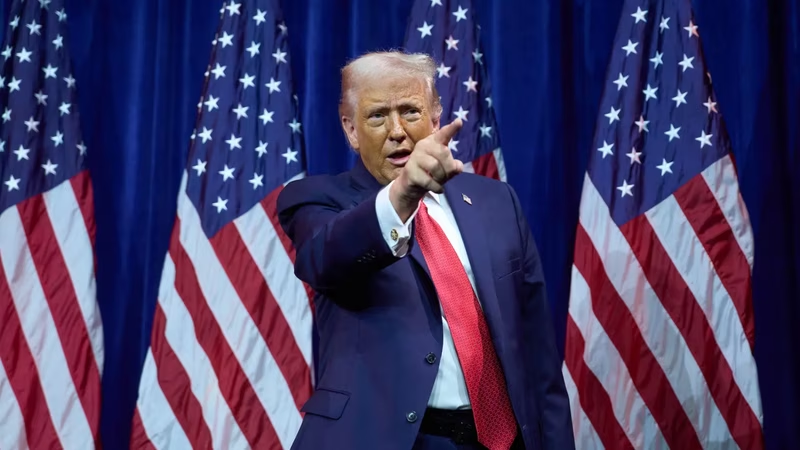
In a stark reversal of America’s commitment to global climate cooperation, the Trump administration has officially pulled the United States out of the India-led solar alliance—a strategic and symbolic blow to one of the most ambitious clean energy partnerships of the 21st century. The decision, confirmed in late 2025, marks yet another retreat from multilateral environmental efforts under Trump’s “America First” doctrine, raising serious questions about the future of U.S. leadership in the fight against climate change .
The International Solar Alliance (ISA), co-founded by India and France in 2015 during the Paris Climate Conference, was envisioned as a coalition of sun-rich nations working together to drive down the cost of solar power, share technology, and mobilize over $1 trillion in investments by 2030. With the U.S. now stepping away, the alliance loses not just financial clout but also geopolitical weight at a time when global unity on clean energy has never been more critical.
Table of Contents
- What Is the India-Led Solar Alliance?
- Why Did Trump Pull the U.S. Out?
- Global Reactions and Diplomatic Fallout
- Impact on Clean Energy and Climate Goals
- The Path Forward for the ISA
- Conclusion: A Setback, But Not the End
- Sources
What Is the India-Led Solar Alliance?
Launched by Indian Prime Minister Narendra Modi and then-French President François Hollande in 2015, the International Solar Alliance (ISA) is a treaty-based intergovernmental organization headquartered in Gurugram, India. Its mission is simple yet revolutionary: to make solar energy affordable and accessible across the 121 countries located between the Tropics of Cancer and Capricorn—regions that receive abundant sunlight year-round .
The ISA aims to:
- Reduce the cost of finance and technology for solar projects.
- Facilitate collaborative research and development.
- Create a common market for solar equipment and services.
- Mobilize $1 trillion in solar investments by 2030.
As of 2026, over 90 countries have signed the ISA Framework Agreement, with more than 70 having ratified it—including major economies like Australia, Brazil, and the UK. The U.S. had initially joined as a signatory in 2017 under the Obama administration but never formally ratified the treaty. Trump’s recent move severs even that symbolic link .
Why Did Trump Pull the U.S. Out?
While the White House has not issued a detailed public statement, insiders and policy analysts point to familiar themes from Trump’s previous environmental decisions. His administration has long viewed international climate pacts as potential constraints on American economic sovereignty and fossil fuel interests.
This withdrawal aligns with Trump’s broader pattern: exiting the Paris Agreement in 2017, rolling back domestic clean energy regulations, and promoting coal, oil, and gas as pillars of “energy dominance.” To his supporters, leaving the India-led solar alliance is consistent with prioritizing U.S. industrial interests over what they see as costly foreign commitments .
Critics, however, argue this is short-sighted. The U.S. solar industry employs over 250,000 Americans and is one of the fastest-growing sectors in the energy economy. By isolating itself from global solar initiatives, the U.S. risks ceding technological leadership to China and India—both of whom are aggressively investing in renewable infrastructure .
Global Reactions and Diplomatic Fallout
The announcement has drawn swift condemnation from environmental groups and allied governments. The European Union called the move “regrettable,” while India’s Ministry of External Affairs expressed “disappointment,” though it stopped short of a direct rebuke, emphasizing that the ISA remains open to all nations committed to solar progress .
Diplomatically, this decision strains an already complex U.S.-India relationship. While the two nations cooperate closely on defense and tech, climate policy has been a growing point of divergence. India sees the ISA as a cornerstone of its global climate leadership—a vision now undermined by its most powerful strategic partner .
Impact on Clean Energy and Climate Goals
The practical impact of the U.S. exit may be limited in the short term—since it never fully participated—but the symbolic damage is significant. The ISA relies on political momentum as much as funding. Losing the world’s second-largest economy (and historically largest carbon emitter) weakens its moral authority and could discourage private investors wary of geopolitical instability.
Moreover, this move comes at a critical juncture. The world is racing to meet the 2030 Sustainable Development Goals and limit global warming to 1.5°C. Solar energy is central to that effort. According to the International Energy Agency (IEA), solar PV is now the cheapest electricity source in history in most parts of the world . Withdrawing from a coalition designed to scale this solution seems counterproductive to global climate resilience.
The Path Forward for the ISA
Despite this setback, the ISA is far from defunct. India, backed by France and a coalition of Global South nations, remains deeply committed. Recent initiatives include:
- The “One Sun One World One Grid” (OSOWOG) project to create a transnational solar grid.
- Partnerships with the World Bank and Asian Development Bank for low-cost financing.
- Capacity-building programs for African and island nations vulnerable to climate change.
[INTERNAL_LINK:india-solar-energy-policy] explores how India is doubling down on domestic solar targets even as it champions global cooperation. The ISA’s success may now hinge on deepening ties with the EU, Japan, and progressive U.S. states like California, which continue to support clean energy collaboration independently of federal policy.
Conclusion: A Setback, But Not the End
Trump’s withdrawal from the India-led solar alliance is a clear signal of his administration’s continued skepticism toward multilateral climate action. Yet, the alliance itself embodies a larger, unstoppable trend: the global shift toward affordable, clean energy. While the U.S. steps back, other nations are stepping up. The real question isn’t whether the ISA will survive—it’s whether America will rejoin the future it’s choosing to ignore.
Sources
- Times of India: Trump pulls US out of India-led solar alliance
- International Solar Alliance Official Website: About ISA
- United Nations Framework Convention on Climate Change (UNFCCC): Paris Agreement & Partnerships
- Council on Foreign Relations: U.S. Climate Policy Under Trump
- International Energy Agency (IEA): Solar PV Global Supply Chains Report [[5], [7]]
- Ministry of External Affairs, Government of India: Official Statements