Introduction
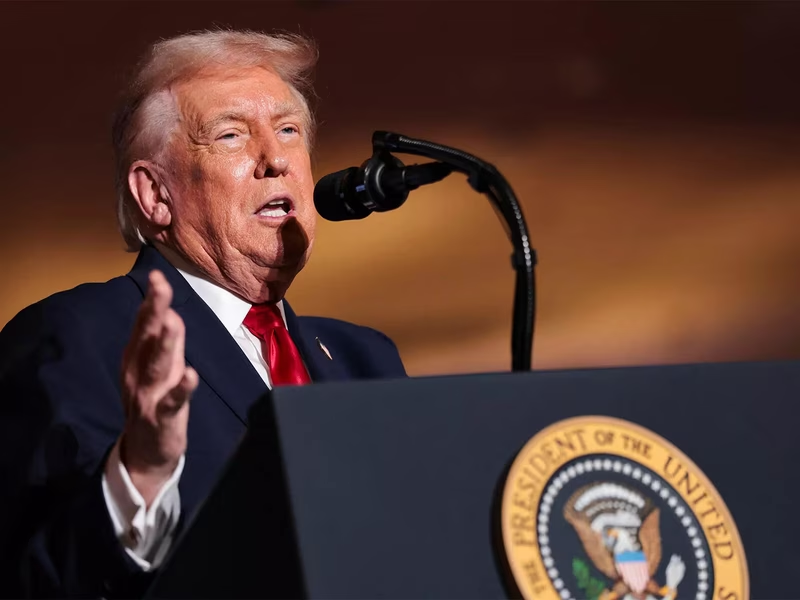
Americans struggling with sky-high mortgage rates may soon get a lifeline—or so says former President Donald Trump. In a bold new economic proposal, Trump has called for the federal government to spend $200 billion buying mortgage-backed bonds issued by Fannie Mae and Freddie Mac. The goal? To inject liquidity into the housing finance system, push mortgage rates downward, and reduce monthly payments for millions of homeowners and buyers . But as the 2026 midterm elections loom, critics are asking: Is this a genuine policy solution or just election-year theater?
Table of Contents
- What’s in Trump’s Mortgage Plan?
- How Buying Bonds Lowers Mortgage Rates
- The Role of Fannie Mae and Freddie Mac
- Potential Impact on Homebuyers & Homeowners
- Expert Criticism and Market Realities
- Political Timing and the 2026 Midterms
- Conclusion: Hope or Hype?
- Sources
What’s in Trump’s Mortgage Plan?
At its core, Trump’s proposal is straightforward: the U.S. Treasury would allocate $200 billion to purchase mortgage-backed securities (MBS) from the secondary market. These securities are bundles of home loans originally issued by banks and then sold to investors—with Fannie Mae and Freddie Mac guaranteeing most of them .
By becoming a major buyer, the federal government would increase demand for these bonds. In financial markets, higher demand typically leads to higher bond prices—and when bond prices rise, their yields (which closely track mortgage rates) fall. The end result? Lower interest rates on new home loans.
How Buying Bonds Lowers Mortgage Rates
To understand the mechanics, consider this simplified chain:
- Banks issue mortgages to homebuyers at prevailing market rates.
- They sell those loans to Fannie Mae or Freddie Mac.
- Fannie/Freddie package thousands of loans into MBS and sell them to investors (like pension funds or foreign governments).
- The yield investors demand on these MBS directly influences what rate banks charge borrowers.
- If the government buys $200B worth of MBS, investor demand surges → MBS prices go up → yields go down → mortgage rates drop.
This isn’t entirely new. The Federal Reserve used a similar tactic during the 2008 financial crisis and again in 2020, purchasing over $1 trillion in MBS to stabilize the housing market .
The Role of Fannie Mae and Freddie Mac
Fannie Mae (Federal National Mortgage Association) and Freddie Mac (Federal Home Loan Mortgage Corporation) are government-sponsored enterprises (GSEs) that don’t lend directly to consumers. Instead, they buy mortgages from lenders, guarantee them against default, and repackage them as MBS .
Since the 2008 crisis, both have been under federal conservatorship—effectively controlled by the U.S. government. This gives any administration significant influence over their operations. Trump’s plan leverages this unique position to create a targeted stimulus for the housing sector without direct taxpayer bailouts.
Potential Impact on Homebuyers & Homeowners
If successful, the plan could deliver tangible benefits:
- Lower monthly payments: Even a 0.5% drop in rates on a $400,000 loan saves ~$120/month.
- Increased affordability: First-time buyers locked out by high rates might re-enter the market.
- Refinancing surge: Existing homeowners could refinance into cheaper loans, freeing up disposable income.
However, the actual impact depends on scale and timing. $200 billion sounds massive—but it’s a fraction of the $13+ trillion U.S. mortgage market . Some analysts argue it may only shave 10–20 basis points off current rates, a modest relief at best.
Expert Criticism and Market Realities
Many economists remain skeptical. “Mortgage rates are driven by broader macroeconomic forces—especially the Federal Reserve’s benchmark interest rate and inflation expectations,” explains Dr. Lisa Davis, a housing economist at Brookings Institution . “A one-time bond purchase won’t override those fundamentals.”
Critics also warn of unintended consequences:
- Moral hazard: Encouraging risky lending if banks expect government backstops.
- Inflation risk: Injecting liquidity could fuel price pressures if the economy is already overheating.
- Distorted markets: Artificially suppressing rates may delay necessary market corrections.
Moreover, the plan doesn’t address the root cause of America’s housing crisis: a severe shortage of supply. Without more homes being built, lower rates could simply inflate prices further .
Political Timing and the 2026 Midterms
It’s hard to ignore the political calendar. With the 2026 midterms approaching, housing affordability has become a top voter concern—especially among suburban and swing-state demographics . By championing a bold, easy-to-understand solution, Trump positions himself as a problem-solver while putting pressure on the Biden administration to respond.
Whether this translates into votes remains to be seen. But in an era of economic anxiety, promises of lower mortgage bills are politically potent—even if the policy’s real-world efficacy is debatable.
Conclusion: Hope or Hype?
Trump’s $200 billion mortgage bond plan is a high-stakes gamble. On paper, it uses sound financial mechanics to target a real pain point for millions of Americans: unaffordable mortgage rates. Yet its success hinges on overcoming deep structural issues in the housing market and broader economy. While it may offer short-term relief, lasting solutions will require addressing supply shortages, regulatory barriers, and long-term fiscal discipline. For now, the proposal serves as both a policy blueprint and a political message—one that will reverberate through living rooms and campaign trails alike. Learn more about how interest rates work in our guide on [INTERNAL_LINK:how-mortgage-rates-are-determined].
Sources
- Times of India: Buying $200 bn worth of bonds! Trump’s new push to bring ‘mortgage rates down’
- Federal Reserve History: Mortgage-Backed Securities Purchases
- Brookings Institution: The U.S. Housing Affordability Crisis Explained
- Urban Institute: Housing Finance Policy Center
- U.S. Treasury: Fannie Mae and Freddie Mac Overview