Introduction
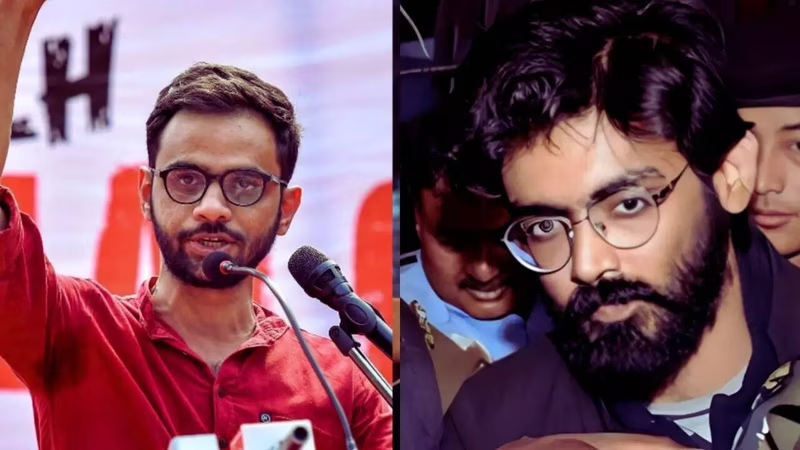
The long, complex legal saga of the Delhi riots case has taken another dramatic turn. Jailed activist Sharjeel Imam, facing serious charges under the Unlawful Activities (Prevention) Act (UAPA), has wrapped up his defense before the Karkardooma Court with a firm denial of one of the prosecution’s central claims: that he was a disciple or had a conspiratorial link with fellow accused Umar Khalid . This development is critical, as it directly challenges the narrative of a pre-meditated, coordinated conspiracy that allegedly led to the deadly violence in Northeast Delhi in February 2020.
Table of Contents
- Imam’s Core Defense Argument
- The Prosecution’s Conspiracy Narrative
- The ‘Mentor Link’ Allegation Debunked?
- Legal Hurdles and the UAPA Challenge
- Current Status of the Delhi Riots Case
- Conclusion: A Battle of Narratives in Court
- Sources
Imam’s Core Defense Argument
At the heart of Sharjeel Imam’s defense is a simple yet powerful assertion: there was no criminal conspiracy. His counsel argued before the court that the prosecution has utterly failed to establish an “agreement of mind” between Imam and the other accused persons . Without this foundational element, the entire edifice of the conspiracy charge crumbles.
Crucially, Imam’s legal team highlighted the complete absence of any direct communication—be it phone calls, messages, or emails—that could link him to Umar Khalid or any other co-accused in planning the riots . They contended that his public speeches, while passionate, were a form of political dissent against the Citizenship Amendment Act (CAA) and lacked any direct causal connection to the subsequent violence .
The Prosecution’s Conspiracy Narrative
In stark contrast, the Delhi Police’s Special Cell has built its case on the theory of a “larger conspiracy.” The charge sheet alleges that the accused, including Imam and Khalid, used their influence to orchestrate protests that were deliberately designed to incite communal unrest . The prosecution points to alleged stockpiling of materials like stones and chilli powder, the use of coded language in communications, and the receipt of foreign funds as evidence of this pre-planned plot .
The state’s argument hinges on the legal principle that in a conspiracy, the act of one accused is attributable to all co-conspirators . This makes proving a direct link between every individual less critical, as long as the existence of a common unlawful objective can be established.
The ‘Mentor Link’ Allegation Debunked?
One of the most persistent claims by the prosecution has been that Umar Khalid acted as a mentor or guru to Sharjeel Imam, suggesting a hierarchical relationship within the alleged conspiracy . Imam has now forcefully rejected this characterization. His lawyer told the court that the claim is “wrong” and lacks any evidentiary basis . In a striking statement, Imam himself claimed he had not spoken to Umar Khalid in the five years leading up to the riots, a claim aimed at severing any perceived personal or ideological bond between them .
Legal Hurdles and the UAPA Challenge
Both Imam and Khalid have been in judicial custody since early 2020, a testament to the stringent nature of the UAPA. The Supreme Court has repeatedly denied them bail, observing that the prosecution material does disclose a prima facie case of conspiracy under the tough anti-terror law [[9], [10]]. This legal framework makes it exceptionally difficult for the accused to secure release, placing a heavy burden on their defense to dismantle the conspiracy theory at the charge-framing stage itself.
Current Status of the Delhi Riots Case
The legal proceedings are ongoing at the Karkardooma Court. While charges have been framed against several accused in related cases , the main “larger conspiracy” case involving Imam and Khalid is still at a critical juncture. It’s worth noting that the court has recently acquitted 11 individuals in another part of the same sprawling case due to a lack of evidence , which the defense may cite as a precedent for their own arguments. Meanwhile, some other accused have been granted bail by the Supreme Court , highlighting the complex and multi-layered nature of the entire investigation.
Conclusion: A Battle of Narratives in Court
The Delhi riots case has evolved into a high-stakes battle between two competing narratives. On one side is the state’s portrayal of a dangerous, pre-meditated conspiracy to destabilize the capital. On the other is the defense’s argument of innocent citizens engaging in lawful protest, unfairly targeted and linked together without concrete proof. Sharjeel Imam’s categorical denial of any link to Umar Khalid is a pivotal moment in this fight, directly challenging a key pillar of the prosecution’s theory. As the court considers whether to frame formal charges, the world watches a case that sits at the intersection of national security, freedom of speech, and the right to a fair trial. For more on India’s legal landscape, see our deep dive on [INTERNAL_LINK:india-judicial-system].
Sources
- Times of India: Delhi riots case: Sharjeel Imam denies ‘mentor link’ with Umar Khalid
- The Hindu: No conspiracy case made out, argues Sharjeel Imam
- Indian Express: Sharjeel Imam was not disciple of Umar Khalid: Counsel
- NDTV: ‘Never Spoke To Umar Khalid In 5 Years’: Sharjeel Imam
- Live Law: SC rejects bail to Umar Khalid and Sharjeel Imam in 2020 Delhi riots case
- The Wire: Why SC denied bail to Umar Khalid and Sharjeel Imam