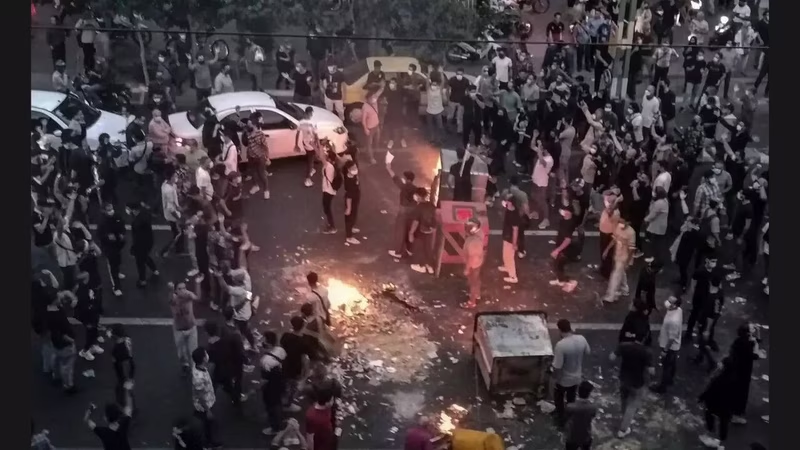
The streets of Iran have erupted in what could become the most significant challenge to the regime since the 1979 revolution, as widespread Iran protests over economic collapse have forced authorities to implement a drastic nationwide communications blackout . In a chilling escalation, the government has completely severed internet and phone services across the country, effectively cutting off millions of citizens from the outside world while demonstrators face violent crackdowns .
This digital siege comes as President Donald Trump delivered one of his most forceful warnings yet to Tehran, stating that the United States will “go in and hit them very, very hard” if the government continues its violent suppression of peaceful protesters . The situation has drawn international condemnation, with exiled crown prince Reza Pahlavi calling for immediate global intervention to protect Iranian citizens demanding basic economic dignity and freedom .
Table of Contents
- The Spark That Ignited Nationwide Iran Protests
- Iran’s Digital Siege: Complete Communications Blackout
- Trump’s Stark Warning: ‘Going to Hit Them Very Hard’
- Exiled Crown Prince Calls for International Action
- The Real Fuel Behind Iran’s Unrest: Economic Collapse
- American Officials Voice Support for Peaceful Demonstrators
- Global Response and Geopolitical Implications
- What Happens Next? Scenarios for Iran’s Future
- Conclusion: A Nation at a Crossroads
- Sources
The Spark That Ignited Nationwide Iran Protests
What began as localized demonstrations over skyrocketing prices and unemployment has rapidly transformed into a nationwide movement challenging the very foundations of Iran’s governance. The Iran protests started in major cities like Tehran, Isfahan, and Shiraz before spreading to smaller towns and rural areas, uniting Iranians across class, ethnic, and generational lines .
Unlike previous protests that were often organized by specific political factions, these demonstrations appear largely grassroots and organic, driven by ordinary citizens who have reached their breaking point after years of economic decline. Social media videos—before the internet shutdown—showed diverse crowds including women, students, factory workers, and even some members of the middle class who had previously remained politically neutral .
Protesters’ demands have evolved from purely economic grievances to include broader calls for political reform and accountability. Chants of “Death to the dictator” and “We don’t want an Islamic Republic” have been heard alongside more traditional economic slogans, indicating a fundamental shift in public sentiment that has clearly alarmed regime authorities [INTERNAL_LINK:iran-political-history].
Iran’s Digital Siege: Complete Communications Blackout
Facing unprecedented challenges to their authority, Iranian officials have resorted to their most extreme measure yet: a total communications shutdown that has severed internet access, mobile networks, and landline services across the entire country . This digital blackout represents one of the most comprehensive attempts to control information flow in the modern era of internet connectivity.
The government’s strategy is clear and brutal: without communication tools, protesters cannot organize effectively, share evidence of violence, or alert the international community about human rights abuses. However, this approach also demonstrates the regime’s desperation, as cutting off all digital communications cripples Iran’s already struggling economy and isolates millions of ordinary citizens who rely on internet access for daily life .
Human rights organizations have documented the devastating consequences of such blackouts:
- Medical emergencies cannot be reported or coordinated
- Businesses lose millions in revenue daily
- Families cannot check on loved ones in protest areas
- Emergency services are severely hampered
- International journalists cannot verify events on the ground
This tactic has been used before by authoritarian regimes, but the scale and completeness of Iran’s current shutdown suggest officials fear these Iran protests could fundamentally threaten their hold on power .
Trump’s Stark Warning: ‘Going to Hit Them Very Hard’
Amid the chaos in Iran, President Trump has issued his most direct threat yet to the Tehran regime. In a statement that has dominated international headlines, Trump declared: “If they continue to hit our people and hurt our people, we’re going to go in and hit them very, very hard” .
The President’s comments, while lacking specific military details, represent a significant escalation in U.S. rhetoric toward Iran and have been interpreted by analysts as both a warning to the regime and a message of support to protesters risking their lives in the streets . Trump’s language is particularly notable because it moves beyond the typical diplomatic condemnations to explicitly threaten military consequences for violence against demonstrators.
However, experts caution that Trump’s warning must be understood within the context of his administration’s broader Iran policy. The President has consistently taken a hardline stance against Tehran, withdrawing from the nuclear deal and implementing crippling economic sanctions. His latest comments may be intended to pressure the regime without necessarily signaling imminent military action .
Exiled Crown Prince Calls for International Action
Adding another layer of complexity to the crisis, exiled crown prince Reza Pahlavi has emerged as a vocal advocate for the protesters, urging the international community to intervene on behalf of Iranian citizens. Pahlavi, the son of Iran’s last shah who was overthrown in the 1979 revolution, has condemned the government’s violent crackdown and internet shutdown as “crimes against humanity” .
Speaking from exile, Pahlavi has called for several specific actions from world leaders:
- Immediate condemnation of the communications blackout
- Targeted sanctions against regime officials responsible for violence
- Humanitarian corridors to allow medical supplies and aid
- Diplomatic isolation of Iran until basic rights are restored
Pahlavi’s involvement is significant because it represents a potential alternative leadership figure for many protesters who are disillusioned with both the current regime and traditional opposition groups. His calls for international intervention reflect a growing sentiment among demonstrators that external pressure may be necessary to force regime change or meaningful reform [INTERNAL_LINK:iran-exile-communities].
The Real Fuel Behind Iran’s Unrest: Economic Collapse
While political grievances have emerged, the root cause of these Iran protests remains Iran’s catastrophic economic situation. Years of mismanagement, corruption, and international sanctions have created a perfect storm that has devastated ordinary Iranians’ lives .
The numbers tell a sobering story:
- Inflation has reached nearly 40%, with food prices doubling in the past year
- Unemployment stands at 25% among young people
- The Iranian rial has lost over 80% of its value against the dollar
- Basic necessities like medicine and food are increasingly unaffordable
- Power outages and water shortages have become daily occurrences
What makes this economic crisis particularly explosive is its universality. Unlike previous protests that were often confined to specific regions or demographic groups, this economic collapse has affected virtually every Iranian family regardless of political affiliation, religious belief, or social class . Even supporters of the regime are struggling to afford bread and medicine, creating widespread disillusionment with the government’s ability to provide basic services.
American Officials Voice Support for Peaceful Demonstrators
Beyond Trump’s headline-grabbing warning, the U.S. government has taken several concrete steps to support the protesters. Secretary of State Marco Rubio issued a statement expressing “full support for the Iranian people’s right to peaceful assembly and free expression” while condemning the violent crackdown .
The State Department has also activated emergency protocols to assist Iranian citizens trying to communicate with family members abroad despite the communications blackout. U.S. embassies in neighboring countries have been instructed to provide humanitarian assistance to any Iranian refugees fleeing the violence .
Perhaps most significantly, the Treasury Department has announced new sanctions targeting specific Iranian officials responsible for ordering violence against protesters and implementing the communications shutdown. These “targeted sanctions” aim to punish individual decision-makers rather than the broader Iranian population that is already suffering from economic hardship [INTERNAL_LINK:economic-sanctions-humanitarian-impact].
Global Response and Geopolitical Implications
The international community has largely united in condemning Iran’s response to the Iran protests. The European Union issued a joint statement calling for “immediate restoration of internet access” and warning of “serious consequences” if violence continues . United Nations human rights officials have demanded access to investigate reports of civilian casualties, though Iran has thus far refused such requests.
Regional powers are watching closely, with Saudi Arabia and Israel expressing support for the protesters while Russia and China have largely remained silent or defended Iran’s right to “maintain internal security.” This divergence reflects broader geopolitical tensions in the Middle East, where Iran’s stability has significant implications for regional power balances .
For ordinary Iranians, the international attention brings both hope and concern. While many welcome global support, there is also fear that foreign intervention could be used by the regime to justify even harsher crackdowns under the guise of defending national sovereignty against “foreign interference.”
What Happens Next? Scenarios for Iran’s Future
As this crisis unfolds, analysts are considering several possible outcomes:
| Scenario | Likelihood | Key Implications |
|---|---|---|
| Regime concessions | Moderate | Economic reforms, limited political openings, restoration of communications |
| Violent suppression | High | Thousands of casualties, international isolation, long-term resentment |
| Leadership change | Low but growing | Fundamental restructuring of government, uncertain transition period |
| Civil war | Low | Regional destabilization, humanitarian catastrophe, refugee crisis |
Most experts believe the regime will attempt a combination of limited economic concessions and severe repression, similar to strategies used during previous protest waves. However, the current Iran protests appear different in their scale, geographic spread, and the regime’s apparent fear—evidenced by the unprecedented communications blackout .
Conclusion: A Nation at a Crossroads
The Iran protests represent more than just economic discontent—they are a fundamental challenge to a system that has failed to deliver basic dignity and prosperity to its citizens. The government’s decision to cut off all communications rather than address legitimate grievances reveals the depth of their fear and the fragility of their control.
As Trump’s warning echoes globally and Reza Pahlavi calls for international action, the world watches anxiously to see whether this moment will become a turning point in Iran’s history. The courage of ordinary Iranians risking everything for a better future stands in stark contrast to a regime willing to plunge an entire nation into digital darkness to maintain power.
Whatever the outcome, one truth is undeniable: the Iranian people have made their voices heard, and the world can no longer ignore their demands for freedom, dignity, and economic justice. The path forward will be difficult and dangerous, but the desire for change has been unleashed, and it cannot be silenced by shutting off the internet or threatening violence. The future of Iran hangs in the balance, and the decisions made in the coming days could reshape not just one nation, but the entire Middle East.
Sources
- Times of India: ‘Going to hit very hard’: Trump warns Iran as protests force govt to cut off internet
- Reuters: Iran cuts internet access amid nationwide protests over economic crisis
- Associated Press: Trump warns Iran over violent crackdown on protesters
- BBC News: Iran protests: Exiled prince Reza Pahlavi calls for international intervention
- CNN: How Iran’s economic collapse sparked nationwide protests
- United Nations Human Rights Council: UN calls for access to investigate Iran protest violence