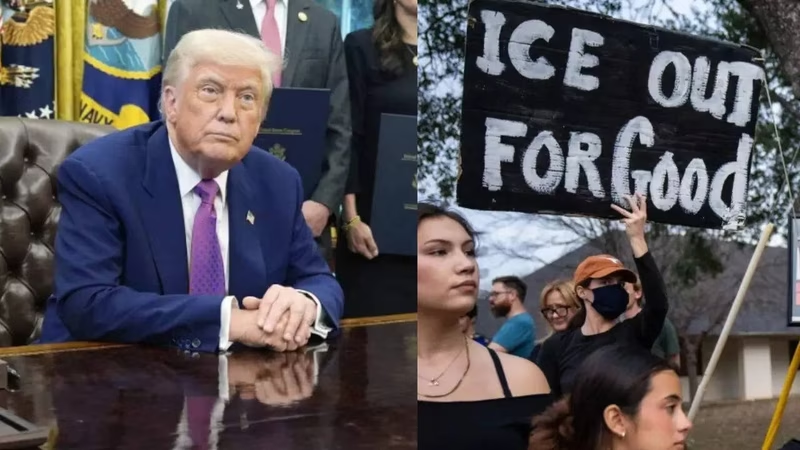
The nation is reeling after President Donald Trump came to the defense of an Immigration and Customs Enforcement (ICE) agent involved in a controversial ICE shooting that left a Minneapolis woman dead. In remarks that have sparked widespread outrage, Trump claimed the victim “behaved horribly” and attempted to run over the federal officer—claims that directly contradict accounts from local authorities and have intensified the already heated debate over federal law enforcement operations in sanctuary cities .
The incident, which occurred during what federal officials described as a routine enforcement operation, resulted in the death of 46-year-old Renee Nicole Good after multiple shots were fired into her vehicle. But as details emerge, a disturbing pattern of conflicting narratives has emerged between federal agents and local Minneapolis leaders, with the city’s mayor demanding that ICE completely withdraw from their jurisdiction .
Table of Contents
- The Fatal Encounter: What Really Happened in Minneapolis
- Trump’s Controversial Defense: ‘She Behaved Horribly’
- The Victim: Who Was Renee Nicole Good?
- Conflicting Accounts: Federal vs Local Authorities
- Political Fallout: Mayors Demand ICE Leave Their Cities
- The Broader Context: ICE Operations in Sanctuary Cities
- Conclusion: A Nation Divided Over Law Enforcement Tactics
- Sources
The Fatal Encounter: What Really Happened in Minneapolis
On the morning of January 7th, 2026, federal agents from U.S. Immigration and Customs Enforcement conducted an operation in Minneapolis targeting individuals with outstanding deportation orders . According to the official federal account, during this operation, 46-year-old Renee Nicole Good was behind the wheel of a vehicle when federal agents approached her.
The Department of Homeland Security (DHS) released a statement claiming that Good “attempted to flee the scene and in the process, struck one of the officers with her vehicle” . They allege that the ICE agent, fearing for his life, then fired multiple shots into the car, resulting in Good’s death at the scene. The agent involved has been placed on administrative leave pending investigation.
However, local Minneapolis police who responded to the scene have raised serious questions about this version of events. Body camera footage from city officers who arrived moments after the shooting shows a vehicle with multiple bullet holes but no visible signs of collision damage that would support the claim that Good intentionally tried to run over the agent .
Trump’s Controversial Defense: ‘She Behaved Horribly’
Just hours after news of the ICE shooting broke, President Trump took to social media to defend the federal agent involved. “This ICE officer was doing his job when this woman behaved horribly and tried to run him over,” Trump posted. “He had no choice but to defend himself. These are the dangers our brave federal agents face every day” .
The President’s comments have ignited fierce criticism from civil rights groups, local officials, and even some members of his own party. Critics argue that Trump’s rush to judgment—without waiting for a full investigation—further erodes public trust in law enforcement and politicizes a tragic incident that should be handled through proper legal channels .
What makes Trump’s defense particularly controversial is that it came before the release of any official investigative findings, body camera footage, or independent witness statements. His narrative appears to rely solely on the initial account provided by federal agents, despite the clear contradiction from local authorities on the ground.
The Victim: Who Was Renee Nicole Good?
Renee Nicole Good was more than just a name in a police report. Community members in Minneapolis describe her as a dedicated mother of three who worked as a home health aide and was actively involved in her local church . Friends and family members have vehemently disputed the federal government’s characterization of her behavior.
“Renee was the most gentle person I knew,” said her sister, Maya Good, in an emotional interview. “She would never intentionally hurt anyone. There’s no way she tried to run over an officer—that’s just not who she was” . Family members have also questioned why federal agents were targeting Good, noting that she had no prior criminal record and was in the country legally through her marriage to a U.S. citizen.
Good’s death has become a rallying point for activists who argue that aggressive federal immigration enforcement tactics are creating dangerous situations in communities that have explicitly chosen not to cooperate with ICE operations.
Conflicting Accounts: Federal vs Local Authorities
The stark contrast between federal and local accounts of the ICE shooting highlights a deepening rift between federal immigration enforcement and sanctuary cities. Minneapolis Mayor Jacob Frey has been particularly vocal in his criticism of the federal operation.
“The federal government’s account simply doesn’t match what our officers witnessed at the scene,” Mayor Frey stated at a press conference. “We have no evidence to support the claim that Ms. Good attempted to run over anyone. What we do have is evidence of excessive force by federal agents operating without our consent in our city” .
Mayor Frey has taken the extraordinary step of formally requesting that ICE cease all operations within Minneapolis city limits, citing concerns about officer safety, community trust, and the lack of coordination with local law enforcement. His demand reflects a growing movement among sanctuary city leaders who feel that federal immigration enforcement is undermining their ability to maintain public safety and community relations.
The key points of contention between federal and local authorities include:
- Use of force justification: Federal agents claim self-defense; local officials see no evidence supporting this claim
- Operation transparency: ICE did not notify Minneapolis police before conducting the operation
- Community impact: Local leaders argue such operations damage trust between police and immigrant communities
- Jurisdictional authority: Debate over whether federal agents should operate independently in sanctuary cities
Political Fallout: Mayors Demand ICE Leave Their Cities
The Minneapolis ICE shooting has triggered a wave of similar demands from mayors across the country. In Chicago, Mayor Brandon Johnson announced that his administration would review all cooperation agreements with federal immigration authorities . San Francisco Mayor London Breed called the incident “a tragic example of why federal agents should not be operating unilaterally in our communities” .
Even traditionally conservative cities are expressing concern. In Phoenix, Arizona, Mayor Kate Gallego issued a statement calling for “clear protocols and communication channels” between federal and local law enforcement to prevent similar incidents . This bipartisan concern suggests that the issue transcends typical political divides and speaks to fundamental questions about law enforcement coordination and community safety.
At the state level, Minnesota Governor Tim Walz has ordered a full independent investigation into the shooting, separate from the federal review. “Minnesotans deserve answers that aren’t filtered through political agendas,” Walz said. “We need to know exactly what happened, why it happened, and how we can prevent it from happening again” .
The Broader Context: ICE Operations in Sanctuary Cities
This incident cannot be viewed in isolation. It occurs against a backdrop of increasing tension between the Trump administration and sanctuary cities that have limited cooperation with federal immigration enforcement [INTERNAL_LINK:sanctuary-cities-debate-us]. Since taking office, the administration has significantly ramped up ICE operations in cities that have declared themselves sanctuaries, often conducting raids without prior notification to local authorities.
Civil rights organizations have documented numerous cases where such operations have led to community disruption, family separations, and—in several instances—use of force incidents similar to the Minneapolis ICE shooting. The American Civil Liberties Union (ACLU) has filed multiple lawsuits challenging the constitutionality of these operations, arguing they violate due process rights and create unsafe conditions for all community members [INTERNAL_LINK:ice-operations-constitutional-challenges].
Law enforcement experts point to a fundamental problem with the current approach: when federal agents operate without coordination with local police, it creates confusion, undermines community trust, and can lead to dangerous standoffs. “Effective policing requires community cooperation,” explains Dr. Maria Rodriguez, a criminology professor at Harvard University. “When federal agents conduct surprise operations in communities that don’t trust them, everyone becomes less safe—including the officers themselves” .
Conclusion: A Nation Divided Over Law Enforcement Tactics
The Minneapolis ICE shooting and President Trump’s swift defense of the involved agent have exposed deep fissures in America’s approach to law enforcement, immigration policy, and federal-local relations. What began as a single tragic incident has evolved into a national conversation about when, where, and how federal immigration enforcement should operate within communities that have explicitly chosen different priorities.
As investigations continue and more details emerge, one thing is clear: the conflicting narratives surrounding this case reflect broader divisions in American society about the role of law enforcement, the balance between security and civil liberties, and the appropriate relationship between different levels of government. The demand from Minneapolis and other cities for ICE to leave their jurisdictions represents not just a policy disagreement, but a fundamental question about who gets to determine public safety priorities in local communities.
Regardless of the final determination about what happened on that Minneapolis street, this incident has already changed the conversation about federal law enforcement operations in sanctuary cities—and the political fallout is likely just beginning.
Sources
- Times of India: ‘She behaved horribly, ran over him’: Trump defends ICE agent who shot Minneapolis woman dead
- Associated Press: Trump defends ICE agent in Minneapolis shooting, sparking outrage
- Minnesota Star Tribune: Minneapolis mayor demands ICE withdraw after fatal shooting of woman
- Department of Homeland Security: Official statement on Minneapolis enforcement operation
- American Civil Liberties Union: ACLU analysis of ICE operations in sanctuary cities